Another Beatles anniversary today: Their “Beatles 1967–1970” album (also known as “the Blue Album”) reached number one today in 1973:
No comments on Presty the DJ for May 26
Another Beatles anniversary today: Their “Beatles 1967–1970” album (also known as “the Blue Album”) reached number one today in 1973:
Two unusual anniversaries in rock music today, beginning with John Lennon’s taking delivery of his Rolls-Royce today in 1967 — and it was not your garden-variety Rolls:
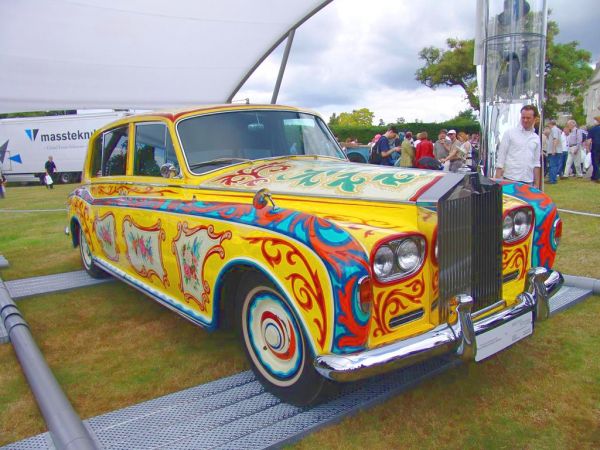
Ten years to the day later, the Beatles released “Live! at the Star-Club in Hamburg, Germany, 1962,” which helped prove that bands don’t need to be in existence to continue recording. (And as we know, artists don’t have to be living to continue recording either.)
Meanwhile, back in 1968, the Rolling Stones released “Jumping Jack Flash,” which fans found to be a gas gas gas:
Two Beatles anniversaries today:
1964: The Beatles make their third appearance on CBS-TV’s “Ed Sullivan Show.”
1969: “Get Back” (with Billy Preston on keyboards) hits number one:
Meanwhile, today in 1968, Mick Jagger and Marianne Faithful were arrested for drug possession. (Those last five words could apply to an uncountable number of musicians of the ’60s and ’70s.)
Today in 1969, the Who released their rock opera “Tommy” …
… two years before Iron Butterfly disbanded over arguments over what “In a Gadda Da Vita” (which is one-third the length of all of “Tommy”) actually meant:
The number one British album today in 1970 was “McCartney,” named for you know who:
How, you ask, has this blogger been spending evenings during the coronavirus-mandated statewide lockdown of sorts?
Binge-watching a TV series that screams the ’80s, NBC-TV’s “Miami Vice.”
The short version of the creation of the TV series is two words from NBC programming executive Brandon Tartikoff: “MTV cops.” Or. more precisely, two cops that looked as if they had stepped out of an MTV music video. (Back when MTV played music videos.)
In one sense, “Vice” could be said to be a 1980s iteration of a classic that had recently gone off the air, the original “Hawaii Five-O.”
Both were set in lush locales that hid the seething sewers of crime (and, in Miami’s case, decadence) underneath. (To unreasonable ends, in Five-O’s case; as costar James MacArthur once put it, the show probably solved every crime in the islands halfway through its run.)
Things diverge from there, though. Unlike, say, “Adam-12,” I am confident in asserting that no one decided to go into police work based on “Miami Vice.” Outside of the setting Five-O was a straight police procedural. Vice was sort of film-noirish in that the heroes had skeletons in their own closets.
James “Sonny” Crockett was a former college football star and Vietnam veteran who started the series by trying to avenge his young partner’s death. Ricardo Tubbs was a New York City police detective who went to Miami to avenge the death of his brother, another NYPD detective.
The two are members of the Miami–Dade (then known as “Metro–Dade”) Police Department’s Organized Crime Bureau, called “Miami Vice,” investigating and either arresting or killing drug dealers and various other purveyors of South Florida vice, as well as their politician and dirty cop (including feds) enablers.
Crockett lives on a sailboat moored in a harbor. Thanks to asset forfeiture, Crockett gets to drive a “Ferrari Daytona” (which was actually a replica car on a Corvette chassis) and a speedboat. (Ferrari was upset about the use of the faux Daytona, which wasn’t built by Ferrari to be a convertible anyway, so Ferrari donated two Testarossas for use.)
It’s always interesting to learn who was considered for the roles that were iconically played (if that’s a word) by the eventually chosen actors. Crockett candidates included Jeff Bridges, Nick Nolte, Richard Dean Anderson, Mickey Rourke, Gary Cole, and Larry Wilcox (yes, of “CHiPs”) before Don Johnson, who had been in four failed pilots (as was Tom Selleck before “Magnum P.I.”) was chosen, reportedly over Wilcox. Denzel Washington would have done a great job, but different job, as Tubbs. Geoffrey Cole, who ended up on “The Cosby Show,” also auditioned for Tubbs.
Johnson considered leaving the series after its second season. Mark Harmon, formerly a rookie cop on “Adam-12,” a sheriff’s rescue guy on “240-Robert” and a San Francisco cop in the movie “The Presidio,” was considered as Johnson’s replacement.
Their boss was initially Lt. Lou Rodriguez, played by character actor Gregory Sierra (previously seen playing a detective in “Barney Miller”). Sierra, however, didn’t like working in Miami, so he was killed — I mean, written out — and Edward James Olmos was cast. And arguably that’s where the series took off in a character sense; the conflict between detectives Crockett and Tubbs and their boss was rather stereotypical in Sierra’s case, but Olmos’ Castillo, described in one place as a “modern-day samurai” with an improbable background for a police lieutenant, was impenetrable and unpredictable, at least until writers lost the plot of his character in the final season. (Olmos joked that he was the highest paid actor per word in Hollywood.)
We started watching the second season, and then when we purchased the whole series (from exactly where you would expect to get DVDs — Menards) we moved to the pilot and the first season. The series certainly was rolling in the second season.
The series is famous for a lot of things, including the start of a lot of acting careers:
One way you can tell its cultural impact, beyond the pastels (an idea creator Michael Mann came up with after going to a Miami paint store — and Crockett’s penchant for baggy light-colored clothing and shoes without socks) …
… is the number of musicians who started appearing in the series during season one, a trend that continued through the third season. The soundtrack is basically a who’s-who of pop and rock music of the ’80s, with a few pleasant flashbacks as far back as the early ’60s.
And, of course, Johnson became a star, as did Olmos.
One of the more amusing moments is when Johnson’s ex-wife, Melanie Griffith (the daughter of Tippi Hedren, with whom Johnson appeared on the 1973 movie “The Harrad Experiment”), appears in an episode as the owner of a call girl service. After the series ended Johnson and Griffith remarried, and then re-divorced.
To say the series is an unrealistic depiction of police work is completely beside the point. Every officer, including Castillo, contributes to the series’ body count to the extent that all of them should have been fired, even if all the shootings passed shooting review board muster. The bad guys usually have the shooting aim of Star Wars storm troopers. Castillo’s detectives lie to their boss about getting personally involved in cases without impunity, and only get called on it once. (Though that was an epic 15 seconds, with Castillo calling their professional conduct in the case “abominable.”)
Miami is, as Hawaii was, depicted as a nest of crime and, well, vice, buried under a sea of cocaine, the wonder drug of the ’80s. (A place called Sex World is prominent in one episode and part of others.) One can only imagine what the producers (including Dick Wolf before he started the “Law & Order” juggernaut) would have come up with a decade later after “NYPD Blue”
The series is quite dark. According to one website 108 people are killed in the five seasons, and frankly that seems low. Crockett is a Vietnam veteran (how that dovetails with his being a college football star and his apparent age in the mid-1980s … well, it’s TV, which is not subject to the usual measurements of time), and he runs into damaged Vietnam veterans who make up plot points in a few episodes. And whether or not Crockett was damaged by Vietnam, he’s got the macho-sensitive brooder thing down. (In two episodes he regrets previous behavior toward a female high school classmate and a former police partner who was homosexual, not to mention his being an absent husband and father, which is why he is an ex-husband. Young Crockett didn’t learn that the way to avoid regrets is to not do the wrong thing(s) in the first place.)
It was also unique for its abrupt endings in the first two seasons of the series that leave unanswered questions. (Did he survive or not?) Not often are there tags with humorous conclusions. In fact, five consecutive second-season episodes end with a suicide, with Crockett yelling “NO!!!” as the character prevents his or her being able to return to the series.
Two of the main characters start by providing comic relief — detectives Switek and Zito, usually found in a van filled with surveillance equipment. (Complete, early on, with a giant bug on the roof.) They’re portrayed as something less than competent early on, though that changes. And then Zito gets killed, and Switek, larger than everyone else and with a penchant for inappropriate comments to match, develops a gambling addiction. The two female leads, detectives Gina Calabrese and Trudy Brown, seem to spend the largest parts of the episodes they’re in engaging in prostitute sting operations.
There is humor in the interaction of the characters, particularly Izzy Moreno the malaprop-plagued informant, such as …
… and another informant known as “Noogie,” but otherwise it was pretty grim until the fourth season, which featured episodes about dueling televangelists, a cryogenically frozen reggae singer, UFOs, and the theft of bull semen. Black humor (appropriate for a series involving police) can be found throughout the series, such as when a chemist developing the most pure synthetic cocaine in the world tries some himself (after Izzy fakes trying some), and achieves the first and last high of his life.
Throughout the series Crockett and Tubbs had underworld alter-egos, Burnett and Cooper, respectively. Oftentimes Crockett/Burnett and Tubbs/Cooper got involved with women as part of their cases, but it always ended badly for the women (one of Tubbs’ girlfriends doesn’t survive the teaser), particularly singer Caitlin Davies (played by singer Sheena Easton), who over several episodes testifies against a corrupt record producer, falls in love with Crockett, marries him, gets pregnant, goes on tour and gets shot to death.
One episode later the writers trotted out the trope of a character’s getting amnesia, and so into the fifth season Crockett thought he was Burnett, and acted accordingly, adding to the series’ body count. And then magically Burnett went back to Crockett, conveniently forgetting Burnett’s carnage, and conveniently avoiding the usual career repercussions for a police officer who killed several people.
After Crockett returns to his right mind, the rest of the series (including four episodes that ran after the series finale, one of which may have been a pilot for another series that NBC didn’t buy, and another of which NBC declined to broadcast because of its subject matter, child molestation) foreshadows the end of the series through Crockett’s increasing burnout. That could be said to apply to the series too, particularly when the last two seasons featured increasingly bizarre storylines or repeated stories from earlier seasons.
The series ended with a two-hour finale movie in which Crockett and Tubbs are recruited by mysterious feds (are there any other kind?) to rescue from a fictional Latin American country a corrupt dictator (supposedly based on Panama’s Manuel Noriega, though he looks more like Libya’s Moammar Gadhafi, and he’s played by non-Latino non-Arab actor Ian McShane) who is willing to tell all to the Drug Enforcement Administration. Crockett and Tubbs are, of course, nearly killed on several occasions and repeatedly double-crossed, which leads them to their living end.
The series interestingly ends not with the iconic theme music, but with a solo effort by Chicago guitarist Terry Kath …
… whose song ended another cult classic, the 1970s movie “Electra Glide in Blue.”
Lopez Video reviewed the series after doing what we did:
The concentration on raw aesthetics during the first 2 seasons makes this show a classic. Whether it was Michael Mann, this Yankovich character, or whoever, the primary emphasis of the show was raw aesthetics – the detective stuff came second (albeit a close second).
This was a show about pastel colors, Art Deco architecture, pop music, cars driving fast beach-side, drugs, and most importantly, sockless loafers with flowing blazers over a wrinkled V-neck.
The detective stuff was obviously interesting on a biological level: I want to know the answer to the mystery! The more mysterious, the more I want to know the answer. And the regional ideation with the various Columbian drug cartels or anti-Castro Cubans or the corrupt cops / politicians… It’s all just fun to watch, especially if you’re from Miami. Like bubblegum.
I stand by my original assessment that the show would’ve been far more addicting if the writers had extended the life of the first drug king-pin, Calderone. His story is tied to the motivational drama of Rico Tubbs – Calderone murdered his brother in New York City, thus kickstarting the entire show.
Instead of killing Calderone by the 5th episode of the 1st season, they should’ve made Calderone an almost omnipotent drug kingpin. His power is profound & supreme. He exists only in shadows.
And so the capturing of Calderone would’ve become the specter that ties the entire series together. This is the season finale everybody tunes in to see (Think: “Lost“).
Anyway, they didn’t do that & the show quickly develops into a psuedo-CSI with a “monster-of-the-week” feel; sometimes introducing random-ass female love-interests for both Sonny & Rico. It’s all kind of blah but you stick around waiting for that new awesome 80s tune or that one unexpectedly good episode of that surprise cameo appearance by Bruce Willis or Julia Roberts.
Not enough Calderone? They took on Calderone and his brother and his cousin. And Tubbs fell in love with Calderone’s sister and they had a child, but of course they both died.
The double agent aspect of the show elevates it to something special. It reminds me of Scorsese’s “The Departed” & Shakespeare’s “Twelfth Night.” There’s something spectacular in seeing people transform by putting on masks to exist in separate worlds. Having to live two realities is extremely archetypal, and very cinematic.
The undercover theme is what made the show consistently interesting for me.
As far as acting, the real stand outs are Edward James Olmos and Martin Ferrero, with Don Johnson representing the blank every-man like a Warhol silkscreen: even his name is a blank canvas for projection… Don Johnson. It might as well be Al Whiteman.
Yet after a while, Don Johnson becomes quite identifiable as the ideal of a Warrior spirit: the kind of person you want to visualize weekly being in your world, because of this-quality or that-quality.
And as for his partner, played by Philip Michael Thomas, he is the quintessential balancing-force of this Warrior energy… with perhaps more of a Lover archetype activated & mixed-in, as he’s usually depicted rocked by his erotic emotions. Johnson is shown this way as well, but his character seems to develop an awareness overtime to consolidate these feelings in exchange for heightening his job performance… like a pure Warrior. Nothing stands out about Philip Michael Thomas’s character, and yet couldn’t imagine this particular show without him. He’s like the ground-rock that keeps the animality of Sonny Crockett contained.
Finally, the music in the show is great. There’s some classic music-movie moments, running all throughout the show, to the very end of the season finale. The resurrection of good obscure music (even if it was popular in its day) by contextualizing the sounds to new images, is just something I adore about cinema. It gets me high.
Everyone has an opinion of the best episodes …
“Miami Vice” clearly is of the ’80s, which is why it was a stupid idea to make a movie. (I will not dignify that idea by watching said movie.) I wonder, though, if a Vice-style show featuring police chasing around all matter of human depravity could be done in a different locale — say, Las Vegas. (Not like the original “CSI” did.)
I thoroughly disagree with the number one song today in 1961:
Today in 1965, the Beatles found that “Ticket to Ride” was a ticket to the top of the charts:
That night, ABC-TV’s “Hollywood Palace” turned this classic …
… into, uh, this:
The number one album today in 1971 was the Rolling Stones’ “Sticky Fingers”:
One strange anniversary in rock music: Today in 1968, Paul McCartney and Jane Asher attended a concert of … Andy Williams:
Eleven years later, not McCartney, but Elton John became the first Western artist to perform in the Soviet Union.
Four years later, David Bowie’s suggestion reached number one:
Today in 1966, Roger Daltrey and Pete Townshend of The Who decided to replace for the evening the tardy drummer Keith Moon and bass player John Entwistle with the bass player and drummer of the band that played before them at the Ricky Tick Club in Windsor, England.
When Moon and Entwistle arrived and found they had been substituted for, a fight broke out. Moon and Entwistle quit … for a week.
The number one single today in 1967:
The number-one album today in 1958, and for the next 31 weeks, was the soundtrack to the musical “South Pacific” went to number one and stayed there for 31 weeks. The film version starred Mitzi Gaynor, who looked very much like my mother a few years later.
Today in 1979, Eric Clapton married Patti Boyd, the former wife of George Harrison and the muse for the song “Layla.” The song lasted much longer than the marriage.
One wonders if anyone played selections from that day’s number one British album:
If you wanna be happy, listen to the number one single today in 1963:
Another one-hit wonder had the number one single today in 1968:
The number one single today in 1974 might be the very definition of the term “novelty song”:
The number one British single today in 1975:
(Which more appropriately should have been called “Stand by Your Men,” since Tammy Wynette had had three husbands up to then, and two more thereafter.)
 Steve Prestegard.com: The Presteblog