Twenty years ago, I wrote a sample graduation speech for a weekly newspaper graduation section. I’ve given that actual speech once.
For the three-pieces-of-advice version, read this.
For the five-pieces-of-advice version, read this.
Paul Fanlund, editor of The Capital Times:
I was in airports and out of touch Monday before settling in front of my home computer to explore coverage of the Oklahoma tornado devastation from that afternoon.
Like most of you, I suspect, I was horrified by early accounts of dead and unaccounted-for children at two flattened elementary schools, a dread much like that distinctive despair I felt after last December’s school massacre in Newtown, Conn. …
My go-to source for online national and international news, The New York Times, provided thorough and sensitive coverage, but then I began exploring the reader comments there and on other sites.
Predictably, I suppose, many comments had zoomed right past the first phase of the news-tragedy checklist: counting and recovering bodies, caring for victims, assessing scope of damage, expressing sympathies and offering help.
No, many were already on to the second phase, and this time it was the left-leaning crowd asking questions: I wonder what those global-warming deniers will say this time? I wonder what those small-government Oklahoma Republicans who griped about federal spending after Hurricanes Katrina (gulf coast) and Sandy (the “liberal” northeast) will say about federal aid now?
Here in Madison, former Mayor Dave Cieslewicz was already online Tuesday morning with an Isthmus column headlined “Don’t blame God for the Moore tornado” discussing climate change.
This, I conclude, is what it has come to.
On almost any news event — local, national or international — we react for what seems a millisecond as Americans (or Wisconsinites or Madisonians). Then we split into our two massive left and right ideological tribes to determine how the news fits our master narrative and suggests blame for the other side.
In fact, it’s impossible to recall a major news story during the past year in which we all simply reacted as Americans for very long.
Perhaps 9/11 was the last time we reacted in unison. Americans rallied around President Bush after deaths of about 3,000 Americans even though reports suggested Bush had been slow to take seriously threats from Osama Bin Laden.
It’s as if there is no news, just red-state news and blue-state news, conservative Fox news or liberal MSNBC. While much of this journalistic reality is not new, what does seem different is how the demarcation occurs almost instantly.
Not that long ago there was, more or less, an agreed-upon set of facts around news events. Opinions would flow some time later. Even longer ago, there were trusted national voices such as Walter Cronkite or David Brinkley delivering what seemed largely undisputed facts. …
Here in Madison and Wisconsin generally, this penchant for instantly shifting news for viewing through partisan lenses has been exacerbated by Republican Gov. Scott Walker, who seems oddly proud that nearly half of his constituents disagree with him on almost every issue. He then leverages the fact that he survived a recall effort as a badge of honor to enhance his national right-wing credibility.
Republican Tommy Thompson, who seemed to relish impressive approval ratings among Democrats while governor, was a product of his times, and Walker is a product of his.
Within the fortress of liberal Madison, the rush-to-judgments are slower and elbows predictably less sharp; our disagreements are more about narrower cultural divides and leadership styles. But, we must remember, we mostly belong to the same tribe.
Oh, I imagine I will be called hypocritical for this column, given that The Capital Times has a century-old reputation for progressive editorial viewpoints. Moreover, our central focus is the progressive enclave of Madison, so some of that criticism is to be expected. …
For decades, journalists have worked to craft stories that answer questions about who, what, when, where, why and how.
Sadly, in my view, today’s news consumer seems most interested in jumping — even before bodies are counted — to “who can I blame?”
My appearance on Wisconsin Public Radio Friday went much better than my previous appearance, even though my opponent remains excessively long-winded. (She’s a lawyer, so this shouldn’t be a surprise.)
One of the subjects we didn’t get to was U.S. Sen. Sheldon Whitehouse (D–Rhode Island), who chose the exact moment the F5 tornado was hitting Moore, Okla., to claim that Republicans are wrong about global climate change, which is causing storms like the Moore tornado. (Whitehouse later apologized, his spokesman claiming Whitehouse didn’t know the tornado was taking place. If your default position is that politicians lie, you have no problem with Whitehouse’s flack’s statement.)
Had the subject come up, I would have said that the most objectionable part of Whitehouse’s verbal diarrhea was that Whitehouse is flat out wrong. My evidence comes from meteorologist Mike Smith, proprietor of the Meteorological Musings blog.
The first chart shows that there is no trend of increasing numbers of tornadoes since 1954, despite continued improvement in meteorological technology. There are active years (1973 and 2012), but there are also inactive years (including 2012).
I would have also mentioned this: The National Weather Service Milwaukee/Sullivan office handles tornado warnings for four of the counties most frequently visited by tornadoes since 1950 — Dane, Iowa, Dodge and Fond du Lac counties. (I’ve lived in three of those counties, plus Grant County, which is also top five. I have yet to see a tornado.) The NWS Sullivan office has not issued a tornado warning in two years.
The second chart shows, again since 1954, that the trend of tornadoes EF3 or stronger is downward, not upward, since 1954.
Another meteorologist, Joe Bastardi, was a guest on “The O’Reilly Factor” on Fox News Channel:
Well, there have been major tornadoes before. As a matter of fact, the charts of the major tornadoes show they’ve been decreasing over the years. They reached their peak in the 50s, 60s and 70s. And if you remember, during the 70s, we were in a global cooling scare. I’m not here to demean anybody. I will debunk them with facts, though. This is not the first time we’ve heard this situation, comments made. It’s almost like ambulance chasing after these devastating events that cause misery to people, and then trying to tie an agenda into it. …
About five years ago, I came on your show, Bill, and told you we were going into a time of climatic hardship because of the shift in the cycle in the Pacific to cooler while the Atlantic was still warm. This happened in the 1950s. It’s why the 1950s were so volatile with the tremendous tornado activity. The heat and drought in the center of the country and, of course, the hurricane activity up the Eastern Seaboard where Senator Whitehouse seems to be ignorant of his own state of Rhode Island was hit four times in the 1950s. There were eight major hurricanes that ran the Eastern Seaboard from 1954 to 1960. Just what do you think is going to happen if the same pattern shows up again? …
O’REILLY: Well, this storm that we’re looking at right now, that’s one of the most powerful tornadoes ever to hit the USA, right?
BASTARDI: Yeah, it is, there’s no question, but the 1925 Tri-State tornado had a path of 180 miles from Missouri into Indiana, and was two miles wide. When you go back and look at the history and the deaths of, the tornado deaths, which have been decreasing in large part to NOAA and the storm chasers who are seeing all these things before they happened.
Smith wrote a column for Sunday’s Washington Post on five tornado myths:
The scene in Moore, Okla., this past week was hauntingly familiar. The images of clean-up crews picking through the wreckage of two elementary schools transported me back to 1957, when an F5 tornado struck my Kansas City neighborhood, destroying my kindergarten and leaving 44 people dead. Thankfully, we’ve learned a lot since then that can help limit tornado casualties. But many misconceptions persist — misconceptions that can encourage bad policy and put lives at risk. I’d like to dispel some of the myths.
1. Meteorologists aren’t any good at forecasting these storms.
How does 99.3 percent sound? In 2011, 553 people lost their lives in tornadoes. For all but four of those victims (99.3 percent), both a tornado watch and a tornado warning were in effect before the storm arrived.
Modern tornado warnings are Nobel Prize-worthy endeavors that combine weather science, social science and technology. As recently as 1990, people in the path of a tornado were lucky to get five minutes’ warning. Now, thanks to advances in radar, computer simulations and research on how tornadoes develop, the average “lead time” is 12 minutes — and more than 15 minutes for major tornadoes. The city of Moore had a stunning 36 minutes of warning.
In addition to the explicit warning to take cover, there was a tornado watch out more than two hours before the tornado arrived in Moore, allowing people to move their valuables into storm shelters or even drive out of the area. There were also tornado “outlooks” four days before the Moore tornado. Those stated, in words and graphics, that central Oklahoma had an elevated risk of major tornadoes Monday.
The one area where weather science needs to improve is false alarms: For every four warnings issued, only about one tornado touches down. Those false alarms can cause people to question the credibility of the warning system. That said, if a significant tornado is headed for your area, the chance of an advance warning is excellent. …
2. Warning systems don’t work.
Since Weather Bureau civilian tornado warnings (as we would think of them today) began in 1957, there has never been a tornado that claimed more than 100 lives — with one notable exception.
On May 22, 2011, an F5 tornado struck Joplin, Mo., population 50,000. This was one of the rare times when almost everything went wrong with the warnings. The National Weather Service misreported the location and direction of the tornado. The sirens were not sounded in a manner consistent with the warnings, leading to confusion. And the tornado was enshrouded in rain, so people couldn’t see it. One hundred sixty-one people died.
On Monday, a tornado of equal strength and larger physical size struck Moore, population 55,000. It was similarly difficult to recognize along its path because of rain and debris. Yet the warnings went out as they were supposed to, and Moore experienced one-seventh the number of deaths in Joplin. …
5. Climate change is producing tornadoes of increasing frequency and intensity.
There have always been F5 tornadoes, and we will continue to experience them regardless of whether the Earth’s temperature rises or falls. National Weather Service figures show, if anything, that violent tornadoes — F3 or greater on the Fujita scale — are becoming less frequent. There is no trend, neither up nor down, in the frequency of all tornadoes.
The Capital Weather Gang’s Ian Livingston tweeted after the Moore tornado: “Climate change people do themselves a huge disservice by running to that after every disaster.”
I heartily concur.
May 23, 1988 was a date that lives in infamy in southwestern Wisconsin journalism history.
On May 23, 1988 at 8 a.m. — eight days after my graduation from the University of Wisconsin — I started work at the Grant County Herald Independent in Lancaster, the first day in a quarter-century of print and/or rural media adventures.
Some thoughts about that can be read in this fine publication.
I am so overscheduled today that I have little to say on this subject … other than that I have to get to work, and that no public celebration of this anniversary is planned.
I will be on Wisconsin Public Radio’s Joy Cardin program Friday doing the 8 a.m. Week in Review segment. (Prerecorded Steve will also be on at 9 p.m.)
Wisconsin Public Radio’s Ideas Network can be heard on WHA (970 AM) in Madison, WLBL (930 AM) in Auburndale, WHID (88.1 FM) in Green Bay, WHWC (88.3 FM) in Menomonie, WRFW (88.7 FM) in River Falls, WEPS (88.9 FM) in Elgin, Ill., WHAA (89.1 FM) in Adams, WHBM (90.3 FM) in Park Falls, WHLA (90.3 FM) in La Crosse, WRST (90.3 FM) in Oshkosh, WHAD (90.7 FM) in Delafield, W215AQ (90.9 FM) in Middleton, KUWS (91.3 FM) in Superior, WHHI (91.3 FM) in Highland, WSHS (91.7 FM) in Sheboygan, WHDI (91.9 FM) in Sister Bay, WLBL (91.9 FM) in Wausau, W275AF (102.9 FM) in Ashland, W300BM (107.9 FM) in Madison, and of course online at www.wpr.org.
We’ll see how this one goes since my last appearance with Democrat Christine Bremer-Muggli was unsatisfactory. Of course, if you had to defend Obamascandalgate and Wisconsin Democrats, you might be rude and long-winded while insulting everyone who doesn’t share your viewpoints or lofty educational level too.
(Perhaps I’ll have to repeat my favorite lawyer joke: What do you call 100 lawyers thrown out of an airplane without parachutes? Skeet.)
Before all that, I will be announcing this afternoon’s WIAA Division 4 softball regional final between Belmont and Highland at theespndoubleteam.com. Today is the 25th anniversary of my employment in Southwest Wisconsin, so perhaps it’s appropriate that I’m doing a game today, since this year is the 25th anniversary of my broadcasting sports.
Mike Smith is not happy about inaccurate weather coverage, specifically of Monday’s Moore, Okla., tornado:
I was bombarded by people, including some associated with large media companies, today telling me:
- Moore had little warning
- Moore had eight minutes warning
- Moore had 16 minutes warning
All of those are incorrect. Depending on part of town, Moore had 36 minutes or more of warning!
Smith’s evidence is the text of the National Weather Service tornado warning, which in its way sounds as apocalyptic as the hurricane warning when Hurricane Katrina drowned New Orleans …
BULLETIN – EAS ACTIVATION REQUESTED
TORNADO WARNING
NATIONAL WEATHER SERVICE NORMAN OK
301 PM CDT MON MAY 20 2013THE NATIONAL WEATHER SERVICE IN NORMAN HAS ISSUED A* TORNADO WARNING FOR…
NORTHWESTERN MCCLAIN COUNTY IN CENTRAL OKLAHOMA…
SOUTHERN OKLAHOMA COUNTY IN CENTRAL OKLAHOMA…
NORTHERN CLEVELAND COUNTY IN CENTRAL OKLAHOMA…* UNTIL 345 PM CDT* AT 259 PM CDT…NATIONAL WEATHER SERVICE METEOROLOGISTS AND STORM SPOTTERS WERE TRACKING A LARGE AND EXTREMELY DANGEROUS TORNADO NEAR NEWCASTLE. DOPPLER RADAR SHOWED THIS TORNADO MOVING NORTHEAST AT 20 MPH.THIS IS A TORNADO EMERGENCY FOR MOORE AND SOUTH OKLAHOMA CITY.
IN ADDITION TO A TORNADO…LARGE DESTRUCTIVE HAIL UP TO TENNIS BALL SIZE IS EXPECTED WITH THIS STORM.
* LOCATIONS IMPACTED INCLUDE…
MIDWEST CITY…MOORE…NEWCASTLE…STANLEY DRAPER LAKE…TINKER AIR FORCE BASE AND VALLEY BROOK.PRECAUTIONARY/PREPAREDNESS ACTIONS…
THIS IS AN EXTREMELY DANGEROUS AND LIFE THREATENING SITUATION. IF YOU CANNOT GET UNDERGROUND GO TO A STORM SHELTER OR AN INTERIOR ROOM OF A STURDY BUILDING NOW.
TAKE COVER NOW IN A STORM SHELTER OR AN INTERIOR ROOM OF A STURDY BUILDING. STAY AWAY FROM DOORS AND WINDOWS.
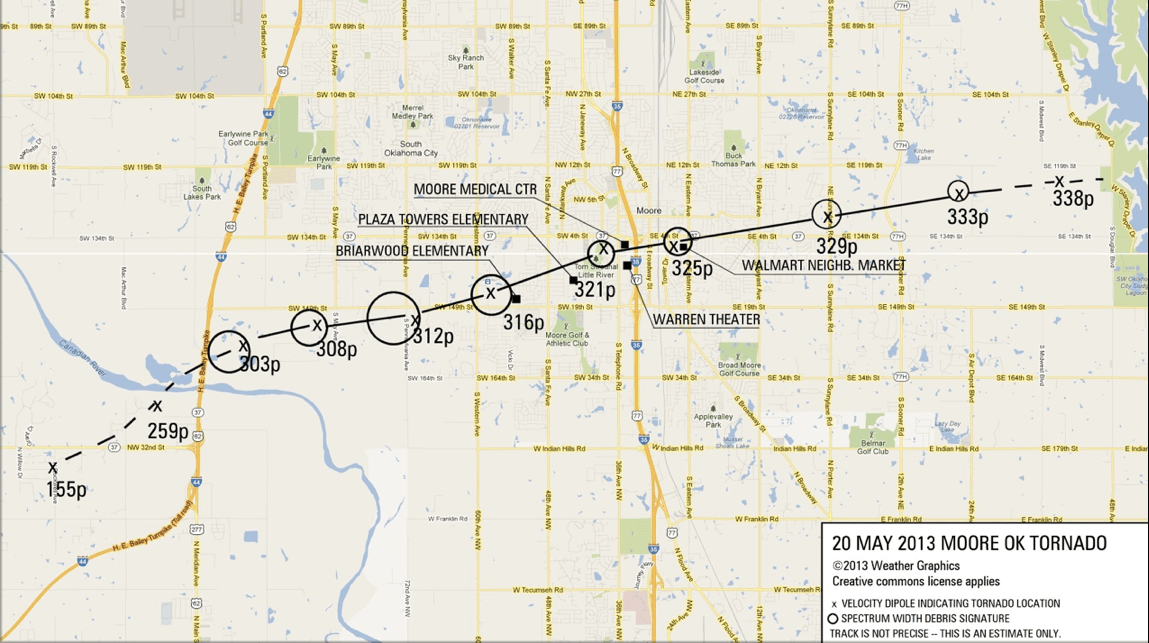
… along with this map:

The first damage in west Moore was at 3:16pm. From 2:40 to 3:16 is 36 minutes. That is triple the national average (12 minutes) for tornado warnings. In east Moore, it was more than 40 minutes! …
A tornado watch was issued for Moore more than two hours before the tornado struck.
When the tornado warning was issued outdoor sirens sounded, local TV and radio stations ceased regular programming and started continuous coverage. NOAA weather radios alarmed. Smartphone apps activated. Two TV stations’ helicopters were showing the tornado – live – approaching Moore.
In other words, just how much warning do you want?! At some point, this becomes an issue of personal responsibility. It is your obligation to be weather-wise. Meteorologists cannot lead you by the hand into shelter.
Twenty-five years ago today, I graduated from UW–Madison with a double-major Bachelor of Arts degree in journalism and political science.
Twenty-five years later, we are right in the middle of college graduation season, with thousands of college students graduating with journalism degrees.
Ben Bromley has some bad news for them:
College kids are sharp cookies, and likely are looking to land someplace more stable and secure than journalism. Someplace like the edges of the Earth’s tectonic plates.
But there still are a few delightfully demented youngsters seeking newspaper jobs, God bless ’em. They’ll bring to the nation’s newsrooms a sense of optimism and enthusiasm most newspaper veterans lost sometime during the second Bush administration. But on the down side, they’ll remind we lifers how old we are — and how much the business has changed since our bylines first appeared in print.
Nearly 20 summers ago I interned at my hometown paper, a country weekly. This was a couple years before computerized page design became common, and long before the advent of digital photography. When I describe this bygone period to our new hires, they look at me as if I am reporting live from the Paleozoic Era. “What was it like commuting via woolly mammoth? Did you write your first city council story on a cave wall?”
Back then, we printed out articles and headlines on paper. Editors then fed the printouts into a machine that coated them with wax, and placed them on pieces of paperboard the size of a news page. Ah, the smells of the 1990s newsroom: melted wax, ashtrays and unshowered police beat reporters.
That era’s tools of the trade now seem as ancient as spear heads. We shot photos on film. We used a device called a proportion wheel to size our pictures — remember, this was before you could Photoshop your face onto an image of Channing Tatum’s body in two minutes flat — and a pica pole to measure out everything on the page. Every now and then, I dig the pica pole and proportion wheel out of my desk and ask newbies to identify them. They sit silently and blink, certain I am holding artifacts on loan from the Smithsonian. …
We thought it was pretty slick in the late 1990s when we could dial up to the Internet and send our pages to the printing plant without leaving our desks. But to kids today, the sound of a 56K modem connecting — “ba donka donka donk … ksssshhhhhhhhh” — is about as modern as a pay phone.
Even the borderline burnouts still believe journalists sometimes can change how the world works. But most of the time, the world changes how we work.
I wish you good luck, class of 2013, and I ask that show your veteran colleagues due respect. Remember, one day you’ll be the dinosaur.
Here’s the thing about Ben: The “hometown paper” he interned at was the Grant County Herald Independent, where I started work May 23, 1988. Before he was an intern, he was a Lancaster High School graduate who was one of the creators of LHS’ underground newspaper, the Arrow Free Press. I did a story about the Arrow Free Press. (The next issue, the Free Press’ staff box was called the “Steve Prestegard Fan Club.) So if Ben is from the Paleozoic Era holding artifacts on loan from the Smithsonian, what does that make me?
Young journalists do not ask me for advice. If they did (other than asking them if they really, really wanted to get into this silly line of work), I would say that journalists need to do four things —
Would I have heeded any of this advice in 1988? Definitely number three. (I’ve always done sportscasting as a side to my regular employment. Given what a goofy profession radio is, I’m probably happy that I’ve never worked full-time in radio.) I knew number one, and probably had figured out number two. (What happens after you get a publication done? You start working on the next edition, unless (A) you’re leaving it or (B) it’s leaving you.) Having had no experience or interest in number four, the concept of being “entrepreneurial” would have sailed right over my head, and I’m taller than most people.
I’ll probably have more on this next week, when I celebrate, if that’s what you want to call it, 25 years in full-time journalism.
Jonah Goldberg:
… a couple of weeks ago I was on a panel at Hillsdale College. It was sponsored by my friends at Liberty21, a scrappy new think tank.
The topic: “Can Conservatives Reclaim the Culture?”
First, I am not sure that conservatives ever claimed the culture in the first place. Sure, in retrospect it almost always seems like the past was more conservative than the present. But that doesn’t mean the conservatives were dominating the culture in the past. It might mean that we’ve just gotten even more liberal since then.
But we can debate all that another time. The thing I wanted to get to is that I think the way the Right talks about popular culture is deeply flawed. If conservatives are going to persuade non-conservatives to become more conservative — which is nearly the whole frickin’ point of the conservative movement — then going around wagging our fingers at every popular movie and TV show is probably not the best way to do it.
One way you persuade people to become more conservative is to explain to them how conservative they already are and build out from there. Persuasion is hard when your main argument is: “You’re a complete idiot and everything you think you know is ridiculous and/or evil.”
Moreover, there’s a Jedi-like Manichaeism running through youthful liberalism: The Light Side is liberal; the Dark Side is conservative. It’s like with little kids; tell them some food is good for them or that some dish has vegetables in it, and they’ll preemptively hate it and refuse to eat it like a jihadi at Gitmo dodging a spoonful of peach cobbler. Tell college kids that something is conservative and they’ll immediately assume it’s not for them. We can spend all day talking about how stupid this pose is, but that won’t do much for the cause.
The better way is to identify things that are popular and celebrate the conservative aspects of them. For instance, as I’ve written before, whenever a sitcom character gets pregnant, the producers make sure to talk up the character’s “right to choose.” But, at least since the painfully unfunny show “Maude,” the character always chooses to keep the baby, and once she does she acts like a pro-lifer. She talks to the fetus. She cares about what she eats. While NARAL considers what is in her belly to be nothing more than uterine contents, the mother-to-be gives those contents a name and acts like it’s already a member of the family. I understand a big part of the pro-life agenda is to make abortion illegal. I get that. But if you could get more people to think abortion is wrong it would A) be easier to make it illegal and B) less necessary to do so.
Or just think about crime. Going by what liberals say they believe about the criminal-justice system, never mind the War on Terror, they should be denouncing vast swaths of what Hollywood churns out. Cops play by their own rules. Good guys use outright torture to get valuable information in order to save lives. But with the exceptions of 24 and Zero Dark Thirty I can’t think of a time when the Left seriously complained about any of it.
Now if you point this out to some liberals, they’ll say that’s because “it’s just TV” or “it’s just a movie.” But you know that if a TV show or movie came out demonizing gays, they’d be screaming bloody murder.
My point is that the Left has quietly surrendered the argument over big chunks of the popular culture, and because they don’t complain about it, conservatives don’t press our advantage. We spend too much time reacting to liberal bait and liberal cues. We act like the opposition, being more against them than for anything of our own. One small place to start is to understand this is our culture too.
Christian Schneider has, shall we say, an interesting theory:
One year ago, before facing a recall election, Republican Wisconsin Gov. Scott Walker traveled to Chicago to give a speech to the Illinois Policy Institute. Following his talk, Walker fielded a question from a woman who, citing a recent movie on education reform, asked whether Walker was the “Superman” she was waiting for. Walker chuckled, then said he was more partial to Batman.
With this admission, Walker stepped squarely into a debate that takes place exclusively in the dark corners of the Internet, where politics nerds and comic book dorks meet to clandestinely debate the political ideologies of superheroes. Which superhero a given politician idolizes may actually tell us a little bit about his or her political philosophy, given one undeniable fact:
Superman is a liberal, and Batman is a conservative.
As noted in Glen Weldon’s superb new book “Superman: The Unauthorized Biography,” the Man of Steel has deep roots in FDR’s New Deal era. Just start with a comparison of the two heroes’ professions: Superman’s alter-ego, Clark Kent, is a member of the dreaded liberal mainstream media, and his father, Jor-El, was one of Krypton’s most noted academics and scientists. Bruce Wayne is a Scarlet Pimpernel-esque billionaire playboy whose father made his money in the real estate market before the economy collapsed (sound familiar?) and whose company, Wayne Enterprises, manufactures military weapons. Superman hangs out with reporters; Batman’s best buddy is a cop. …
Sometimes, Superman gets directly involved in Democratic politics – in the early 1960s, he befriends President John F. Kennedy and trusts him enough to divulge his real identity. Kennedy goes so far as to disguise himself as Clark Kent to fool Lois Lane while Superman rushes off on a mission. (In 1986, Superman meets Ronald Reagan, but the storyline makes Reagan seem like a buffoon.)
Batman, on the other hand, is less of a believer in the inherent good of man. In the early Bob Kane comics, Batman was cruel, often mutilating his opponents before killing them.
And Batman’s opponents are illustrative, too. Ra’s al-Ghul is an environmentalist who wants to destroy humanity and its inherent decadence. By fighting him, Batman is essentially defending wealth and free markets. Other notable Batman foes include a who’s who of lefty bad guys, including another tree hugger (Poison Ivy), a college professor (the Scarecrow) and an occupier with a respiratory problem (Bane).
The most recent slate of Batman movies from director Christopher Nolan are seen by many as sympathetic to Republican politics of the past decade. In “The Dark Knight,” Batman is reviled by the public as he wages a “war on terror” to keep Gotham’s citizens safe. (Nolan might as well have called the hero “Bat W. Man.”)
In “The Dark Knight Rises,” Batman takes on a gang of filthy hippies who occupy the stock exchange and fight for the “oppressed” against the 1%. We find out that Gotham fell into disrepair because Bruce Wayne’s profits were down and he didn’t have enough to spend on charitable activities to keep at-risk youths out of trouble. Batman cherishes order; his opponents relish revolution.
(What if you’re a reporter who hangs around cops? What’s your ideology then?)
On Facebook Schneider added to his righty-superhero list industrialist Tony “Iron Man” Stark and Spiderman. He added today:
First, it is true that each superhero morphs over time. Different writers and illustrators bring different sensibilities. As Glen Weldon points out in his book, by the 1950s, Superman had morphed from an FDR New Dealer to more of an Eisenhower Republican. (Known these days as a “Democrat.”) By the 1970s, Superman was seen as part of the “Establishment,” and his writers struggled to keep up with the revolutionary times – often attempting ridiculous storylines dealing with racial issues. In the days of counter-culture, Superman was the “culture.”
But that doesn’t change the fundamentals of who each character is and how their origin stories depart. There are simply too many political differences between each superhero for this all to be mere coincidence.
And then Superman switched from being an Eisenhower Republican to a Kennedy Democrat. Really.
Schneider quotes the New York Times’ Ross Douthat:
Across the entire trilogy, what separates Bruce Wayne from his mentors in the League of Shadows isn’t a belief in Gotham’s goodness; it’s a belief that a compromised order can still be worth defending, and that darker things than corruption and inequality will follow from putting that order to the torch. This is a conservative message, but not a triumphalist, chest-thumping, rah-rah-capitalism one: It reflects a “quiet toryism” (to borrow from John Podhoretz’s review) rather than a noisy Americanism, and it owes much more to Edmund Burke than to Sean Hannity.
My personal favorite, of course, comes from journalism as does Clark Kent, but at the top of the management chart: