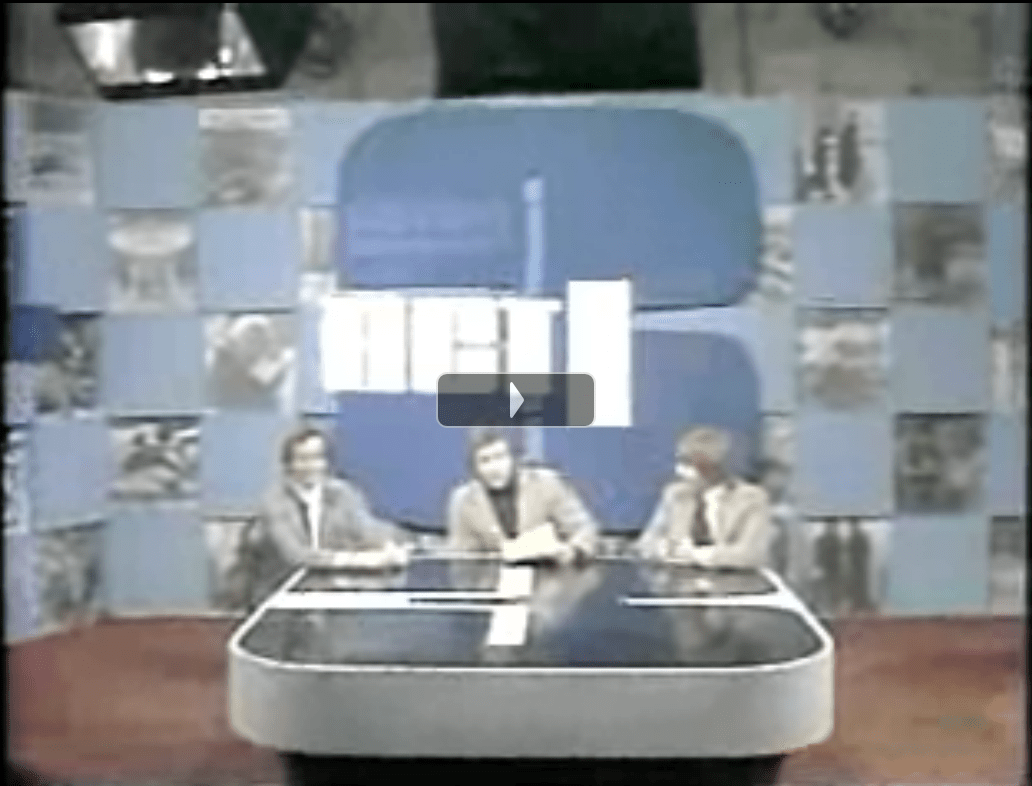
That included this classic photo of WISC-TV’s “Action News” from the 1970s:
The earliest version of this set had neither of the Big Giant 3s; it had up to five anchors sitting in chairs you might find on your screened-in porch, with graphics that would come up in the non-blue checkers behind them. (Which obviously eliminated the old summertime blazer-and-tie-and-shorts for those who report the news behind desks.)
News Checkerboard 2.0 added the 3 table (which obviously also indicated how many people could be seated at the table) and the big blue 3 behind them. (Back when I was on cable TV in Ripon I suggested someone build a big giant R table for programs. It didn’t happen.)
Doing the news on the Big Giant 3 set this night were Tedd O’Connell (center), the so-called “hipster newsman” whose career highlights included visiting Cuba with Mayor Paul Soglin (in the middle); sports director Jim Miller (left); and reporter and weatherman John Digman, who used a ’40s car antenna as his weather map pointer.
(Digman once talked to my high school journalism class. He was hilarious. Sadly, he died at 40 of a heart attack.)
It turns out that WISC-TV’s website has a number of old photos, including O’Connell after “Action News” was replaced by “News 3” and the checkerboard and Big Giant 3s were replaced by something more colorful:
Channel3000.com also has photos of O’Connell’s colleague and replacement John Karcher …
… weekend anchor Rick Roberts …
… Bill Brown (at least I think he is), deep-voiced news anchor who preceded O’Connell back when WISC had one hour of “Eyewitness News” at 6 …
… local TV pioneer Marlene Cummings …
… meteorologist Marv Holewinski, minus his banana-yellow blazer (and Holewinski can still be heard on Wisconsin radio) …
… and former weekend sports anchor Curt Menefee, now host of Fox NFL Sunday:
A web search found another photo of Brown, who is one of the first TV people I remember:
YouTube also has one of the aforementioned Digman’s former coworkers, Rick Fetherston, who later went to WMTV while teaching my UW–Madison broadcasting course. Digman and Fetherston were on-set at WISC while longtime anchor Jerry Deane was doing the news, when suddenly Deane’s dentures flew out of his mouth live on the air. Since apparently this had happened before, Deane calmly caught the dentures in mid-air, put them back in his mouth, and continued as though nothing unusual had just happened. He was the only person acting like this; Digman said Fetherston and he were on the floor laughing off camera.
Also on YouTube is Tom Bier, who worked on- and off-air at WISC for years:
Those with interest in Madison media history can also go to the online Wisconsin Broadcasting Museum, where can be found Wisconsin Broadcasting Hall of Fame members Tom Bolger of WMTV, WISC owner Elizabeth Murphy Burns and general manager David Sanks, WIBA radio founder William T. Evjue (who, yes, also founded The Capital Times; Evjue is probably spinning in his grave over WIBA’s carrying non-lefties Rush Limbaugh and Vicki McKenna), WKOW meteorologist and Weather Central founder Terry Kelly, WISM and Z104’s Jonathan Little, WKOW radio (later WTSO) and TV’s Roger Russell, WKOW sportscaster and “Dairyland Jubilee” host John Schermerhorn, WKOW and WOLX radio owners Terry and Sandy Shockley, former WISM and Magic 98 general manager Bill Vancil, and one of my favorite UW professors, School of Journalism director Jim Hoyt. A number of famous Wisconsin sports announcers can be found there too.
Not in the Hall of Fame is former UW–Madison pharmacy Prof. Phil Mendel, better known as the former public address announcer for Badger hockey games at the Dane County Coliseum, and road-game color commentator for Badger games. Mendel worked with Bob Miller, the first of three Badger hockey announcers who later worked in the NHL, and then when Miller left for the Los Angeles Kings, Paul Braun (announcer of four of six UW NCAA hockey titles) and former UW assistant coach Bill Howard.
Mendel always opened games at the Coliseum with “Good evening … hockey fans” which I, uh, pay tribute to by opening every one of my live games with “Good morning/afternoon/evening, [insert sport name here] fans.” The “If you grew up in Madison you remember …” Facebook page contains a thread started by a former UW hockey player, where those who remember Mendel’s ’70s radio and ’80s TV appearances chimed in with such sayings of his as “[insert opposing goalie’s name here] is as useful as a screen door on a submarine!” and “[insert opposing sieve’s name here] is as frustrated as an unmated coon!” You are unlikely to hear the latter on the air anymore, but that’s not the point.
For those who think a 30-minute hockey fight started by a water bottle is strange, consider what Braun, Howard and Mendel got to cover the next year in another UW game against the Boys (Then) Named Sioux. Wisconsin played North Dakota in the 1983 Western Collegiate Hockey Association semifinals, a two-game total-goal series in Grand Forks that, thanks to the first night’s 1–1 tie and second night’s 4–4 score after three periods (only because of a Chris Chelios goal with 12 seconds left in regulation), went to overtime. And then a second overtime. And then a third overtime. And then things got strange.
Ted Pearson scored the game-winning goal in the third overtime, only to have the goal disallowed because Pearson was using an excessively curved stick, which Mendel and his partners dramatically announced upon coming back from commercial after the supposedly game-winning goal. So not only was the game (and series) not over, but the Sioux went on the power play due to the resulting unsportsmanlike-conduct penalty. An overtime penalty usually is a recipe for losing the game, and yet 26 seconds after Pearson went to the penalty box, teammate Paul Houck scored to win the game again, this time officially. (Remarkably, it was the first shorthanded goal North Dakota had given up all season.) The Badgers then beat archrival Minnesota in Minneapolis to win the WCHA playoff, and beat St. Lawrence twice in the quarterfinals, then Providence and Harvard in the Frozen Four in, of all places, Grand Forks (where North Dakota fans improbably wore “This Sioux’s for You” buttons in support of the Badgers) to win the Badgers’ fourth NCAA title and the first of two for coach Jeff Sauer.
Would you believe there is something older from Madison? How about WISM radio from March 4, 1966 (when I was nine months and one day old):
In our Friday column, we noted that Trump had acceded to years of media demands and declared that Barack Obama was born in the United States. Those demands were as phony as the “questions” about the president’s birthplace. Rather than credit Trump for finally admitting the truth, the media turned on him with a new kind of viciousness.
That is, they followed the urgings of Jay Rosen and Jim Rutenberg and tore down the wall between news and opinion. The following quotes all come from news stories, not editorials or columns:
Associated Press: “After five years as the chief promoter of a lie about Barack Obama’s birthplace, Donald Trump abruptly reversed course Friday and acknowledged the fact that the president was born in America. He then immediately peddled another false conspiracy.”
Reuters: “Republican presidential candidate Donald Trump on Friday abandoned his false claim that Barack Obama was not born in the United States after spending five years peddling conspiracy theories that the country’s first African-American president started life as a foreigner. But, never one to let a controversy go without fanning its flames, Trump accused Hillary Clinton . . . of starting the so-called birther movement in her failed 2008 presidential campaign against Obama, a claim that does not stand up to scrutiny.”
New York Times: “Donald J. Trump publicly retreated from his ‘birther’ campaign on Friday, tersely acknowledging that President Obama was born in the United States—and effectively conceding that the conspiracy theory he had promoted for years was baseless. Mr. Trump made no apology for and took no questions about what had amounted to a five-year-long smear of the nation’s first black president. Instead, he claimed, falsely, that questions about Mr. Obama’s citizenship were initially stirred by the Democratic presidential nominee, Hillary Clinton, in her unsuccessful primary contest against Mr. Obama in 2008.”
Washington Post: “Republican presidential candidate Donald Trump on Friday acknowledged for the first time that President Obama was born in the United States, ending his long history of stoking unfounded doubts about the nation’s first African-American president but also seeking to falsely blame Democratic rival Hillary Clinton for starting the rumors.”
CNN: “Donald Trump finally admitted Friday that ‘President Barack Obama was born in the United States,’ reversing himself on the issue that propelled him into national politics five years ago. . . . But the issue isn’t likely to die down any time soon—especially as Trump continues to falsely blame Democratic nominee Hillary Clinton for starting the ‘birtherism’ controversy.”
There are plenty more examples, along with lots of editorials and columns that were more or less indistinguishable from these news stories—and that indistinguishability is the point. In response to Trump’s statement, news reporters felt free, perhaps even duty-bound, to editorialize against him.
In doing so, they perpetuated a falsehood by denying Trump’s assertion that “Hillary Clinton and her campaign of 2008 started the birther controversy.” A McClatchy report provides the evidence that the campaign, in the person of longtime Clinton consigliere Sidney Blumenthal, did just that:
Former McClatchy Washington Bureau Chief James Asher tweeted Friday that Blumenthal had “told me in person” that Obama was born in Kenya.
“During the 2008 Democratic primary, Sid Blumenthal visited the Washington Bureau of McClatchy Co.,” Asher said in an email Friday to McClatchy, noting that he was at the time the investigative editor and in charge of Africa coverage.
“During that meeting, Mr. Blumenthal and I met together in my office and he strongly urged me to investigate the exact place of President Obama’s birth, which he suggested was in Kenya. We assigned a reporter to go to Kenya, and that reporter determined that the allegation was false.
“At the time of Mr. Blumenthal’s conversation with me, there had been a few news articles published in various outlets reporting on rumors about Obama’s birthplace. While Mr. Blumenthal offered no concrete proof of Obama’s Kenyan birth, I felt that, as journalists, we had a responsibility to determine whether or not those rumors were true. They were not.”
Blumenthal denied it, and some journalists took his side against Asher. “Imagine a reporter claiming Steve Bannon once told him that Hillary killed Vince Foster,” tweeted the Washington Post’s Dave Weigel, who finished the thought: “Do you ask the reporter for more proof? Or do you run with it?” Later, he added: “Journalism, er, isn’t about taking someone’s word. If your mother says ‘I love you,’ you verify it.”
Which is exactly what Asher says he did. Blumenthal told him Obama was born in Kenya; Asher sent a reporter there to check out the claim, which turned out to be baseless. But in Weigel’s analogy, Asher is the putatively loving mother. Weigel is setting up a standard he cannot possibly mean to apply in general: When a reporter reports that a source told him something, do not believe him without further verification.
Other journalists stipulated that Asher’s account was truthful but tried to draw a distinction disadvantageous to Trump. The most revealing example came from Mark Murray, NBC News’s senior political editor: “If someone shopped the story—and no media outlet ran with it—is that really ‘starting’ it? Not how I see it.”
We replied: “In other words, Trump is to blame because the media paid him so much attention.” Murray: “We paid attention to Trump bc he was holding press conferences and interviews on topic. No similar behavior from ’08 HRC camp.”
It seems to us that if a whispering campaign is followed by an open one, it is reasonable to think the former “started” it. One can also make a strong case that a whispering campaign is worse because it allows the campaigner to evade accountability.
But what interests us most here is Murray’s justification for the attention the media lavished on Trump’s various bloviations about Obama’s birthplace. To be sure, anything he has ever said is newsworthy now that he is a presidential candidate. But why did journalists bother with Trump’s nonsense before June 2015?
In part no doubt because Trump is a fun and colorful figure who is good for ratings. But this column has argued, and we continue to believe, that the liberal media had a partisan interest in promoting birtherism so as to make Republicans look crazy and racist.
That theory is consistent with the frenzied reaction to Trump’s acknowledgment that Obama was born in the U.S. and his effort to shift the onus to Mrs. Clinton. In a hilarious interview with Mike Pence over the weekend, ABC News’s Martha Raddatz asked: “Why did it take him [Trump] so long to put it to an end?” Pence simply said, “It’s over,” to which Raddatz replied plaintively: “It’s not over.”
And we suppose it’s not, or we wouldn’t be writing about it. But now we’re talking about who started it—and on that question the facts are not on Mrs. Clinton’s side, even if the media are. Trump spent half a decade trolling the media with birther baloney, only to implicate Mrs. Clinton in the end. Whether that was his strategy from the start or a recent tactical adaptation, it’s dazzling gamesmanship on his part.
The question is whether the media’s open hostility will hurt Trump and help Mrs. Clinton. It may have the opposite effect. As the social psychologist Robert Cialdini—who is rumored to be advising Mrs. Clinton’s campaign—observes in his new book, “Pre-Suasion: A Revolutionary Way to Influence and Persuade”:
The central tenet of agenda-setting theory is that the media rarely produce change directly, by presenting compelling evidence that sweeps an audience to new positions; they are much more likely to persuade indirectly, by giving selected issues and facts better coverage than other issues and facts. It’s this coverage that leads audience members—by virtue of the greater attention they devote to certain topics—to decide that these are the most important to be taken into consideration when adopting a position. As the political scientist Bernard Cohen wrote, “The press may not be successful most of the time in telling people what to think, but it is stunningly successful in telling them what to think about.”
In that vein, consider what happened over the weekend, after a spate of comparatively low-level terrorist attacks and attempts in Minnesota and the New York area. Most notably, a bomb made from a pressure cooker—similar to the one used in the fatal Boston Marathon attack in 2013—exploded in the Manhattan neighborhood of Chelsea, wounding 29 but killing nobody.
Trump mentioned the attack in a Colorado speech, and as the Hill reports, “the press . . . largely slammed Trump for referring to the explosion as a ‘bomb’ too soon.” But one news network went further:
CNN edited out the opening sentence of Democratic presidential nominee Hillary Clinton’s statement during breaking news coverage of an explosion in New York City that injured 29 people.
Clinton was on board her campaign plane Saturday night when she addressed the press following the explosion in New York’s Chelsea neighborhood.
According to an ABC News transcript below, Clinton called the attacks in New York and New Jersey “bombings” before criticizing Republican presidential nominee Donald Trump—who also referred to the explosion as a “bomb”—in an attempt to show contrast between the temperament of the two candidates, who are deadlocked in the polls.
The apparent intention is to make Mrs. Clinton look “responsible,” but the effect may be to make her look complacent. CNN is inducing viewers to think about terror, but what they think about it is up to them. Cialdini: “According to this view, in an election, whichever political party is seen by voters to have the superior stance on the issue highest on the media’s agenda at the moment will likely win.”
For some in the media, though, it may be more personal. Consider this exchange from NBC’s “Meet the Press” yesterday, between host Chuck Todd and New York Times columnist Maureen Dowd:
Todd: New York Times, I think it was Saturday, Maureen, had a lead that said, basically interviewing all these Upper West Siders panicking now. And in fact I think referred to it as “The polls are showing a ‘margin of panic’ for Clinton supporters.” Describe this east coast freakout that I feel like you’ve seen among the elites this week.
Dowd: Right. Well my friends, one of my friends, Leon Wieseltier, calls it a national emergency. And my friends won’t even read, if I do interviews with Donald Trump, they won’t read them. And basically they would like to censor any stories about Trump and also censor any negative stories about Hillary. They think she should have a total free pass. Because as she said at that fundraiser recently, “I’m the only thing standing between you and the abyss.” Oh, and they’re taking— Democratic strategists are taking antacids. In the Times today.
The Times story is well worth reading; if it doesn’t make you laugh, you have a heart of stone.
Imagine being a political reporter who sees the world in that Upper West Side way, and so do all your friends. But you operate under the professional constraint of being impartial, or at least appearing impartial. Suddenly Trump does something so dramatic that a signal goes through the media hive: The constraint of impartiality has been lifted.
It’s bad for journalism as an institution. It may be bad for Mrs. Clinton’s campaign—and hence for the country if you think Trump is a national emergency. But would you be able to resist surrendering to the frisson of liberation, the immediate gratification of shouting “LIAR!”? And as you did surrender, wouldn’t you feel a twinge of gratitude to the man who made it possible?
My new Road & Track magazine included Jack Baruth‘s paean to the best non-nuclear power source man ever invented, which requires multimedia additions:
It starts with the sound. You can’t mistake a V8 at wide-open throttle for anything else, and once that sound gets into you, nothing else will satisfy. The internal-combustion engine offers a veritable symphony of exhaust notes, from the boxer blat of a flat-six to what is often called the “ripping canvas” sound of a V12, but the bent-eight is the violin of the orchestra, the concertmaster’s choice. It is simultaneously exotic and democratic, appearing in quarter-million-dollar supercars and everyday work trucks. You hear its song in the Lotus 49 and the Ford Crown Victoria. The V8 logo has proudly adorned the fenders of Ford Mustangs and AMG-powered Mercedes-Benzes. It is the archetypal American performance engine, but it was also the logical choice for the first Lexus LS 400. Some people say it is the only engine that matters. …
Henry Ford didn’t invent the V8, but he made it available and accessible. In 1932, Ford put a “flathead” V8 in his Model 18 after a short, troubled, and somewhat incomplete design and development process. The flathead design, which placed the exhaust and intake valves in the block next to the cylinder instead of above it, was already old tech at the time. At 65 hp, the flathead’s output was more than 50 percent higher than the four-cylinder in the Model A but wasn’t significantly more powerful than Chevrolet’s inline-six.
Ford’s advantage was curb weight. The Model 18 was a couple hundred pounds lighter than the competition, making it perhaps the first American muscle car. The price was right, too: $460 for the roadster. The flathead wasn’t without teething problems in early production, but nobody seemed to care. Production barely kept up with demand. And just like that, the V8 established itself—in the United States, anyway.
Strictly speaking, the notion of connecting two inline-four engines to make an eight-cylinder wasn’t even an American idea; French engineer Léon Levavasseur filed the first patent for a V8 in 1902, and in 1905, Henry Royce designed one for the Legalimit, a model so named because its engine—powerful enough to go 26 mph—was governed not to exceed the 20-mph British restriction of the time. As with pizza and swiss cheese, however, the new world lost little time in adopting the idea for its own purposes. In 1914, Cadillac became the first automaker to put the V8 into volume production, capturing the imagination of the American public and setting the stage for Ford to democratize the concept 18 short years later. …
American V8s sound different from European V8s …
After the war, a new generation of overhead-valve V8s appeared from the likes of Oldsmobile, Buick, Studebaker, and Cadillac, but those marques all carried a significant price premium. Chevrolet, Ford’s most frequent antagonist for the annual-sales crown, didn’t offer a modern V8 until 1955. To put it mildly, it was worth the wait.
Ed Cole, Chevrolet’s newly promoted chief engineer on the project, had ambitious goals for what came to be known as the “Mighty Mouse” engine. His personal motto was “Kick the hell out of the status quo,” and the Chevrolet small-block did just that. It weighed less than the Blue Flame inline-six that preceded it but made considerably more power. Just as important, it was designed to be capable of growing from its original displacement of 265 cubic inches (4.3 liters) all the way to 428 cubic inches (7.0 liters) in the 2000s. It was an overhead-valve design, with two valves per cylinder operated by a single cam nestled in the vee of its cast-iron block, and it benefited from every innovation, and every lesson, that General Motors had learned during the design and production of its upscale siblings.
Cole’s small-block V8 should be considered one of mankind’s greatest inventions in any area given that the basic design — with aluminum replacing iron, fuel injection replacing carburetors, computer controls and pollution-reduction equipment — is still being used today, even in non-GM cars. (For instance, a ’30s Ford I saw at a car show last weekend.)
Ford had actually beaten Chevrolet to market with its Y-block overhead-valve V8, but it was quickly apparent that it couldn’t cut the mustard against Cole’s brilliant effort. The Y-block’s replacement, the 1961 Windsor V8, made a much better case for itself, particularly in the new Mustang that appeared three years later. In the decades to come, the small-block Ford V8 would become synonymous with the Mustang brand, from the original Shelby GT350 to the Boss 302 all the way to the infamous “five-point-oh” Mustangs of the Eighties and Nineties.
By 1963, every major American manufacturer had at least one modern V8 design, with some fielding both a small-block for general-purpose use and a big-block for full-size cars and trucks. Most of these engines, like the small-block Chevrolet, were designed with considerable room between the cylinder bores to accommodate increases in displacement. When John Z. DeLorean found a way to circumvent an internal GM policy limiting cars to 10 pounds per cubic inch, the result was the 389-cubic-inch 1964 Pontiac GTO and the beginning of the muscle-car era. …
Perhaps the most interesting overseas V8, however, was one with American origins. In 1960, Buick released a small, light, all-aluminum V8 engine for use in compact and mid-size cars. It wasn’t a big hit, so the company decided to cancel the program. A few enterprising fellows at U.K. automaker Rover convinced GM to sell them the tooling. In 1967, the Rover V8 made its debut in the P5B luxury sedan; three years later, it was used as the power unit in a brand-new off-road vehicle called, simply, Range Rover. The Rover V8 became the engine of choice for a variety of English small-batch sports-car manufacturers, including Morgan, TVR, and even MG, in its MGB GT V8 coupe from 1973 to 1976.
The V8, then, is a global superstar. But what makes it so good, so desirable, so widely adopted for both street and competition cars? There are several answers to that question. The first is that the V8, in its traditional overhead-valve, 90-degree bank-angle form, tends to be light, compact, simple, and smooth. It’s light because the block is considerably smaller than the block of an equivalent inline engine. It’s compact because it is the same length as an inline-four of half the displacement, without being twice as wide. It’s simple because it has a single short camshaft to serve eight cylinders and 16 valves. And it’s smooth because most V8s have a 90-degree crankshaft that balances the firing order, reduces vibration, and spaces out the power pulses.
The 90-degree crankshaft also gives the V8 the unique burble that has threaded its way into the popular consciousness over the past 80 years. It’s the stock soundtrack for every action movie and television show, so much so that Back to the Future used a Porsche 928’s engine noise instead of the actual sound of the DeLorean’s V6. But the V8’s cultural impact goes deeper than an exhaust note. The Beach Boys’ “little deuce coupe with a flathead mill” was “stroked and bored,” and their “409” was, of course, the big-block Chevy engine. Chuck Berry’s “Maybellene” is about a race between two V8s—an early Coupe de Ville and a V8 Ford, most likely a flathead since it appears to have that design’s tendency to overheat at high speed.
Nor can you even begin to consider the automobile’s relationship to the silver screen without seeing the outsize star power of the bent-eight. The list includes everything from Mad Max to Vanishing Point to The Blues Brothers. The Bandit’s Trans Am? V8, of course—but you might not know that the Firebirds used in The Rockford Files also had the Pontiac 400 under the hood. Starsky and Hutch had a V8; so did Bo and Luke Duke. Two-Lane Blacktop is the story of a battle between a big-block Chevy-powered ’55 and a 455 Pontiac GTO. Last but not least, there’s that Mustang GT 390 driven by Frank Bullitt, evading a 440 R/T Charger on the hills of San Francisco. It’s about as basic as a Mustang can get, except for the motor—but did you think that Steve McQueen would have been caught dead driving the Thriftpower inline-six that came standard?
As for “Bullitt,” this is what his Mustang actually sounded like …
… and this is when the 390 V-8 was magically replaced by the V-8 from the Ford GT-40 at Le Mans, along with a more-than-four-speed transmission …
… in the greatest movie car chase scene of all time.
When the fuel crisis of the Seventies hit, the V8 acquired a new name and a new reputation: gas-guzzler. It didn’t help that newly mandated emissions equipment and the unleaded fuel required by the catalytic converter stole a lot of its power and prestige. But even in the darkest days of the energy crisis, when the speed limit was a dismal double-nickel and Jimmy Carter was on television telling us to turn our thermostats down to an equally depressing 55 degrees at night, the romance of the V8 continued. Mad Max drove a V8 Interceptor in 1979’s idea of the future, while the 1982 Corvette still had a 350 small-block. All the V8 needed was some good news on fuel price and maybe a bit of technology to help it reach the next millennium.
Both were forthcoming, leading to a veritable supernova of new V8 designs and new homes for those designs. Lexus, Infiniti, BMW, Audi, Mercedes, Cadillac, and Lincoln all introduced new 32-valve, overhead-cam V8s. Ford modernized its V8 with the Modular overhead-cam engine, while Chevrolet reengineered the traditional small-block into the LS series. You could get a V8 in everything from the Yamaha-engined, third-gen Ford Taurus SHO to the outrageous BMW Z8. The horsepower wars returned in earnest, and the V8 led the charge. …
The good news is, there are still plenty of brilliant V8s on the market. On the exotic side, there’s the Ferrari 488 GTB and every new McLaren supercar. Affordable V8 choices exist in the form of both pickup trucks and pony cars from Ford, GM, and Chrysler.
Somewhere in the middle, you have the stunning 8250-rpm flat-crank 5.2-liter mill in the Shelby GT350 Mustang; the Corvette Stingray’s stout-hearted, naturally aspirated LT1; and the almighty supercharged 707-horse Hemi from the Dodge Charger and Challenger SRT Hellcats. The latter engine is a testament to what can happen when modern technology is applied to a traditional formula. From its iron block to the single camshaft nestled in the bank between its cylinders, very little about the Hellcat’s basic design would shock the men who designed the 135-hp Oldsmobile Rocket V8 for the 1949 model year, but every aspect of that design has been painstakingly massaged and computer-engineered to a space-age level. …
So although the future might be filled with snail-stuffed small-displacement engines thrashing tunelessly through a CVT or assisted by an electric motor, you can consider us unconvinced. A boosted V6 or inline-four might turn impressive numbers on the dyno or the drag strip, but the bent-eight remains the gold standard of internal-combustion engines. It sounds right. It feels right. And it looks stunning beneath the lifted hood of a Mustang or the glass engine cover of a Ferrari. We’ll continue to cheer, and choose, the V8 as long as we can. Even after the last small-block Chevy or flathead Ford or flat-crank Shelby GT350 is silenced forever. As long as that sound exists, even in our memories, the V8 will continue to be the only engine that matters.
The modern baseball broadcaster provides a public service to sports fans everywhere: He receives our hatred; he’s a magnet, or a receptacle, for our frustration. To talk for three-plus hours extemporaneously, particularly during a game as leisurely and mannered as baseball, is to invite listeners to pounce on every poorly researched remark. Each year the baseball site Fangraphs.com asks its readers to rank all 30 teams’ announcers; perhaps the nicest thing written about one was that he was “phlegmatic to a fault.” Snarking on broadcasters is a fan’s sport within a sport.
The rise of hate-listening tracks the decline of the Big Broadcast Personality. Today, baseball announcers pretty much sound the same. John, Dave, Tom, Marty, Joe, Jack, Dan … They are interchangeable and anonymous: Choosing one over another would be like choosing between brands of paper clips.
There are, of course, a few grandfathered-in exceptions to the bland-yet-hated rule: Hawk Harrelson in Chicago, Mike Shannon in St. Louis—and most exceptional of all: Vin.
Vin Scully, who now enters his final month on the job, began broadcasting for the Brooklyn Dodgers in 1950 as an apprentice to Red Barber. Three years later, he was the team’s lead broadcaster. By 1958, when the team moved to Los Angeles to play in the Coliseum, he was so vital to fans – many of whom had difficulty following the game in a stadium far too massive for it – that they packed transistor radios so they could listen to Vin in the stands. By 1976, fans elected him the “most memorable personality” in Dodgers history. That was 40 years ago.
Over the decades, the sports-media landscape changed dramatically, and Scully’s once-beloved profession was whittled down to those Johns and Daves and Toms and Joes we like yelling at so much—but he never lost his touch.
The key to Scully’s success is his calm, intimate vibe. While many broadcasters call games as if they’re trying to talk anonymous hordes out of looking at their iPads, Scully is having a conversation with you – and only you. “I’ve always felt that I was talking to one person,” he said in 2007. “But I’ve never envisioned who that one person is.”
To listen to Scully is to be drawn in by a storyteller—and a fellow traveler. Scully has seen nearly 10,000 baseball games but he never sounds like a jaundiced expert. He’s excited to find out what happens just like you. It’s a baseball game. Let’s watch it together.
In 1950, you listened to Vin Scully because you wanted to know if the Dodgers were winning and he was the only way for you to find out. Now, in an age of push notifications and Twitter alerts, it’s difficult not to find out the score. And we have an absurd number of ways to follow along. We can watch the game on our TVs, our iPads, our phones, our video game consoles or even our wristwatches. We can listen to national audio feeds. We can turn off broadcasters altogether and just listen to the crowd. But still we choose Vin.
Ask any baseball fan. When they’re flipping around MLB.tv looking for a default game, just “which game should I turn on right now?” the determining factor is always, always, “Are the Dodgers at home?” Because if they are, Scully’s calling the game, and that’s the one you choose. Sure, the score of that Diamondbacks-Rockies game might be a little closer. But you’re going to turn down the chance to listen to Vin? In his last season, no less? The Dodgers are in first place, but even if they were on a 100-loss pace, they would be must-watch all season. That’s because of Vin.
Though he’s been around forever, he’s not some nostalgia play. He doesn’t complain that They Just Don’t Play Like They Used To or invoke the Good Ole Days, perhaps because he realizes they’re not behind us.
Baseball is the game we love to lament. Fans yearn for the time when it was America’s pastime in more than name, back when every theoretical American was rapt to attention, Ovaltine in hand, to watch the Mick. But that’s not how it really was. (Yankee Stadium was one-third full when Roger Maris broke Babe Ruth’s record.) In reality, more people are watching baseball right now than did in 1950, or 1960, or 1970, or any other time in recorded history. The newer fans are a more diverse group, more global, more liable to GIF a Mike Trout catch at the wall than keep a scorebook at the ballpark.
What unites the newer fans to the past is that they adore Vin Scully. The man in the booth – doing the job we now love to denigrate – is more beloved than the players he describes on the field.
His voice has served as the soundtrack of baseball even as that game, and the way we interact with it, has evolved. We’ll choose him right down to the very end. And then we’ll get back to booing the other guys.
NBC News asks nine questions about Hillary Clinton’s pneumonia, including…
1.) Why hide the pneumonia diagnosis?
Clinton suffered a coughing attack last week during an appearance in Cleveland, which she dismissed as seasonal allergies. She received her pneumonia diagnosis on Friday, but the public was not told about it until hours after the incident at the memorial, raising questions about whether Clinton had any plans to ever inform the public. Between the diagnosis and the near-collapse, Clinton appeared at two fundraisers, ran a national security working session, and held a press conference.
Clinton’s campaign appears to have, at best, withheld information from the public and — at worst — misled them by aggressively batting down “conspiracy theories” that her coughing fit was anything more than allergies. Opponents are already seeing the incident as proof of their claims that Clinton has been hiding health issues. And others may now be more incredulous of the campaign’s statements on her health.
The first question answers itself. Hillary Clinton is as familiar with the truth as she is with marital fidelity.
3.) Who made the call not to go to the hospital and when?
And did Clinton lose consciousness at all? After leaving the memorial, Clinton went to her daughter Chelsea’s apartment and was later examined by her doctor at her own home in Chappaqua, New York. Why was it decided not to visit a hospital immediately?
4.) What is the campaign’s position on the protective press pool?
Presidents and presidential candidates have traditionally traveled with a small, rotating group of journalists so the American public can get real-time updates about unexpected incidents—exactly like the one on Sunday. But Clinton left her press pool behind at the Sept. 11 event and kept them in the dark for 90 minutes before providing any information on her whereabouts or health. Clinton has yet to agree to full “protective pool” coverage, which would allow reporters to follow her door-to-door. Will she now? (Trump, so far, has not allowed for pool coverage, and reporters do not fly with his campaign to events.)
5.) Will Clinton allow a true protective pool if elected president?
Clinton’s health scare is already expected to potentially affect financial markets, but the impact would be far more dramatic if she were president. A 90-minute window with no news about a missing president could lead people to assume the worst. Clinton’s, or her campaign’s, choice to leave the press pool behind broke with precedent on access—will that change if she’s in the White House? Meanwhile, because Clinton has so far not agreed to full coverage, reporters have no way of knowing if she made other stops Sunday.
6.) Does Clinton accept the obligation to inform the public about her health?
Bill Clinton faced questions about his health too, and while he was unforthcoming in 1992, he sat for a detailed interview with the New York Times in 1996. “[T]he public has a right to know the condition of the president’s health,” Clinton said at the time.
8.) Will Clinton’s health affect the first debate?
Clinton’s first debate with Donald Trump is just over two weeks away, on September 26, so she’ll want to be fully recovered by then.
9.) How will voters respond?
Clinton’s core vulnerability is that most Americans don’t find her honest or trustworthy. Will voters now feel like they’ve been misled about her health? Or will the vulnerability of the illness make Americans empathize more with someone who often has difficulty connecting.
To be sure, we know vastly more about Clinton’s health than we do about Donald Trump’s. Not only is the information released by her campaign more comprehensive than that released by his, but Clinton has lived her life in the national spotlight for 25 years.
We have intimate details about her 2012 hospitalization, for instance, because she was secretary of state at the time. Trump has not been subjected to the same kind of scrutiny and has been less forthcoming during his presidential campaign.
[Monday] morning on NPR’s Morning Edition, journalist and author Cokie Roberts indicated that many of the establishment Democrats may be getting antsy over the renewed speculation of Hillary Clinton‘s health. …
“It’s taking her off of the campaign trail,” said Roberts Monday morning, indicating that the pneumonia has forced Clinton to cancel her upcoming trip to California. But as for members of the Democratic party, “It has them very nervously beginning to whisper about her stepping aside and finding another candidate.”
Despite any rumors that someone like Joe Biden would be able step in as the new standard-bearer of the Democratic party in the absence of Hillary Clinton, Roberts admitted that the idea may be farfetched. “I think it’s unlikely to be a real thing. I’m sure it’s an overreaction about an already-skittish party,” she added.”
Of course, whether she’s got merely pneumonia or atrial fibrillation (one online theory), Parkinson’s Disease (another), alcohol issues (ditto) or whatever else, none of those are Hillary’s worst malady, Tim Stanley notes:
It’s often not the crime that undoes a politician, it’s the attempted cover-up. …
This display of infirmity came at the very worst moment possible: a ceremony to commemorate the victims of 9/11. America feels vulnerable, it needs direction and strength. The sight of Mrs Clinton’s fall suggests that she isn’t physically capable of providing either. …
Her supporters have rushed to remind us that other presidents were even frailer. Woodrow Wilson had a massive stroke while in office and his wife had to run the country. Grover Cleveland had oral cancer surgery in secret on what was billed as a fishing trip. And, besides, Clinton’s doctor says that all she has is pneumonia. Lesser mortals would’ve been in hospital being stuffed with antibiotics. Not our Hillary.
Ah, but if Clinton had told the world she had pneumonia earlier then either she could’ve legitimately sat out the weekend’s events, or at least we wouldn’t have been quite so shocked when she appeared unwell. No: Hillary refused to be straightforward. She lied. She was caught out. Hillary has been hoist by her own façade.
The string of deceptions surrounding Clinton’s health is reminiscent of her email problems, the Lewinsky affair, and a host of other challenges that the Clinton family has obfuscated its way through. Keen-eyed observers sensed there was something wrong when Mrs Clinton kept coughing in speeches and interviews. At first she laughed that off, called it a conspiracy theory.
Then she admitted that she had allergies – nothing serious. Then came the fall on 9/11. Suddenly she admitted that she had pneumonia. So this story isn’t just about health. It’s about integrity. Mrs Clinton has validated the suspicions of voters who think that she can’t help lying about everything. Is this why, they ask, she won’t talk to the press or allow them to follow her daily activities?
What does this mean for the race? In a normal election, one might predict a sudden shift in the polls. When electing a president, Americans are looking for someone who can discharge the duties of the office to the best of their ability – and Clinton doesn’t look like she can do that.
But when the only alternative is Trump, anti-Trump sentiment might bolster the Democratic ticket. Some voters might actually rally in sympathy. It depends on how the Clinton team handles it. Recall that Reagan was dubbed old and tired in 1984, yet he laughed it off brilliantly. Mrs Clinton is going to have to somehow “own” her pneumonia.
The story speaks to why the race is so close. Clinton is a bad candidate. She clearly thought that she could just walk this campaign, that Trump’s negative ratings would put her in the White House. Say nothing. Have no big agenda. Just avoid the press and focus on fundraising and speeches attacking her opponent. But that wasn’t enough.
At the first stumble, confidence will drain away. And Trump’s egomania alternative is nothing if not vital and vigorous.
One would have thought that Hillary’s time on the Senate Watergate Committee would have taught her Stanley’s first sentence. Deplorable.
CNN reports on the latest in the love–hate relationship between The Donald and the news media:
Donald Trump is ending a practice most journalists think he never should have started: his “blacklisting” of news outlets.
Effective on Thursday, the Trump campaign says it will approve requests for press credentials from The Washington Post, BuzzFeed, Politico, and other news organizations that were previously blocked by Trump.
A campaign spokeswoman confirmed the change on Wednesday. Trump provided a cheeky statement to CNN about the restoration of credentials: “I figure they can’t treat me any worse!”
Leaders of some of the affected newsrooms were glad to hear of the change, but said it shouldn’t have been necessary at all.
“Access to a major party’s presidential campaign events shouldn’t be a favor to be granted or withheld,” Politico editor Susan Glasser said.
“It is important to remember that this was an absurd policy to begin with and a dangerous precedent for any campaign to have set,” Huffington Post senior politics editor Sam Stein said.
Several Trump aides, including campaign manager Kellyanne Conway, had been lobbying behind the scenes for a loosening of the restrictions against the Post and other news organizations.
Trump’s running mate Mike Pence said five weeks ago that he was looking into the issue.
The so-called “blacklist” took hold last year, when the campaign denied press credential requests from The Huffington Post and the Des Moines Register.
The Daily Beast, BuzzFeed and Politico’s credential requests were also rejected by the campaign. At various points Univision has also been blocked.
Trump seemingly formalized the bans last June when he announced that he had revoked the Post’s credentials.
In August he threatened to add The New York Times to the list, but did not follow through.
In most cases, reporters from the offending outlets were still able to attend Trump rallies as members of the general public, but without the access and privileges that press credentials provide.
Some journalists took it as a badge of honor. But the rejection of individual news outlets was troubling, some press freedom advocates said, because of possible chilling effects and precedents.
Recognizing the media controversy, and perhaps relishing it, Trump said in June that if elected president, he would not ban news outlets from the White House press briefing room.
The three print pool chairs — Time magazine’s Zeke Miller and The New York Times’s Maggie Haberman and Ashley Parker — argued that candidates shouldn’t be able to pick the members of the pool rotation, a source with knowledge of the matter said.
Separately, news outlets have also been pressing for greater access to Trump, citing the Clinton campaign’s decision to let some reporters travel on Clinton’s plane.
Even with this week’s change, Trump is likely to continue attacking the media.
All this is despite the fact that Trump’s campaign exists almost solely because of free media coverage. Trump’s campaign is in horrible financial shape, getting outspent on a daily basis by Hillary Clinton’s campaign. Things have gotten so bad that Republicans are pushing the Republican National Committee to stop spending money for Trump and divert funds to Congressional candidates.
Jonathan Tobin grades Wednesday’s NBC Commander-in-Chief Forum:
Last night’s preview of the first presidential debate at the military forum held in New York confirmed what many, if not most Americans think about the two leading candidates. In just an hour’s worth of gobsmacking political television, both made statements that were disqualifying. Clinton embroidered upon her previous lies about her email scandal and Trump dumped on the U.S. military while giving yet another endorsement to Vladimir Putin. But if voters woke up today scratching their heads about their dismal choice, Libertarian Party candidate Gary Johnson, the man even some otherwise sensible people are demanding to have included in the debates, went on television to demonstrate that he is as bad, if not worse, than either Hillary Clinton or Donald Trump.
The NBC forum is being perceived in some quarters as a victory for Trump because of the pasting Clinton took from both moderator Matt Lauer and audience members who asked about her email scandal. Liberals think this is all very unfair since it allowed Clinton to spend less time demonstrating that she is more knowledgeable than Trump. But Clinton’s continued denials that she knowingly sent classified material on her insecure home server are outrageous. Yet not quite as outrageous as her claim that her server was actually more secure than well-protected systems operated by the government. You can’t admit responsibility for what you say was a mistake and in the next breath claim to have done nothing wrong if you want to retain a shred of credibility. Her sense of entitlement about breaking the rules and cavalier attitude toward the truth make for a depressing spectacle. And its because of that combination that Americans don’t trust her.
Clinton’s answers about foreign and security policy — where she has an advantage over Trump — weren’t much better. Trying to be both a responsible internationalist and an antiwar leftist is an impossible task and Clinton failed miserably. You can’t promise to beat ISIS while at the same time vowing never to commit American ground troops to the fight and still sound like you’re the serious person you claim to be.
That Lauer and the audience easily cornered Clinton speaks to her weakness as a politician. That the Today Show host had less success holding Trump accountable for the string of outrageous and false statements that poured forth from his mouth during his half hour speaks to his strength as a media personality. It may also be, as we saw during the Republican primary debates, that the sheer magnitude of his falsehoods is such that it defeats the ability of ordinary people to cope with them.
Suffice it to say that for an American presidential candidate to praise Vladimir Putin and prefer him to our own president is, by itself, disqualifying. The Obama presidency deserves harsh criticism, but anyone who sees the Russian dictator as a role model is simply running for president in the wrong country. That also applies to Trump’s trashing of our military, hostility to the presence of women in the armed forces, and clear desire for only those generals who will tell him what he wants to hear. Does anyone really believe he has a “secret plan” to defeat ISIS? Even if he does, what are we to make of a man who vows he won’t send troops to Iraq or engage in regime change but then says he also intends to steal oil from that country and Libya, a colonial quagmire project that would make George W. Bush’s invasion of Iraq look like an act of strategic genius.
This morning, however, Gary Johnson exceeded Trump and Clinton in the contest to determine which candidate was the most unqualified to be commander-in-chief. On the “Morning Joe” program, Mike Barnicle asked Johnson what he would do about the situation in Aleppo. Johnson replied, “What is Aleppo?” Barnicle responded, “You’re kidding,” to which Johnson simply said, “No,” with a deer-in-the-headlights look.
Americans will have two more months to hear more from the candidates. But no matter where you stand on the political spectrum, honest observers must admit that within a span of 12 hours, Clinton, Trump, and Johnson have all proved again why none of them should be president.
Clinton supporters’ position on this has been to attack the messenger, as James Taranto reports:
With Donald Trump gaining ground in the polls, Hillary Clinton’s campaign has begun a series of attacks—on Matt Lauer. We kid you not: Subscribers to Mrs. Clinton’s email solicitations (we read them so you don’t have to) received two missives Thursday with Lauer’s name as the subject line.
“Last night, during the Commander-in-Chief Forum on live national television, Donald Trump kicked off his evening by lying to the American people about his position on the Iraq War—and no one stopped to call him on it,” read the first email, signed by deputy communications director Christina Reynolds. “Not only did the moderator, Matt Lauer, fail to fact-check Trump—he then kept the conversation moving.”
The second email, also attributed to Reynolds, begins: “I wanted to share this important column from Jonathan Chait I read last night.” Underneath is an image of the headline of Chait’s column, “Matt Lauer’s Pathetic Interview of Hillary Clinton and Donald Trump Is the Scariest Thing I’ve Seen in This Campaign.”
Reynolds breaks her promise and doesn’t actually share the column; she quotes a mere sentence of it. The headline image is hyperlinked to a donation page on the campaign website, not to New York magazine. (Out of professional courtesy, here is a link to Chait’s piece, which we discussed yesterday.)
Fascinating, isn’t it? It’s far from unprecedented for candidates for national office to campaign against the media: Spiro Agnew did it, and so has Trump. President Obama has been known to disparage Fox News and Rush Limbaugh. But usually it’s Republicans vs. the liberal mainstream media or Democrats vs. the conservative alternative media. Trump’s feud with Fox’s Megyn Kelly last year broke the pattern, and now Mrs. Clinton is following Trump’s lead in attacking a journalist on what is understood to be her own side.
Of course the postwar mainstream media’s conceit—mirrored in Fox’s slogan “fair and balanced”—is that journalists don’t take sides, or at least strive for objectivity. This year, that ideal has come under direct attack as never before. Inspired by Donald Trump, liberal journalists are demanding that other liberal journalists choose liberalism over journalism.
On Twitter, BuzzFeed’s Andrew Kaczynski reports “basically universal condemnation from journalists for Lauer letting Trump get away with Iraq War comments.” That’s hyperbolic—Kaczynski’s evidence consists of four tweets—but the condemnation is widespread. David “Iowahawk” Burge quips: “I expect campaigns to ‘work the refs.’ What’s weird is watching the refs work the refs.”
A Washington Post editorial today laments that, as the headline puts it, “The Hillary Clinton Email Story Is Out of Control,” though the editors never specify who they think should control it. “Ms. Clinton’s emails have endured much more scrutiny than an ordinary person’s would have,” they shrug, and besides, “there is no equivalence between Ms. Clinton’s wrongs and Mr. Trump’s manifest unfitness for office.” The paper that has dined out for decades on its aggressive Watergate coverage is now pro-coverup.
Meanwhile, Mediaite reports that “for the second time in three months, The New York Times sent a memo to reporters reminding them not to editorialize” on social media “about sensitive political issues.” The Times itself has openly editorialized on the front page twice of late—once in an unsigned editorial about gun control, and once, as Mediaite notes, in a column by Jim Rutenberg, ironically arguing that the media can’t afford to be objective lest they help elect Trump. That suggests discord within the Times about the question of whether to junk old-fashioned standards of fairness for the sake of all-out war against Trump (or against guns).
The pressure for journalists to take sides is focusing on the journalistic role most akin to that of referee: debate moderator. Supporters of Mrs. Clinton, both in and out of the media, are demanding that moderators act as “fact-checkers.” As the Times puts it in an editorial today:
If the moderators of the coming debates do not figure out a better way to get the candidates to speak accurately about their records and policies—especially Mr. Trump, who seems to feel he can skate by unchallenged with his own version of reality while Mrs. Clinton is grilled and entangled in the fine points of domestic and foreign policy—then they will have done the country a grave disservice.
That “especially Mr. Trump” is rich given that the editorial goes on to criticize Lauer for “interrogating Mrs. Clinton about her use of a personal email server while secretary of state.”
We don’t envy Lester Holt and the other moderators. Conservatives still haven’t forgiven Candy Crowley for that one time she intervened to help Obama in a 2012 debate with Mitt Romney. If Holt & Co. don’t adopt a hostile attitude toward Trump, they’ll probably losefriends.
And adopting a hostile attitude won’t be enough. Mrs. Clinton’s supporters want the moderators to destroy Trump. If he gets the better of a hostile exchange—as he did with Megyn Kelly last year—the moderators will take the brunt from their liberal peers and friends. If Trump wins the election, Holt may face being vilified for the rest of his life.
The Chicago Tribune quotes an old-timer with an old-school view of the moderator’s role:
“I don’t think fact-checking is the function of the moderator,” said Jim Lehrer, who moderated every first presidential debate of the general election campaign between 1988 and 2012. “It is the moderator’s job to make sure the candidate has the opportunity to do the fact-checking. It’s a subtle difference. If the moderator fact-checked all the time, you’d never get through it.”
Lehrer gets at an important and frequently overlooked point. Even if the moderators play it straight, Trump will have an antagonist in the debates: Hillary Clinton. Implicit in the demand that moderators favor Mrs. Clinton is the fear that she is not up to the task of taking on Trump herself. That’s what you get when you choose a nominee based on family connections and spare her the tough primary campaign that might have exposed her lack of political talent.
And all this was before what happened Sunday to make you think Hillary is not up to the task of being president.
Although Burt Reynolds was a megastar, the more important TV program premiered right now 50 years ago (in the Eastern, Central and Pacific time zones) on your favorite NBC station:
At a minimum, Star Trek was the best non-anthology science fiction TV series to that point, and for years afterward. Other than “The Twilight Zone” (hence my “non-anthology” description), most science fiction on TV was monster-related or rocket-related, each with bad special effects.
There has been considerable revisionist history in the ramp-up to Star Trek’s 50th anniversary. The hard truth is that Star Trek was not a commercial success in its first iteration. Despite having a lead-in of “Daniel Boone,” rated 25th, and followed by eventually the color version of “Dragnet,” rated 21st, and “The Dean Martin Show,” rated 14th, Star Trek was third in its time period, behind ABC’s “Bewitched,” rated seventh, and CBS’ “My Three Sons” and “The CBS Thursday Night Movie,” rated 29th. The second-season ratings were bad enough (CBS had “Gomer Pyle, USMC,” rated third) that NBC considered canceling the series. Star Trek was canceled after its third season, unable to compete against CBS’ Friday movie and ABC’s “Judd for the Defense.”
Recently, however, author Marc Cushman has been challenging this account in a series of self-published books and a flurry of interviews promoting them (my review of Cushman’s first volume, These Are The Voyages: TOS – Season One, can be found here). In one of those interviews, at Trek Core, Cushman said:
Star Trek was not the [ratings] failure that we had been led to believe.
It was NBC’s top rated Thursday night series and, on many occasions, won its time slot against formidable competition, including Bewitched, ABC’s most popular show. And when they banished it to Friday nights, as Book Two will reveal, it was the network’s top rated Friday night show. Yet NBC wanted to cancel it! Even when they tried to hide it from the fans at 10 p.m., during Season Three, it’s [sic] numbers were not as bad as reported. So, once I made this discovery, then, of course, I needed to find out the real reason for the way the network treated Star Trek, and the documents regarding that, which build as we go from Book One to Two and then Three, are quite fascinating.
One must wonder why a network would even consider cancelling a Top 40 series that was almost always a solid second place in the ratings — often hitting the No. 1 spot in its timeslot — against formidable competition, pulling in, on average, just under 30% of the TVs in use across America. (On the few occasions when it slipped to third place, it was always in a close race for the number two spot.)
– Marc Cushman with Susan Osborn, These Are The Voyages – TOS: Season One (2013), p. 541
The views expressed in These Are The Voyages about Star Trek‘s ratings performance are, needless to say, irreconcilable with previous accounts. Either the series was a ratings failure — as has been so often understood — or it was, as Cushman argues, a ratings success. …
Marc Cushman closes These Are The Voyages – TOS: Season One by asking why NBC would even consider cancelling Star Trek at the end of its first broadcast season. This question, however, is predicated on the assumption that Mr. Cushman’s argument about the ratings is correct. I believe I have pointed out enough flaws in his reasoning and presented enough counter-evidence that such claims should be held in considerable doubt.
Therefore, I believe a more appropriate question to ask would be this: why was Star Trek renewed for a second season? After all, the show was an expensive one to produce, and following an initial flash of success, its ratings had dropped to a level that was nothing to shout about. I can think of three reasons which may have been the tipping point convincing NBC to go forward with the program – although I hope my readers will be able to come up with others that I haven’t considered.
First, Star Trek had garnered some awards recognition at the close of its first season, with five Emmy nominations (including the Emmy for Outstanding Drama Series) and a Hugo Award (for “The City on the Edge of Forever”). NBC may have hoped the publicity surrounding this recognition would have translated into increased viewership.
Second, as argued by Solow and Justman in their book, Inside Star Trek: The Real Story, at the time the series was produced, RCA was the parent company of NBC, and Star Trek helped sell color television sets for RCA:
In 1966, NBC, at the behest of RCA, commissioned the A.C. Nielsen Company to do a study on the popularity of color television series as opposed to all television series. The results were expected–and very unexpected.
Favorite series were popular whether or not they were viewed in color. For example, NBC’s Bonanza series was a top-rated series on the overall national ratings list as well as on the color ratings list.
However, in December 1966, with Star Trek having been on the air only three months, an NBC executive called with some news. The Nielsen research indicated that Star Trek was the highest-rated color series on television. I distributed the information to the Star Trek staff. We thought it was all very interesting, nothing to write home about, and went back to work. We were wrong; we failed to see the importance of the research
Perhaps those initial and subsequent Nielsen color series ratings contributed to giving Star Trek a second year of life. Putting aside low national ratings and lack of sponsors, perhaps a reason for renewing Star Trek, other than all the phone calls, letters, and demonstrations at NBC, was its position as the top-rated color series on the ‘full color network.’ NBC’s parent company was RCA. Star Trek sold color television sets and made money for RCA.
– Herbert F. Solow, Inside Star Trek: The Real Story (1996), p.305
Third, NBC may have simply had nothing better to replace the series with. Star Trekwasn’t generating huge ratings, but the ratings weren’t disastrous, either, at least not during its first season. According to Television Magazine in 1967:
Disaster…is the shock word in network programming. One of the best ways to avoid it is to put on even a weak grey-area show [a show ranked 30th-70th in the ratings] rather than take a chance with the least promising of the new batch of programs.
Fourth, renewing the series might have made sense because of the overall younger demographic it appealed to, which even in the late 1960s was becoming more important to advertisers. Paul Klein, the vice president of research for NBC, told Television Magazine in 1967 that “a quality audience – lots of young adult buyers – provides a high level that may make it worth holding onto a program despite low over-all [sic] ratings.” He went on to tell the magazine that, “‘quality audiences’ are what helped both Mission Impossible and Star Trek survive another season.” In a later TV Guide interview, Klein specifically mentioned Star Trek again, telling the magazine that the series was renewed in spite of weak ratings, “because it delivers a quality, salable audience…[in particular] upper-income, better-educated males.”
Even one of the writers most recognized for the series, David Gerrold, called “The Man Trap” “The Giant Salt Vampire.” It was not the best first episode the series could have begun with; the first filmed episode, “The Corbomite Maneuver,” would have been better.
At least the series got going by halfway through the first season, unlike Star Trek: The Next Generation, which took two seasons. (No series with episodes as poor as some of TNG’s were would have survived to two years had it not been for TOS’ post-cancellation popularity.)
Certainly TV critics weren’t fans, as StarTrek.com reveals from newspaper clippings:
They may not have been fans because of what had passed for sci-fi on TV before then, including CBS’ “Lost in Space,” the supposed reason CBS rejected Star Trek. (Interestingly, CBS now owns the Star Trek franchise thanks to being part of the Paramount world; Paramount purchased Lucille Ball’s Desilu studio, the original producer.)
Everything seems obvious in retrospect, and it’s obvious why Star Trek should have been able to be on the air longer. What creator Gene Roddenberry described as “‘Wagon Train‘ to the stars” (referring to an eight-season Western) was an ideal format for whatever kind of episode you wanted — adventure, action, drama, comedy, romance, camp, and whatever “Spock’s Brain” was. The format also allowed old stories (Moby Dick) and movies (“The Enemy Below”) to be recast as outstanding episodes (“The Doomsday Machine” and “Balance of Terror,” respectively). Roddenberry also demonstrated rare (for the period) ingenuity and courage in using the format to explore contemporary issues, including racism and war. (Not sexism, because this was the swinging ’60s.)
The series worked because of the characters Roddenberry created — characters that haven’t been equaled in any Star Trek iteration since then. James T. Kirk is one of the ultimate commanders in fiction. There was no character in fiction like Spock before Spock. In Kirk’s world Spock was his brain and McCoy was his heart. And the other characters as well — the always-loyal and inventive engineer Mr. Scott, Lt. Uhura, whose impact exceeded her role, and the Rosencrantz and Guildenstern (or they could have been had they been used more together), Sulu and Chekov — if Roddenberry’s work before and after Star Trek left a mixed record (quick: name something else Roddenberry did), Roddenberry hit a grand slam with Star Trek’s characters. (Which is one reason for the negative reaction to the J.J. Abrams reboots — he screwed around with the characters.)
I have written a lot about Star Trek on this blog, including about its failings, including bad economics and an excessively Utopian view of human nature. Another problem specific to the series that premiered 50 years ago tonight was the realities of 1960s TV. NBC at the time was the second-place network unwilling to devote enormous resources to something the suits probably didn’t understand. By the third season Star Trek was already recycling tropes from the first two seasons’ episodes, leading to Gerrold’s description of …
“The Enterprise approaches a planet (…) Kirk, Spock, and McCoy get captured by 6-ft green women in steel brassieres.
“They take away the spacemen’s communicators because they offend the computer-god these women worship.”
“Meanwhile, Scotty discovers that he’s having trouble with the doubletalk generator, and he can’t fix it. The Enterprise will shrivel into a prune in 2 hours unless something is done immediately. But Scotty can’t get in touch with the Captain.”
“Of course he can’t. Kirk, Spock, and McCoy have been brought before the high priest of the cosmic computer, who decides that they are unfit to live. All except the Vulcan, who has such interesting ears. She puts Spock in a mind-zapping machine which leaves him quoting 17-syllable Japanese haiku for the next 2 acts.
“McCoy can’t do a damn thing for him. “I’m a doctor, not a critic!” he grumbles. Kirk seduces the cute priestess.”
“On the ship, sparks fly from Chekov’s control panel, and everyone falls out of their chairs. Uhura tries opening the hailing frequencies, and when she can’t, she admits to being frightened… Scotty figures there’s only 15 minutes left. Already the crew members are wrinkling as the starship begins to prune.”
“Down on the planet, Kirk, Spock, and McCoy are being held in a dungeon.”
“The girl Kirk’s seduced decides that she has never had it so good in her life and discards all of her years-long training and lifetime-held beliefs to rescue him, conveniently remembering to bring him his communicator and phaser. Abruptly, Spock reveals how hard he has been working to hide his emotions and then snaps back to normal. Thinking logically, he and Kirk then drive the computer crazy with illogic.
“Naturally, it can’t cope, its designers not having been as smart as our Earthmen. (…) It shorts out all its fuses and releases the Enterprise just in time for the last commercial. For a tag, the seduced priestess promises Kirk that she will work to build a new civilization on her planet – just for Kirk – one where steel brassieres are illegal.”
“GREEN PRIESTESSES OF THE COSMIC COMPUTER has no internal conflict; it’s all formula. Kirk doesn’t have a decision to make (…) It’s a compendium of all the bad plot devices that wore out their welcome on too many Star Trek episodes. It’s all excitement, very little story. (…) FORMULA occurs when FORMAT starts to repeat itself. Or when writers are giving less than their best. (…) Flashy devices can conceal the lack for awhile, but ultimately, the lack of any real meat in the story will leave the viewers hungry and unsatisfied.”
By that point Roddenberry was Executive Producer In Name Only, already thinking of his next project. Star Trek’s current existence may be to the credit, almost as much as Roddenberry, as Lucille Ball, whose Desilu Studios produced Star Trek until Paramount purchased Desilu. From all indications, Ball was as ardent a supporter of the series as anyone. (Which makes it too bad that there was never an on-camera role for Ball during the series, though screwball comedy was probably one of the few formats that didn’t fit into the series.)
It should be obvious that Star Trek went far beyond what even its creator, Roddenberry, thought it was capable of doing. Roddenberry was certainly a visionary, but necessarily imperfect, because the future is very difficult to predict, as the fact that we already have communicator- and tricorder-like devices, but we haven’t had a third world war, nor a eugenics war. As I’ve stated before, Roddenberry was, and Star Trek’s most ardent fans are, wrong about at least two things — (1) the idea that economic realities will go away in 300 years even if everything can be made in a replicator, and, even more importantly, (2) the fairytale that human nature will be overcome 300 years from now.
Given all of that, what has happened after Star Trek’s cancellation is nothing short of remarkable. Had you told me upon my fourth birthday, when the last (and arguably worst) TOS episode, “Turnabout Intruder,” aired, that the canceled series would be remade into six movies, four spinoff series (and three movies from the original spinoff), remade in its original premise into three movies, and spawn an entire universe of fan fiction, I wouldn’t have known what you were talking about, and neither would have anyone else with more knowledge than a 4-year-old has about the TV business.
At an absolute minimum, Star Trek was entertaining TV, and TV that even in its original iteration stands up better than most of what else was on TV in the late 1960s. Regardless of the series, there is no substitute for good characters and good stories.


 They may not have been fans because of what had passed for sci-fi on TV before then, including CBS’ “Lost in Space,” the supposed reason CBS rejected Star Trek. (Interestingly, CBS now owns the Star Trek franchise thanks to being part of the Paramount world; Paramount purchased Lucille Ball’s Desilu studio, the original producer.)
 Steve Prestegard.com: The Presteblog