I’ve spent much of the last couple of years decrying the increasing partisan tribalism of our politics. I’ve earned some strange new respect from liberals (and at times regrettable new enmity from some conservatives) because I’ve been willing to call out my team. A case in point: I don’t like President Trump’s “enemy of the people” rhetoric about the “fake news.” I don’t think it’s true or helpful or presidential. “Enemy of the people” is a totalitarian and authoritarian term of art unfit for our country or our president, and employing it gives license to the press to indulge its worst instincts.
Which brings us to the current moment. Democratic senators who announced they would never vote for Kavanaugh under any circumstance keep getting asked if the FBI investigation they demanded will be “enough for them.” Enough for what? To still vote no? I’m not criticizing the Democrats themselves — though I obviously could — I’m criticizing the people who interview these senators. Time and again, these journalists interview the Democrats as if they were open-minded about this investigation when in every breath they insist that the investigation will be illegitimate if it doesn’t prove what they want it to prove.
I listened to an MSNBC host [Tuesday] morning sound almost panicked about how the FBI might not be able to confirm Julie Swetnick’s — absolutely ludicrous — charges against Kavanaugh even as she reported that NBC couldn’t confirm any of it. The urgency wasn’t that the media let Michael Avenatti play them all for suckers, but that it might be just too difficult to prove allegations Swetnick herself walked back almost entirely. In other words the fear, palpable in many quarters, is that the charges might unravel prematurely, and so the press must start raveling them.
Or, in other cases they must spin new ones. Hence the New York Times’ decision — for which they’ve now apologized — of assigning deeply (and openly) partisan reporter Emily Bazelon to go spelunking for the latest bombshell: that Brett Kavenaugh threw some ice at a bar scuffle while in college.
Meanwhile, whole panels of pundits and experts on MSNBC are made up of people who cannot imagine why Kavanaugh might be upset at the unverified, uncorroborated, and literally unbelievable claim that he ran a rape gang when he was 15. Instead, we get hours of hand-wringing every day about his supposedly unjudicial temperament, as if any judge or justice on the bench, now or ever, would be expected to remain calm under such circumstances.
Jeff Flake is celebrated as a hero for wanting the FBI to investigate the more credible charge from Ford and the sketchy tale co-reported by the famously partisan New Yorker writer Jane Mayer. But when the FBI was reportedly limited to what Flake wanted investigated, one senator after another said the investigation was a sham. And nearly all the interviewers simply nod.
Print publications are flooding the zone to get to the bottom of Boofgate and Ice-Throw-Gotterdammerung. As if proving that a yearbook quote meant some other juvenile thing, or that if he threw some ice cubes in a bar tussle, that would prove . . . something. Kavanaugh, fully aware that he will get no benefit of any doubt, offers lawyerly and arguable evasive answers — mostly about trivialities — and, like a self-fulfilling prophecy, these ambiguous answers are taken as proof of perjury and drunken perfidy that the press must get to the bottom of.
Interviewers respond to Republicans who decry the defamation and innuendo being brought to bear on Kavanaugh by asking, essentially, “Didn’t Republicans start this by blocking Merrick Garland?” As a stand-alone question, this is defensible — barely. But while I have heard this question asked over and over again, I’ve yet to hear anyone ask a Democrat, “Isn’t what Mitch McConnell did to Merrick Garland very different from what you have done to Kavanaugh?” Republicans didn’t try to destroy Garland personally and professionally. Denying a nominee a hearing isn’t akin to fomenting a witch-hunt or having Chuck Schumer say that the presumption of innocence was an irrelevant standard (it’s actually entirely within the Senate’s constitutional authority). It might be irrelevant for partisan Democrats, but since when is the burden of proof irrelevant to journalists?
I could go on for pages about all of this, but here’s the point: On nearly every question and issue, the tenor of the press — shockingly — mirrors the tenor of the Democrats who insist that it falls to Kavanaugh to disprove these allegations. That is an understandable (albeit morally grotesque) position for partisan Democrats who’ve made it clear they will do whatever it takes, again, as Chuck Schumer admitted, to block Kavanaugh.
But that’s not your job, you supposedly objective journalists. You should care every bit as much about disproving the allegations of Swetnick, Ramirez, and — yes — Ford as proving them. Your job — as you’ve said countless times, preening in your heroic martyr status in the age of Trump — is to report the facts. If Swetnick is lying, you should want to report that every bit as much as you would if you could prove that Kavanaugh is. Because you’re not supposed to have a team. It’s fine if you support the #MeToo movement in your private time, but you’re not supposed to lend any movement aid and comfort, never mind air cover, in your reporting.
Now, I get that most journalists are liberal, even if they deny it. I understand that most think they’re just seeking the truth. But, dear champions of the Fourth Estate, you might take just a moment to understand that you need to be fair to the other side of the argument even if you disagree with it.
You might also consider why millions of people love it when Trump says you are the enemy of the people: It’s because of how you are behaving right now. You’re letting the mask slip in Nielsen-monitored 15-minute blocks of virtue-signaling partisanship. You’re burning credibility at such a rate, you won’t have enough to get back to base when this is all over.
Yes, Donald Trump has done the country a disservice by how he talks about the press. But so have you, because you have made it so easy for him — and you’re making it worse right now.
Category: media
-
No comments on On idiot reporters
-
One of the first blog entries when this blog began in 2011 was “Adventures in radio,” chronicling such events as driving four hours to do a game and then driving back the same night, driving 800 miles over two days to cover four games, announcing games from the top of a ravine, losing your partner before the game due to injury, etc.
It just occurred to me that this year is not just the 30th anniversary of my entrance into the full-time work world, but it is also the 30th anniversary of my announcing sports on a part-time basis. The first game I ever announced on the radio was a Friday afternoon football game between Lancaster and Cuba City Sept. 25, 1988. (Cuba City 28, Lancaster 27 in overtime.)
I returned to Southwest Wisconsin, from whence my career and announcing began, six years ago, and as with seemingly everything in my life, I have experienced enough for a second volume.
I’ve written here before that my favorite sports announcer of all time is the late Dick Enberg. I don’t sound like Enberg, but one thing he had, and one thing I hope comes across when I do games, is that Enberg sounded as if there was no place he would have rather been than calling the game he was calling. I am unaccountably lucky to be doing something I wanted to do from around the time I started watching games on TV, and, since I’m part-time, without all the downsides of working in broadcasting.
Adventures in Radio Volume 2 starts with the second game that I wasn’t exactly scheduled to announce. I was asked to go to Highland and do reports of the Black Hawk–Highland game. I was told before the game that the regular game would probably be a blowout, so I might get to call the second half of the game. That turned out to be pessimistic, because the station called me and put me on with two minutes left in the first half, when I was not quite ready to report. There were no commercials for my part of things, which I discovered when I threw it back to the station and the on-air host/engineer immediately threw it back to me.
Complicating matters further (that phrase perhaps should be engraved on my gravestone) was the fact that I ad a cellphone whose battery had seen better days. I was hoping (because apparently I didn’t bring a charger with me) that the charge would be sufficient to announce the second half, so coming on before the half was a complication. And sure enough, a few minutes into the second half, my phone died.
What did I do, you ask? I simply said, loudly in the press box, “Does anyone have a cellphone that I can borrow?” The public address announcer, who I was standing next to, held up his, and so I called the radio station back and announced the rest of the game.
People unfamiliar with radio have no reason to know this, but cellphones generally don’t produce great sound quality. If you’re fortunate, the quality of the game overcomes technical issues, or your lack of ability as an announcer. Fortunately, it was a great game, with the winning quarterback scoring the fourth of his four touchdowns with about three minutes left for the come-from-behind home team win.
The next year I did more games, including the entire football season of an unlikely state finalist, the 2013 Platteville Hillmen. (Alma mater of UW football coach Paul Chryst, by the way.) The second game of that season featured a Super Bowl-length game due to one team’s throwing the ball a lot (the clock stops more often in high school and college games than in pro games), and a lengthened halftime due to the fact that the officials saw the lightning in the southern sky that they had either not seen or ignored the entire second quarter. The game ran so long that we were bonus coverage on the other radio stations doing games that night. The game ended with Dodgeville beating Platteville 51–45 at 10:50 p.m., and we left the stadium at 11:10 p.m., 4½ hours after the broadcast start.
More unusual than that was the conference’s decision to have each team play three teams in their conference twice. (The conference has only six teams, which means just five conference games except for this season.) That was meeting number one; meeting number two ended with the home team, which had scored 51 the first meeting, scoring 51 fewer points and losing their Homecoming game.
Platteville’s problem was that the three teams they played twice turned out to all be playoff teams. Add their season-opening nonconference opponent, and Platteville arguably had the most difficult schedule in the entire state, with seven of nine games against playoff opponents, including three games against teams that would get to state. After their 1–3 start, the Hillmen needed, we figured out, to win four of their last five games to have any chance of all of getting in the playoffs.
That is what ended up happening, including two wins over teams to which Platteville had lost earlier in the season. The coaches in Platteville’s playoff bracket were either impressed or persuaded by Platteville’s regular season to give the Hillmen a third seed, despite barely getting into the playoffs. That meant, believe it or don’t, a third meeting with Dodgeville, which Platteville shut out fo the second time. (That was the first time, and I guarantee you the last, that any team will play another team three times in one Wisconsin high school football season.)
Platteville then went on the road and knocked off the number two seed, setting up a trip to Big Foot High School in Walworth to play the number-one-ranked and number-one-seeded Big Foot Warriors. That turned out to be a grim defensive struggle thanks to 35-mph winds from one end of the stadium. But Platteville scored, sort of, all the points in the game — one touchdown, and then one safety when the long-snapper, snapping into the wind, missed the punter and lined the snap off the goalpost for a safety. Ironically, that turned out better for Platteville than it could have, since on a safety the resulting free kick comes from the 20-yard line. Platteville ended Big Foot’s undefeated season 7–2, and, it turned out, the career of the coach, who left after the season.
(I found out why he left some time later, which explained why the people in the press box were acting as if their last chance to go to state had just ended. It turned out the Big Foot coach had been dealing with parent complaints during the season about their children’s lack of playing time. During their undefeated season. Parents can be, and perhaps are becoming more of, a problem in high school sports.)
One week later, Platteville played Manitowoc Roncalli in Watertown for a trip to state. The end-of-the-game highlight was from one of Platteville’s best players, whose absence due to injury was much of the reason for the Hillmen’s 1–3 start. Roncalli had two quarterbacks, one of which was obviously a better passer than the other. So it might seem odd that the lesser thrower was in on the potential game-tying or game-winning drive, but he was. And the last pass was intercepted by our formerly fallen hero, who figured out what was happening, got out of position and made the end-zone interception to send Platteville to state. I was yelling so much that no one needed a radio to hear me back in Platteville.
After 25 years of announcing that included several state semifinal games but no championship game (and two times where the team I was covering got to go to state, but we couldn’t broadcast state), that also sent me to cover state football for the first time. There is really nothing bad I can say about announcing at Camp Randall (other than parking, but you knew that). Making matters even greater is that four teams from the radio stations’ coverage area got to state, which prompted wall-to-wall football from 9:40 a.m. until 10 p.m. The Division 5 game ended, the announcers went to commercial, and we jumped in like we were the second drivers at Le Mans, in what we called the Cinderella Bowl, because Platteville, having finished the regular season 5–4, faced Winneconne, which ended the regular season 4–5. The Wolves’ win over the Hillmen left both teams with 9–5 records — and I believe they are the only two teams in history of state high school football to finish with those records — but, as I have said numerous times, getting a silver trophy at state beats getting no trophy at state.
That fall also saw me announce for the first time a sport I played — if you want to call sitting on the bench for two seasons “playing” — but had never announced before, girls volleyball. Until then, the only announcer I had ever heard do volleyball was Chris Marlowe, who announced Olympic and college volleyball. Marlowe can get very excited, which is not really my style. I had heard very little volleyball on the radio, so I wasn’t really sure how to announce volleyball on the radio, where nothing happens unless you say it happened.
The radio stations had four teams get to the sectional semifinals, and had games on three stations, because that’s all the announcers they had. That is, until I called the news/sports director and said I’d never done volleyball before before volunteering to do the fourth match. And so, on Halloween night, driving throughj several small towns while hoping to not hit little Trick-or-Treaters (because that would have made me late for the broadcast), there I was, stuck on one end on the second floor, with a telephone, not broadcast equipment (because they now had more announcers than available equipment), trying to announce. I say “trying” because it turned out that a technical problem at the station knocked me off the air before the match began. (What did I write about “complicating matters further” again?)
The station managed to find someone to go to the station to put me back on the air, but that meant he had to engineer for me. (The system that failed was supposed to allow me to do everything from the game site.) I didn’t get on until halfway through the second set. After stumbling through set two, I threw it back to the station for commercials, only to hear in my earpiece, “I don’t have any commercials!” So I ended up doing the final two sets of the four-set match by rereading the reader spots I have, and that was it. Fortunately again, they were close sets, and I heard afterward a group of peoiple were listening to me call the final moments of the final set, and apparently they could tell what was going on by what I was saying, which meant that a good game saved not-so-good announcing again.
That moved me into doing volleyball the next season. That was a good season to announce, because two area teams got to state. One of the regular-season matches I did featured Platteville’s volleyball archrival, River Valley, which had beaten Platteville twice in the previous regular season, only to lose to the Hillmen in the regional final. In their second regular-season meeting, River Valley took a 2–0 set lead, only to have Platteville come back and win the last three sets and the match. Match number three was back in the regional final, and it again went to five sets, with the Hillmen winning in a two-hour-long heart attack of a match.
Platteville breezed through the sectional semifinal, taking less time to win than it took to get to the game site. That set up the sectional final the following Saturday night in Whitewater, one night after I had to announce a football playoff game. And then the radio station called and asked me to announce another game, a secodn-round playoff game the afternoon before the vollleyball final, without, it turned out, another announcer or (as I found out when I got to the station) equipment. Fortunately the one thing I did have was my phone charger, and so I announced a football game and the volleyball match on my cellphone. (The lack of equipment was matched by the fact that the high school that hosted the sectional final didn’t apparently know I was coming, so they had no place for me.)
That sent me to the Resch Center in Ashwaubenon for state volleyball in the morning and late afternoon … until another radio station owner called me and wondered if I could do one of his team’s early-afternoon semifinal. As long as I was up there, why not? (And as long as I could get to my broadcast position, which was for someone unfamiliar with the Resch a trip approximating climbing to the top of Camp Randall Stadium.) So three matches Friday, and after the first team chronologically speaking won a state championship match Saturday morning, during which I looked at the lack of radio station for the opponent and I concluded I was the only radio announcer in the entire world announcing that match.
I forgot to mention, though, how that Green Bay trip started. The previous Sunday I got a call from the radio station that when I got it I assumed I was either going to be told I was going to Green Bay or told that I was not. Instead I was asked if I were interested in doing UW–Platteville basketball, starting Thursday. So I started at the former Milwaukee Arena Thursday night, where a few minutes before the broadcast began (after they fed me — really) I thought to myself that I was about to announce a game on the floor where Kareem Abdul-Jabbar and other NBA greats played and Al McGuire coached. And then I drove to Waupaca, where my parents lived at the time, that night, got up before sunrise the next day, drove to Green Bay for three volleyball matches, drove back to Waupaca (after doing a pregame interview in the station van for the next day), then went back to Green Bay for the early-morning championsnip match.
The weird part was when I got back home and covered the next Platteville school board meeting, where the announcement had been made that the coach was fired. To quote a popular phrase, it’s … complicated.
I announced both men’s and women’s basketball for UWP for two seasons, and I’ve filled in some (due to a radio station hiring) since then, including one football game, which happened to feature the two highest-ranked teams in Division III playing each other that day. That game went to overtime, with a 28–7 deficit erased thanks to this:
Since they feed you (three hours) before and after the basketball game (I was known as the pasta with marinara and Subway Club Sub guy), and since sports information people do all your stats for you and compile stats for your game prep, I have no cause for complaining about anything about that experience.
I did get to announce the final UWP men’s basketball game at UW–Superior, at least as a conference game. That game started the day before when we bused to Eau Claire for a practice, dinner and night at the hotel. (Where I did halftime segments with the entire team for the rest of the season’s games.) The next day we went up to Superior on U.S. 53 through a part of the state where there are more trees than people. That night, we got to the arena the usual two hours before tipoff, and I chatted with UW–Superior’s radio and cable announcers.
In the lobby of that arena is a photo of UWS’ most famous graduate, Arnold Schwarzenegger, as a cheerleader. Since I knew where Ahnuld went to college, I concluded the pregame interview with his most famous line …
I mentioned that to the Superior announcers, and they laughed and said they’d never thought to do that, which I find hard to believe. So of course I mentioned Superior’s upcoming new conference by using Schwarzenegger’s second most famous line …
… to announce their departure from the Wisconsin Intercollegiate Athletic Conference.
Then we left. We stopped in Sparta at 1 a.m., and the bus driver got out, to be replaced a few minutes later by a new bus driver. (You know you’ve gone a long way when the trip requires a second bus driver.) She apparently had not been told we were going to Platteville, because she tried to turn onto U.S. 61/151 to go to Dubuque, at 3:30 a.m., making us about a half-hour late getting home. The players and coaches could wander in whenever they wished, but there was one person on that bus who was expected to go to work at the usual time on two hours sleep.
The bus is the way everyone goes in the WIAC. So in my two years I saw more college-age-demographic movies than I ever needed to, since I cannot sleep on buses. (Well, I did once.) I saw some good movies that the kids won’t be seeing, including “The Wolf of Wall Street” on the Superior trip. There was one movie that I saw part of on two trips, but I have never seen the whole movie …
… not that I probably need to.
The second year I announced UWP was the year that coach Jeff Gard’s father, Glen, died just before the season. Jeff’s brother, of course, is UW–Madison coach Greg Gard. We stopped at a Subway in Madison on the way, and when Jeff paid the bill, the clerk looked at the credit card and said, “Are you related to our coach Gard?” (Who I announced when he was playing in high school, by the way.) That seemed to be a good omen for the evening.
Platteville and Whitewater have been archrivals since the Bo Ryan vs. Dave Vander Meulen days, and probably before that. The year before was a White Out game in Platteville, and so to follow the spirit of the evening I found a white sport coat, shirt and tie and white pants, and wore all of those, making me look, I suppose, like the Good Humor Man at the microphone. That also required bumper music for the occasion:
Unfortunately Platteville lost on White Out Night. A year later in Whitewater, though, Platteville won in overtime, one night after UW beat Indiana in overtime with “their” coach Gard as the interim coach. So during the postgame I brought that up, and Jeff started to get emotional, and I had to avoid doing the same because I still had a broadcast to finish. Having our blue Gatorade mysteriously disappear from the bus and dumping spaghetti on my lap were minor in comparison to the thrill of that win.
I had another highlight last year, when I announced UWP’s women’s game against Wisconsin at the Kohl Center. It was the first time I had ever announced a game with my alma mater, though they were the opponent of the team I was covering. I got to talk about the UW Band (which was there, though Mike Leckrone wasn’t). And I also got, for the third consecutive year, to announce my own last name belonging to a player (though she spells her last name with an additional A). Between my uncommon last name and my lack of athletic ability, the first time I heard her name on the PA was a startling moment.
Remember Enberg’s advice to never say no? One day I got a phone call from the radio station asking if I knew anyone who announced soccer. A radio station in northwest Wisconsin was looking for someone to announce Rice Lake’s state game, or games. I said I didn’t know anyone but would think about it. And then after I hung up I realized I did know someone who had announced soccer — me, on cable TV.
To make a long story slightly shorter, after I got the gig I wondered who I could do the match with, since I really didn’t know soccer that well. And then I realized the soccer player in the house could help, and so …

… we made our soccer debut. We probably didn’t do a great job. For one thing, the scoreboard was not actually visible from the broadcast position, so I had to give the score and he hd he had to lean way to the right to see the scoreboard off to the left. Fortunately, it was a compelling listen only because the game went into overtime and penalty kicks. (With Michael critiquing the goalies rather severely.)
That was part one of the day’s doubleheader, since after driving from Platteville (leaving before sunrise in the fog) to Milwaukee, I drove to Clinton to announce a football playoff game, returning home, of course, in the dark.
Proving yourself reliable has gotten me asked to announce three state girls basketball tournaments (with four state champions) and two boys basketball tournaments (with the teams ending as runners-up), and three state football championship games, in the Resch Center, the Kohl Center and Camp Randall. No football team has won the gold ball yet, but from the announcer’s perspective if you get to state you can’t announce any more games.
This spring I added high school baseball and softball to the list of things to do. One baseball game was not interesting, but what happened to me may have been. The game started late due to a rain delay, and then had another rain delay during the game. The tech we use makes the announcer sound as if he’s sitting next to you, but there is one problem — there is no way to stop the broadcast and then resume it in case of, let’s say, a rain delay. So when the heavens reopened, I had to fill an hour of airtime by myself. (At least I had brought an umbrella.) So I said what else was going on, did play-by-play of efforts to remove water from the field, talked about watching rain delay coverage on cable TV … whatever it took to fill the hour.
That experience got me to Fox Cities Stadium for state baseball. It was just one game, but afterward my partner and I sat in the stands, sun shining, and watched the next game, just like a couple of guys who made up some excuse to get out of work.
For someone who has never done this more than part-time (and has learned to not want to do this full-time), I have been unaccountably lucky to have done as many games, and great games, as I have. Unlike in my day job, where I will complain about something I feel isn’t right (sometimes in a passive/aggressive sense), I am quite laid back at this. Want me to drive to Onalaska on a Tuesday night for basketball? Fine by me. Want me to cover a seven-hour-long wrestling regional? OK, wwhere is it? The game I’m supposed to do is postponed so you want me to do another game tonight? I better find out how long it takes to get there.
Unless I am having technical problems, my blood pressure and pulse probably drop when I’m announcing. It is my favorite thing to do, and unlike most hobbies, I get paid to do it.
I’d write more, but I have a game tonight and a game Saturday afternoon. Click here to listen if you dare.
-
James Wigderson wrote this on the first day of school:
Unfortunately I don’t have any “first day of school” photos from my days in school. We didn’t have phones back then that could take the photo and Matthew Brady was unavailable. I just have cherished memories of walking a mile uphill each way in frigid temperatures that made my daily peregrination resemble the Shackleton expedition.
The destination of these daily walks may surprise some of you. I’m a graduate of Milwaukee Vincent High School. We won’t mention the year, but we’ll point out the school still had that new school smell (as well as urine in the stairwells, etc.). The school is evidence, if anyone needs it, that money and a new building do not add up to academic performance.
Yes, it was possible for me to get a good education there, in part because I sought it out against the odds. I spent my lunch hour my senior year hanging out in the Social Studies study lounge and my other free time in the math department office. I rewrote my school schedule to eliminate gym class starting my sophomore year so I could take extra academic classes and managed to find a guidance counselor to sign the new schedule.
Somebody had to look out for my education.
The school has only gotten worse since my days there. The school “fails to meet expectations” according to the state of Wisconsin’s Department of Public Instruction and it’s not even close. Yet nothing will be done about Vincent and 999 kids will be trapped in a failing school this year. Some students will succeed but the odds are horribly against them. But at least it’s a union school, right?
So imagine my surprise when, thanks to the Facebook page for an upcoming high school reunion, I learned the school is getting a new $5.7 million stadium. The stadium will have artificial grass and a new track for WIAA events. The report I saw didn’t mention metal detectors, but it would be a good idea.
The new stadium is part of an $11 million improvement in athletic facilities for Milwaukee Public Schools (MPS), presumably so the little convicts can have the best facilities before being sent to the penitentiary.
So the next time someone tells you that MPS needs more money, remind them that more money does not mean a better academic performance. And if they ask for evidence, ask them if $5.7 million could be better spent than on a new stadium for a failing school. And then ask them if the students would be better off with a new track instead of shutting the school down entirely.
At least the artificial turf matches the artificial concern of Wisconsin’s Democrats, including gubernatorial candidate Tony Evers, for the well-being of MPS students. Perhaps the new scoreboard can flash the number of kids being pushed through the system without learning anything – not that any of the students will be able to read it.
That prompted this reaction reported by the Milwaukee Journal Sentinel:
A conservative blogger who disparaged Milwaukee Public Schools students as “little convicts” has drawn stinging rebukes from MPS and state lawmakers, who have criticized his remarks as hurtful, racist and dishonest.
The backlash comes in response to a recent column by Right Wisconsin Editor James Wigderson, who made the remark in an essay referencing $11 million in planned upgrades for MPS’ athletic fields, including a new $5.7 million stadium at his alma mater, Vincent High School.
The upgrades were being made, he said, “presumably so the little convicts can have the best facilities before being sent to the penitentiary.”
“The next time someone tells you that MPS needs more money, remind them that more money does not mean a better academic performance,” Wigderson wrote. “And if they ask for evidence, ask them if $5.7 million could be better spent than on a new stadium for a failing school.”
MPS issued a statement Tuesday, touting its students’ achievements and saying it is proud to “provide the same access to state-of-the-art facilities for our students as districts in surrounding areas have for theirs” and accusing Wigderson of cyberbullying.
“MPS is outraged — as every parent in the City of Milwaukee should be — that an adult would feel free to make such a derogatory, hurtful, and dishonest statement about more than 75,000 children,” the statement said.
“We have far too many students who work hard every day and who accomplish great things to let an ill-informed and hateful statement stand without comment,” it went on to say.
Current and former state lawmakers also weighed in.
“This is beyond offensive, pure ignorance and complete ‘BS,’” wrote state Sen. LaTonya Johnson, a Milwaukee Democrat. “MPS is home to 77,000 children. These children, and their families, deserve to be treated with respect and dignity.”
State Rep. David Crowley, another Milwaukee Democrat, said he must have been one of the “little convicts” for whom tax dollars should not be spent.
“This kind of racist undertone is how the right communicates,” Crowley tweeted. “This rhetoric is how Trump and the Republican Party continue to rally their white supremacist and base and cannot be met with silence.”
Mandela Barnes, the Democratic candidate for lieutenant governor and a former state lawmaker, attempted to connect the Wigderson comments to allies of Gov. Scott Walker.
“They expect their casual racism to be excused,” Barnes tweeted. “The governor’s allies have gone full southern strategy.”
Barnes issued a statement saying, “We have long been ranked the worst state for black Americans, and the governor’s allies continue to drive a wedge and make things even worse with their rhetoric.”
MPS Superintendent Keith Posley declined to comment on the remarks during a visit to Reagan High School where U.S. Assistant Secretary of Education Frank Brogan was meeting with students to discuss their anti-bullying efforts.
District spokeswoman Denise Callaway said MPS is not seeking an apology but said the district will use the opportunity to help people understand what it is doing to educate students.
And Callaway made it clear that she deemed Wigderson’s piece “unacceptable.”
Asked if she considered it racist, Callaway said: “That is for other people to judge. It certainly perpetuates stereotypes, which are by definition untrue.”
“How small is it to be a cyberbully against children?” Callaway said.
Wigderson did not return an email from the Journal Sentinel asking to discuss the column but criticized Journal Sentinel columnist Dan Bice, who first raised the issue on social media.
Wigderson tweeted that he was referring specifically to Deontay Long, a standout Milwaukee basketball player who was recently sentenced to five years of probation for his role in an armed robbery last year.
“So the only smear being done here is by @DanielBice because if he was a serious journalist he would know how to click a link and actually share the context of my statement,” Wigderson tweeted.
Wigderson then wrote:
Now, unlike a lot of other MPS graduates, I have actually paid attention to what has happened to my high school since I left. In fact, it’s largely the result of my experience in MPS and what has happened since I graduated that I have remained concerned about education. I have written about school choice and alternative education since I was a blogger, and then as a columnist for the Waukesha Freeman, then as an education reporter for Watchdog.org, and now as editor of RightWisconsin.
Here’s the bad news about my old school: it’s failing. It’s failing big time. It wasn’t a great school when I graduated (as I described in the editorial) and now it’s worse. There are 999 students trapped in that failing school, according to the Department of Public Instruction. Instead of doing something about it, MPS is building them a new stadium for sports. Instead of getting the kids out of that failing school, or doing something to improve the schools, MPS is putting in artificial turf.
As I wrote in the editorial in a line not being re-posted on Twitter, “At least the artificial turf matches the artificial concern of Wisconsin’s Democrats, including gubernatorial candidate Tony Evers, for the well-being of MPS students.”
But what has them really upset is that I wrote:
“The new stadium is part of an $11 million improvement in athletic facilities for Milwaukee Public Schools (MPS), presumably so the little convicts can have the best facilities before being sent to the penitentiary.”
The line, with the link to a Fox 6 story that my critics neglect to mention, is clearly referring to the Deontay Long case. Long, for those of you that have forgotten, was a Milwaukee Washington basketball star convicted of armed robbery – a felony – but was still allowed to play by MPS in the state basketball tournament while he awaited sentencing. It’s a clear example of MPS’ screwed up priorities that they still haven’t addressed.
If MPS and my critics are upset with me for referencing that as an example of the screwed-up priorities of the school district, they need to be upset with every other media outlet that bothered to report the story, too.
I obviously did not intend the line to reference all students in MPS. I explained earlier in the editorial how I was an MPS graduate and I included the link to the story about Deontay Long. If I intended to “smear” (as a Journal Sentinel reporter wrote without ever contacting me) all MPS students, I wouldn’t have included the link, nor would I have mentioned my own educational background.
What’s been most disappointing about the reaction to my editorial is how my critics, willing to seize on a fake “gotcha” moment for their purposes, are willing to ignore the fact that nearly 25,000 students are trapped in failing MPS schools. When are they going to show real concern for those students, as I have for the last 18 years of writing about public policy, instead of just drumming up fake outrage to try to silence any voice that calls for real educational reform in Milwaukee?
The tragedy here is that this shouldn’t be about me. It’s the MPS to prison pipeline that won’t be rectified by building new football stadiums. As an MPS graduate I find the embrace of the status quo disgusting. The soft bigotry of low expectations is more vile and more insidious than anything my critics have accused me of being.
Real students, mostly minorities, are being held captive in failing schools, including Milwaukee Vincent. Instead of prettifying the Potemkin buildings, we need to do more to improve the lives of the students in those schools. I stand by what I wrote: the African American, Hispanic and other minority children of MPS would be better off if failing schools were shut down rather than upgrading the athletic facilities.
Wigderson isn’t going to accept being called racist any more than I would. And it’s really revealing that all the reaction to what Wigderson originally wrote fails to address the fact that MPS is the worst school district in the state of Wisconsin, and dragging down Milwaukee and the entire state.
That doesn’t mean Democratic gubernatorial candidate Tony Evers doesn’t have an answer, though it is as predictable as the sun rising in the east tomorrow, reported by the Journal Sentinel:
State Superintendent Tony Evers is proposing sending millions of dollars more to the state’s largest school districts to help reduce the massive gaps in academic achievement between the districts’ students of color and their white counterparts.
First: The Journal Sentinel writer committed an error. Evers is the superintendent of public instruction, not the “state superintendent,” despite the DPI propaganda the reporter must have read.
Democrat Evers is challenging Republican Gov. Scott Walker’s bid for a third term in a race that has been focused on the two state officials’ records on educational issues — including whether either have done enough to improve the state’s poor rate at which black students keep pace in the classroom.
One target of Evers’ plan is Milwaukee Public Schools, where about 80 percent of the 76,000 students are black and Hispanic and live in low-income households. Few districts in Wisconsin report worse academic performance than Milwaukee, where more than half the district’s schools are rated as meeting few or no expectations on the state report card.
Walker previously said he would by late summer or fall be making recommendations for Milwaukee schools, but on Tuesday his campaign could not say if Walker still planned to do so.
Under a plan released this week, Evers’ Department of Public Instruction would in the next state budget devote $13 million to programs designed to address struggling students’ performance in the classrooms of Green Bay, Kenosha, Madison, Milwaukee and Racine, including:
- $5 million in grants to expand summer school offerings.
- $1.5 million set aside to provide $15,000 for each National Board Certified teacher who teaches in the five school districts.
- $500,000 to expand principal training in urban settings for each of the five districts.
- $5 million in new funding to provide kindergarten for 3-year-olds in the five-school district.
- $1 million for a two-year project in each school district community to work with health care providers around childhood trauma and with housing agencies to stabilize living situations for children, while improving staff-to-child ratios in child care and educational settings.
DPI spokesman Tom McCarthy said the recommendations were developed with input from the five districts and will be submitted as a budget request for the 2019-’21 state budget. He said the department hasn’t proposed the measures before because Walker had previously rejected other similar proposals.
Think the rural school districts that have complained about money going to private schools are going to complain about this money that could be going to other schools but instead will be sucked up by these five giant school districts?
-
This from Jonah Goldberg about this …

… seems appropriate on Patriot Day:
The film First Man debuted at the Venice Film Festival. The movie chronicles the life of Neil Armstrong, the first human to land on the moon. A social-media-fueled firestorm ensued when it was revealed that the movie doesn’t show the moment where the American astronauts planted the U.S. flag in what, I hope, will one day be considered American soil on the lunar surface.
Ryan Gosling, who plays Armstrong, told reporters that filmmakers decided to keep that moment out of the film because the moon landing “transcended countries and borders” and was “widely regarded in the end as a human achievement [and] that’s how we chose to view it.”
Conservatives had a field day, and understandably so. The idea that America went to the moon, at the height of the Cold War, in a “space race” against the Soviet Union primarily as part of a global vision of universal human solidarity is silly.
But in fairness to the filmmakers, the idea that this wasn’t a giant leap for all mankind — as Armstrong famously said and as the plaque on the moon declares — is silly, too. Landing on the moon was widely regarded as a human achievement around the world. But that shouldn’t detract from the national pride Americans feel for it. It should complement it.
And while I side with my conservative friends that this all sounds way too Kumbaya and ahistorical — Armstrong was a great American patriot and decorated naval aviator — what I think everyone is missing is the dog that didn’t bark. Specifically, liberals should be aghast.
I spend a lot of time arguing that conservatives should not imbibe too deeply from the bottle of nationalism. But it should be noted that one of the reasons many conservatives have decided to get drunk on nationalism is that so many liberals have cut patriotism from their diets.
Pride in American accomplishments should not be a partisan affair. And yet, from flag pins to the Pledge of Allegiance, so many of our dumbest and nastiest political fights over the last few decades have been purely symbolic fights over national pride.
But just because these fights are symbolic doesn’t mean more practical politics aren’t affected. Just ask Barack Obama. When he was president, Obama routinely appealed to precisely the patriotic fervor that made the moon landing possible.
For instance, in 2010, Obama gave a speech at Forsyth Technical Community College in North Carolina. It was one of countless calls for a new “Sputnik moment.” “In 1957, just before this college opened, the Soviet Union beat us into space by launching a satellite known as Sputnik,” he explained. “And that was a wake-up call that caused the United States to boost our investment in innovation and education — particularly in math and science. And as a result, once we put our minds to it, once we got focused, once we got unified, not only did we surpass the Soviets, we developed new American technologies, industries, and jobs.”
“So 50 years later,” he continued, “our generation’s Sputnik moment is back. This is our moment.”
-
Today in 1926, Radio Corporation of America created the National Broadcasting Co. …
… which later returned to RCA’s parent, General Electric Co. (from whose name came the famous NBC chimes), and now is part of what used to be Universal Studios …
… and is part of Comcast cable TV.
The number one single in Britain today in 1965:
Today in 1971, five years to the day after John Lennon met Yoko Ono, Lennon released his “Imagine” album:
-
Hollywood Reporter on news about an actor I’ve written about here and here:
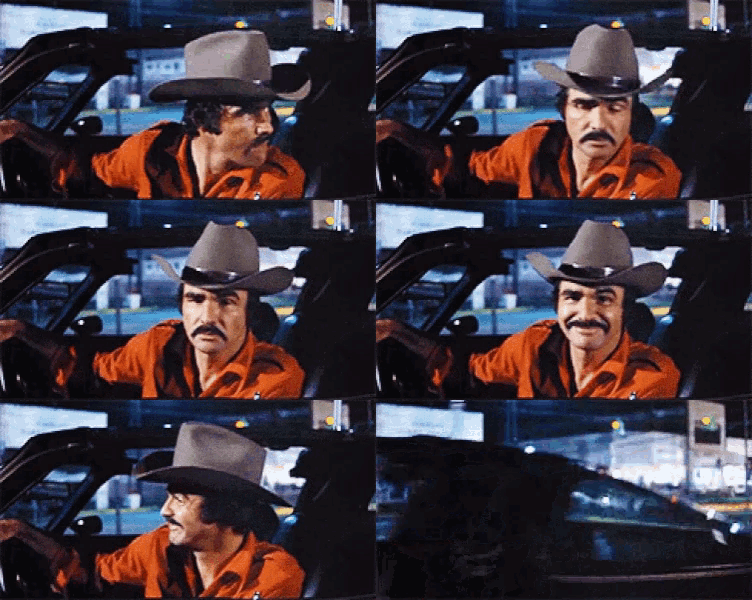
Burt Reynolds, the charismatic star of such films as Deliverance, The Longest Yard and Smokey and the Bandit who set out to have as much fun as possible on and off the screen — and wildly succeeded — has died. He was 82.
Reynolds, who received an Oscar nomination when he portrayed porn director Jack Horner in Paul Thomas Anderson’s Boogie Nights (1997) and was the No. 1 box-office attraction for a five-year stretch starting in the late 1970s, died Thursday morning at Jupiter Medical Center in Florida, his manager, Erik Kritzer, told The Hollywood Reporter.
Always with a wink, Reynolds shined in many action films (often doing his own stunts) and in such romantic comedies as Starting Over (1979) opposite Jill Clayburgh and Candice Bergen; The Best Little Whorehouse in Texas (1982) with Dolly Parton; Best Friends (1982) with Goldie Hawn; and, quite aptly, The Man Who Loved Women (1983) with Julie Andrews.
Though beloved by audiences for his brand of frivolous, good-ol’-boy fare, the playful Reynolds rarely was embraced by the critics. The first time he saw himself in Boogie Nights, he was so unhappy he fired his agent. (He went on to win a Golden Globe but lost out in the Oscar supporting actor race to Robin Williams for Good Will Hunting, a bitter disappointment for him.)
“I didn’t open myself to new writers or risky parts because I wasn’t interested in challenging myself as an actor. I was interested in having a good time,” Reynolds recalled in his 2015 memoir, But Enough About Me. “As a result, I missed a lot of opportunities to show I could play serious roles. By the time I finally woke up and tried to get it right, nobody would give me a chance.”
Still, Reynolds had nothing to apologize for. He was Hollywood’s top-grossing star every year from 1978 through 1982, equaling the longest stretch the business had seen since the days of Bing Crosby in the 1940s. In 1978, he had four movies playing in theaters at the same time.
Reynolds’ career also is marked by the movies he didn’t make. Harrison Ford, Jack Nicholson and Bruce Willis surely were grateful after he turned down the roles of Han Solo, retired astronaut Garrett Breedlove and cop John McClane in Star Wars, Terms of Endearment and Die Hard, respectively. He often said that passing on James L. Brooks’ Endearment was one of his worst career mistakes. (Nicholson won an Oscar for playing Breedlove.)
Reynolds also indicated he was Milos Forman’s first choice to play R.P. McMurphy (another Nicholson Oscar-winning turn) in One Flew Over the Cuckoo’s Nest, “backed away” from playing Batman on TV in the 1960s and declined the part made famous by Richard Gere in Pretty Woman.
In John Boorman’s Deliverance (1972), based on a book by James Dickey, Reynolds starred as macho survivalist Lewis Medlock, one of four guys from Atlanta who head to the wilderness for the weekend. Filmed by Vilmos Zsigmond along the Chattooga River near the Georgia-South Carolina border, it was an arduous production that Boorman shot in sequence.
“When I asked John why, he said, ‘In case one of you drowns,’” Reynolds wrote.
He had good reason. When Reynolds saw test footage of a dummy in a canoe going over the falls in one scene, he told Boorman the scene looked fake. He climbed into the canoe, was sent crashing into the rocks and ended up in the hospital. “I asked [Boorman] how [the new footage] looked, and he said, ‘Like a dummy going over the falls,’” Reynolds wrote.
Deliverance, infamous for its uncut 10-minute hillbilly male rape scene (“squeal like a pig”), was nominated for three Academy Awards but came away empty. It lost out to The Godfather in the best picture battle.
“If I had to put only one of my movies in a time capsule, it would be Deliverance,” Reynolds wrote. “I don’t know if it’s the best acting I’ve done, but it’s the best movie I’ve ever been in. It proved I could act, not only to the public but me.”
Three months before the movie opened, Reynolds — once described by journalist Scott Tobias as the “standard of hirsute masculinity” — showed off his mustache and other assets when he posed nude on a bearskin rug for a Cosmopolitan centerfold in April 1972. (Seven years later, he would become the rare man to grace the cover of Playboy.)
The Cosmo issue sold an outlandish 1.5 million copies. “It’s been called one of the greatest publicity stunts of all time, but it was one of the biggest mistakes I’ve ever made,” he wrote, “and I’m convinced it cost Deliverance the recognition it deserved.”
A running back in high school and college who talked with legendary coach Bear Bryant about attending Alabama, Reynolds put his gridiron skills to use in Robert Aldrich’s The Longest Yard (1974), playing Paul “Wrecking” Crewe, who leads his rag-tag team of prison inmates in a game against the guards. He later starred in Semi-Tough (1977), another football film.
Smokey and the Bandit (1977), written and directed by his pal, the legendary stuntman Hal Needham, grossed $126 million (that’s $508 million today, and only Star Wars took in more that year). Reynolds, who stars as Bo “Bandit” Darville, hired to transport 400 cases of Coors from Texas to Atlanta in 28 hours, noted that, unbelievable as it sounds, Smokey was Alfred Hitchcock’s favorite movie.
Reynolds drives a sleek Pontiac Trans-Am in the film, and after the picture opened, sales of the model soared. (His black car is mentioned in Bruce Springsteen’s “Cadillac Ranch,” and the Tampa Bay Bandits, a U.S. Football League team in which he had an ownership stake, were named for the movie.)
Smokey spawned two sequels, and Reynolds went on to work again with Needham in The Cannonball Run (1981), another fun-filled action film that spawned another franchise. His other high-octane films included Sharky’s Machine (1981) and two movies as ex-con Gator McClusky.
In Smokey, Reynolds starred alongside Sally Field, and the two were an item for some time. He also had relationships with the likes of Dinah Shore (20 years his senior), Inger Stevens and Chris Evert, and he talked about dating Hawn and Farrah Fawcett in his book.
Reynolds was married to British actress Judy Carne (famous for NBC’s Rowan & Martin’s Laugh-In) from 1963-66 and then to Loni Anderson, the voluptuous blonde best known for the CBS sitcom WKRP in Cincinnati, from 1988-93. Both marriages were tempestuous, and his divorce with Anderson was particularly messy.
After a string of big-screen failures and the cancellation of his ABC private detective series B.L. Stryker, Reynolds rejuvenated his career by starring in the 1990-94 CBS sitcom Evening Shade, created by Harry Thomason and Linda Bloodworth-Thomason.
He won an Emmy Award in 1991 for best actor in a comedy series for playing Woodrow “Wood” Newton, a former Pittsburgh Steelers quarterback who returns to his small-town home in Arkansas to coach a woeful high school team.
Burton Milo Reynolds Jr. was born on Feb. 11, 1936, in Waycross, Georgia, and raised in Florida’s Palm Beach County. His father was an Army veteran who became the police chief in Riviera Beach, Florida, not too far from the Everglades.
“My dad was my hero, but he never acknowledged any of my achievements,” he wrote in his memoir. “I always felt that no amount of success would make me a man in his eyes.”
Then known as Buddy Reynolds, he played halfback at Palm Beach High School, where his teammate was future New York Yankees manager Dick Howser, then suited up at Florida State, where Lee Corso, later a college coach and ESPN analyst, played on both sides of the ball. But he suffered a knee injury as a sophomore, and that was it for football and Florida State.
Reynolds enrolled at Palm Beach Junior College and appeared in a production of Outward Bound, playing the part handled by John Garfield in the 1944 film adaptation, Between Two Worlds. That led to a scholarship and a summer-stock stint at the Hyde Park Playhouse in New York. He roomed with another aspiring actor, Rip Torn, and they studied at the Actors Studio.
After a few appearances on Broadway and on television, Reynolds was off to Hollywood, where he signed with Universal and manned the wheel as Ben Frazer on Riverboat, an NBC Western that starred Darren McGavin.
He met Needham on that show, and the stuntman would double for him on projects through the years. Reynolds is referenced in “The Unknown Stuntman,” the theme song from the 1980s ABC series The Fall Guy, and he played an aging stuntman in Needham’s second film, Hooper (1978).
Reynolds joined Gunsmoke for its eighth season in 1962 as Quint Asper, a half-Comanche who becomes the Dodge City blacksmith. He played the title warrior in the 1966 spaghetti Western Navajo Joe, was an Iroquois who worked as a New York City detective in the short-lived ABC series Hawk and portrayed a Mexican revolutionary in 100 Rifles (1969).
Reynolds got another shot at toplining his own ABC show, playing homicide detective Dan August in a 1970-71 Quinn Martin production, but the series was axed after a season.
Reynolds appeared often on NBC’s The Tonight Show, and in 1972 he became the first non-comedian to sit in for Johnny Carson as guest host (Reynolds’ first guest that night was his ex-wife, Carne; they hadn’t spoken in six years, and she made a crack about his older girlfriend Shore). He and Carson once engaged in a wild and improvised whipped-cream fight during a taping, and he got to show a side of him the public never knew.
“Before I met Johnny, I’d played a bunch of angry guys in a series of forgettable action movies, and people didn’t know I had a sense of humor,” he wrote. “My appearances on The Tonight Show changed that. My public image went from a constipated actor who never took a chance to a cocky, wisecracking character.”
Reynolds showed that lighter side when he played a sperm in Woody Allen’s Everything You Always Wanted to Know About Sex (1972), and he lampooned his lavish Hollywood lifestyle in Mel Brooks’ Silent Movie (1976). He was not above making fun of himself and his toupee.
In 1979, he opened the Burt Reynolds Dinner Theatre in Jupiter and in the 1980s, he developed the syndicated game show Win, Lose or Draw with host Bert Convy. The set was modeled after his living room.
With his divorce from Anderson and bad restaurant investments contributing to more than $10 million in debts, Reynolds filed for Chapter 11 bankruptcy protection in 1996 and came out of it two years later. In recent years, he sold properties in Florida, including his fabled 160-acre ranch — The Allman Brothers recorded an album there in the 1990s — and auctioned off personal belongings.
Survivors include his son, Quinton; he and Anderson adopted him when he was 3 days old.
Despite the ups and downs of a Hollywood life, Reynolds seemed to have no regrets.
“I always wanted to experience everything and go down swinging,” he wrote in the final paragraph of his memoir. “Well, so far, so good. I know I’m old, but I feel young. And there’s one thing they can never take away: Nobody had more fun than I did.”
-
After the New York Times committed a flagrant act of … something by publishing this anonymity by a claimed member of the Trump administration, everyone wants to know, and is now speculating upon, the identity of the writer.
Jim Geraghty says:
We can draw a few conclusions about the anonymous senior official in the Trump administration who wrote the New York Times op-ed about the “stable state” “resistance” within the executive branch.
The writer is a traditional Republican, referring to “ideals long espoused by conservatives: free minds, free markets and free people.”
The writer is particularly informed about, and concerned about, the president’s views on Russia:
On Russia, for instance, the president was reluctant to expel so many of Mr. Putin’s spies as punishment for the poisoning of a former Russian spy in Britain. He complained for weeks about senior staff members letting him get boxed into further confrontation with Russia, and he expressed frustration that the United States continued to impose sanctions on the country for its malign behavior. But his national security team knew better — such actions had to be taken, to hold Moscow accountable.
The writer looked up to John McCain: “Senator John McCain put it best in his farewell letter. All Americans should heed his words and break free of the tribalism trap, with the high aim of uniting through our shared values and love of this great nation. We may no longer have Senator McCain. But we will always have his example — a lodestar for restoring honor to public life and our national dialogue.” The writer may well have been compelled to write this op-ed after McCain’s passing and the eulogies and reaction at his memorial service.
The writer did not work on the campaign — obviously, he holds Trump in low regard — but he’s probably been around the administration a while: “Given the instability many witnessed, there were early whispers within the cabinet of invoking the 25th Amendment, which would start a complex process for removing the president.”
The writer must understand that being uncovered would end his career in GOP politics and torpedo any hopes of running for the Republican nomination someday. This is probably the last stop of his career. He probably considers himself to be part of a knowledgeable bipartisan consensus policy establishment and is worried about how his current work for Trump is perceived and will be remembered. This person is probably worried about his reputation and whether or not working for Trump will tarnish his legacy.
Traditional Republican, focused on Russia, inspired by McCain, been around a while, no future ambitions, part of the establishment. There is more than one figure in the administration who fits these criteria, but not many.
But I notice the recent article, “Aside from his father, Huntsman Jr. had ‘no greater mentor’ than McCain,” August 27, in the Desert News:
“Aside from my own dad, there’s been no one more impactful in my life,” [U.S. Ambassador to Russia] Jon Huntsman told the Deseret News from Moscow after initially declining to comment on his relationship with the Arizona senator, who died Saturday after battling brain cancer.
“It was the highest honor to associate with him. He was a mentor in many ways. Country first and bipartisanship were deeply ingrained due to his influence,” Huntsman said of his longtime friend.
Huntsman attended John McCain’s memorial service at the Washington National Cathedral. And Huntsman has already addressed calls for him to resign after Trump’s summit with Putin.
Huntsman responded:
Representatives of our foreign service, civil service, military and intelligence services have neither the time nor inclination to obsess over politics, though the issues of the day are felt by all. Their focus is on the work that needs to be done to stabilize the most dangerous relationship in the world, one that encompasses nuclear weapons, fighting terrorism, stopping bloodshed in Ukraine, and seeking a settlement of the seemingly intractable Syrian crisis. Their dedication to service to their country is above politics, and it inspires me to the core. It is my standard. (Emphasis added.)
I have taken an unscientific survey among my colleagues, whom you reference, about whether I should resign. The laughter told me everything I needed to know. It also underscores the fragile nature of this moment.
The unnamed official who wrote the New York Times op-ed concludes, “There is a quiet resistance within the administration of people choosing to put country first.”
Just a theory.
The mystery writer of The New York Times op-ed that claims to be a member of the “Trump Resistance” while serving as a “senior official” in the administration has sparked a lot of speculation as to who it might be. One popular theory: Vice President Mike Pence.
The theory, which Pence’s office has adamantly denied, stems from the presence of one word in the piece that Mike Pence frequently uses, a word not in common use. Step aside “Rosebud,” the mystery word of today is “lodestar.”
According to Merriam-Webster, lodestar refers to “a star that leads or guides” or a person who “serves as an inspiration, model, or guide.” The mystery writer uses the word at one point in reference to the late Sen. John McCain, calling him “a lodestar for restoring honor to public life and our national dialogue.”
Vice President Mike Pence, apparently, has a penchant for the word. …
Another explanation for the use of the word “lodestar” could be that the mystery writer wanted to throw off people’s scents and make Mike Pence a suspect, a pretty low thing to do in a narcissistic stunt.
In a statement on Thursday, the Vice President’s office denied the charge and agreed with Trump that the mystery writer is “gutless.”
I wrote yesterday wondering about the Times’ motivation given that the Times has opposed every Trump policy since he was elected, when the writer does not oppose Trump policy, but believes Trump is too unstable to be president. If you were Deep Trump, and you believed Trump shouldn’t be president but Trump’s policies should continue, would you do the seemingly principled thing and loudly resign, or would you stay in, hope Trump left the White House, but seek to continue working with President Peice? Of course Shapiro’s theory makes that unlikely if Deep Trump did throw out “lodestar” to cast suspicion on the writer’s potential future boss.
The New York Post reports:
Vice President Mike Pence – and “the field” – lead offshore bookmaking picks as the White House mole behind the anonymous bombshell New York Times op-ed blasting President Trump.
Pence was listed at 2-to-3 odds on the site MyBookie as the fifth column official who claims to be working behind the scenes to stop some of Trump’s policies that they find wrongheaded.
The biggest favorite, at 1-3 odds, is “the field,” someone not listed among the 18 administration officials listed by the Costa Rica-based operation.
At 2-to-3 odds, a winning bettor investing $1 would profit 66 cents. At 1-to-3, a gambler wagering $1 would net 33 cents with a win.
“What tipped us off was ‘lodestar,’ “ MyBookie head oddsmaker David Strauss said of Pence. “When you search members of the administration (who have used that word) only one name comes up – and that name is Mike Pence. He’s used in multiple speeches this year.”
The other 17 named potential moles, listed by MyBookie, are: Education Secretary Betsy Devos (2-to-1), Secretary of State Mike Pompeo (4-to-1), Treasury Secretary Steven Mnuchin (4-to-1), chief of staff John F. Kelly (4-to-1), Defense Secretary Jim Mattis (5-to-1), Attorney General Jeff Sessions (5-to-1), Interior Secretary Ryan Zinke (6-to-1), Agriculture Secretary Sonny Perdue (6-to-1), Commerce Secretary Wilbur Ross (7-to-1) Labor Secretary Alex Acosta (7-to-1), HHS Secretary Alex Azar (8-to-1), HUD Secretary Ben Carson (8-to-1), VA Secretary Robert Wilkie (8-to-1), Homeland Security Secretary Kirstjen Nielsen (10-to-1), Ivanka Trump (12-to-1) and Jared Kushner (12-to-1).
Hours after MyBookie posted numbers, Canada-based Bovada issued its own Trump-leak odds and listed embatted AG Sessions as its favorite at 5-to-2.
He was followed by Pence (3-to-1), Kelly (4-to-1), Mattis (4-to-1), UN Ambassador Nikki Haley (10-to-1), “Javanka” (15-to-1), Director of National Intelligence Dan Coats (15-to-1), White House counsel Don McGahn (15-to-1), Melania Trump (50-to-1) and White House counselor Kellyanne Conway (50-to-1).
Bovada listed President Trump, himself, as the potential mole and Times writer at 25-to-1.
As for the last sentence: Readers my age or thereabouts might remember the original TV series “Dallas” and the worldwide speculation over who shot J.R. Ewing in a season-ending cliffhanger episode.
After the next-season opener revealed J.R.’s shooter, another show revealed that the producers had filmed several characters shooting J.R. so the cast wouldn’t know who actually shot J.R. until the next season, including actual shooter Kristin Shepherd, brother-in-law and archrival Cliff Barnes, J.R.’s wife Sue Ellen, and even J.R.’s father Jock and mother Miss Ellie.
And one more:
-
First, USA Today last Thursday:
A California man was arrested and charged Thursday with making violent threats to Boston Globe employees, calling the newspaper the “enemy of the people,” the U.S. Attorney’s office for Massachusetts said.
Robert D. Chain, 68, of Encino, California, was charged with one count of making threatening communications in interstate commerce, which carries a maximum sentence of five years in prison. He is scheduled to appear in federal court in Los Angeles Thursday and be transferred to Boston at a future time.
Court documents say Chain made about 14 threatening calls between Aug. 10-22, in reaction to the Globe’s efforts to organize a coordinated response from newspapers across the country to President Trump’s repeated attacks on the media.
In those calls, Chain allegedly referred to the Globe as “the enemy of the people’’ and threatened to kill its employees. Trump has often used that phrase in lambasting the news media.
According to the criminal complaint, the caller said, “As long as you keep attacking the President, the duly elected President of the United States, in the continuation of your treasonous and seditious acts, I will continue to threats, harass, and annoy the Boston Globe, owned by the New York Times, the other fake news.”
The Globe said more than 400 news outlets joined the coordinated campaign, including the New York Times, Dallas Morning News, Chicago Sun-Times, Philadelphia Inquirer and Denver Post, writing editorials in support of freedom of the press and decrying Trump’s references to the press as “fake news.’’
For the Wisconsin version of those opinion pieces, click here, then read this blog.
The day the mass editorials published on Aug. 16, authorities say Chain called the Globe’s newsroom and threatened to shoot its employees in the head “later today, at 4 o’clock.’’ Boston police responded by stationing personnel outside the Globe’s offices.
“Everyone has a right to express their opinion, but threatening to kill people takes it over the line and will not be tolerated,” Harold H. Shaw, Special Agent in Charge of the FBI’s Boston Division, said in a statement. “Today’s arrest of Robert Chain should serve a warning to others, that making threats is not a prank, it’s a federal crime.’’ …
Trump’s condemnations of the press have become a common part of his speeches and rallies, and at some of them his supporters have directed invectives and obscene gestures at the media section.
In announcing Thursday’s arrest, U.S. Attorney Andrew Lelling said, “In a time of increasing political polarization, and amid the increasing incidence of mass shootings, members of the public must police their own political rhetoric. Or we will.”
Next, Patrick Poole:
A man rammed his truck into the studios of Dallas Fox affiliate KDFW earlier this morning, just two days after Meet the Press host Chuck Todd published an article calling on his media colleagues to “start fighting back” against Fox News.
KDFW reports on the incident targeting their offices:A man was arrested Wednesday morning after crashing a truck into the side of the FOX4 building in downtown Dallas.
The man, after repeatedly crashing his vehicle into a side of the building with floor to ceiling windows, got out of his vehicle and began ranting.FOX4 photojournalists were able to film him placing numerous boxes next to a sidedoor filled with stacks of paper. The papers were also strewn across the sidewalk and street adjacent to the building.The man ranted about “high treason” and also mentioned a sheriff’s department.
The Dallas police bomb squad was dispatched to investigate a bag the man had left at the scene.
KDFW reports that all personnel were inside the building at the time, and no one from the station was injured.
This car ramming attack comes just after NBC host Chuck Todd published an articleon Monday at The Atlantic calling for others to “start fighting back” against Fox News.
According to Todd, Fox News is the face of a 50-year vilification campaign targeting corporate media.
Of course, his corporate media colleagues all dutifully jumped on the anti-Fox News bandwagon in support of Todd’s call.
Now that someone may have responded to their collective call to “start fighting back” against Fox News, it remains to be seen if the establishment corporate media will tone down their open incitement targeting Fox News and supporters of President Trump.
Yeah, well, don’t hold your breath on that one. Todd appears to have forgotten that Fox is a corporation too, which means by his definition one part of the corporate media has been waging a 50-year war against the rest of the corporate media.
Some people on social media tried to claim that Trump’s rhetoric caused the attack on the TV station. I am untrained in psychiatry, so who knows the motivations of the guy who tried to turn a TV station into a drive-in. (Which happened an employer of mine 90 minutes into my first day there, without the ranting. For that matter, as readers know I’ve fielded various threats since college.)
At this point, though, it’s a race to see what’s going to happen next — assassinations or bigger mass murders than what happened at the Annapolis (Md.) Capital.
-
For readers unfamiliar with Watergate: The headline is a reference to the anonymous source who fed the Washington Post information about the 1972 break-in at the Democratic Party headquarters at the Watergate Hotel in Washington. (From which came every reference to a scandal as ______gate, and every anonymous source tied to said _____gate as Deep _____.)
Now, the New York Times:
The Times today is taking the rare step of publishing an anonymous Op-Ed essay. We have done so at the request of the author, a senior official in the Trump administration whose identity is known to us and whose job would be jeopardized by its disclosure. We believe publishing this essay anonymously is the only way to deliver an important perspective to our readers. We invite you to submit a question about the essay or our vetting process here.
President Trump is facing a test to his presidency unlike any faced by a modern American leader.
It’s not just that the special counsel looms large. Or that the country is bitterly divided over Mr. Trump’s leadership. Or even that his party might well lose the House to an opposition hellbent on his downfall.
The dilemma — which he does not fully grasp — is that many of the senior officials in his own administration are working diligently from within to frustrate parts of his agenda and his worst inclinations.
I would know. I am one of them.
To be clear, ours is not the popular “resistance” of the left. We want the administration to succeed and think that many of its policies have already made America safer and more prosperous.
But we believe our first duty is to this country, and the president continues to act in a manner that is detrimental to the health of our republic.
That is why many Trump appointees have vowed to do what we can to preserve our democratic institutions while thwarting Mr. Trump’s more misguided impulses until he is out of office.
-
Bob Woodward is preparing to release the latest book describing a chaotic Trump White House led by an unhinged ignoramus. Also in the news today, the manufacturing revival promised by the alleged ignoramus is in full swing.
As is his custom, Mr. Woodward includes in his new book a great deal of material from anonymous sources. The result, according to his colleagues at the Washington Post, is a “a harrowing portrait of the Trump presidency.” The Post reports:
A central theme of the book is the stealthy machinations used by those in Trump’s inner sanctum to try to control his impulses and prevent disasters, both for the president personally and for the nation he was elected to lead.
Woodward describes “an administrative coup d’etat” and a “nervous breakdown” of the executive branch, with senior aides conspiring to pluck official papers from the president’s desk so he couldn’t see or sign them.
According to the book, the most senior of the President’s aides thinks the President is out of his mind:
White House Chief of Staff John F. Kelly frequently lost his temper and told colleagues that he thought the president was “unhinged,” Woodward writes. In one small group meeting, Kelly said of Trump: “He’s an idiot. It’s pointless to try to convince him of anything. He’s gone off the rails. We’re in Crazytown. I don’t even know why any of us are here. This is the worst job I’ve ever had.”
This afternoon, the White House released a statement from General Kelly that referenced a similar report from NBC in May:
The idea I ever called the President an idiot is not true. As I stated back in May and still firmly stand behind: “I spend more time with the President than anyone else, and we have an incredibly candid and strong relationship. He always knows where I stand, and he and I both know this story is total BS. I’m committed to the President, his agenda, and our country. This is another pathetic attempt to smear people close to President Trump and distract from the administration’s many successes.”
White House Press Secretary Sarah Sanders addressed the book more generally today as “nothing more than fabricated stories, many by former disgruntled employees, told to make the President look bad. While it is not always pretty, and rare that the press actually covers it, President Trump has broken through the bureaucratic process to deliver unprecedented successes for the American people. Sometimes it is unconventional, but he always gets results.”
The results are not always positive, but she does have a point. Today the Journal reports on what’s been happening outside of Washington:
American factory activity in August expanded at the strongest pace in more than 14 years, despite rising tensions with some of the U.S.’s largest trade partners.
The Institute for Supply Management on Tuesday said its manufacturing index rose to 61.3 in August, the highest level since May 2004, from 58.1 in July. Sales of factory-made products, or new orders, output and employment all grew at a faster pace in August.
Based on this bullish manufacturing report and another pleasant surprise today in the Census Bureau’s report on construction spending, the Federal Reserve Bank of Atlanta raised its estimate of economic growth in the third quarter to a sizzling 4.7%.
One might conclude that allowing the economy to grow by reducing the burden of taxes and regulation is so simple that even an unhinged ignoramus can do it. Yet many seemingly sane and knowledgable politicians have proven unable to grasp the concept.
 Steve Prestegard.com: The Presteblog