National Rifle Association president David Keene has a surprising statement for those who do not know American history:
“You know, when you go back in our history … the initial wave of [gun-control laws] was instituted after the Civil War to deny blacks the ability to defend themselves,” Keene said.
“It’s the reason, for example, that Condoleezza Rice says, as far as the Second Amendment is concerned, ‘I’m an absolutist.’ Because she remembers her house being surrounded by neighbors with firearms to protect them from a white mob back during the worst days of the civil rights struggle.” …
“Guns are tools,” Keene continued. “Guns are something that can be used for good or for ill. It’s our contention in this country that history shows that in most instances, guns are used for good — to protect people and families.”
Those same people ignorant of history do not know that the groups who went through the South to get blacks the right to vote that the U.S. Constitution guaranteed them were usually armed. They had to be. The Ku Klux Klan was armed, after all.
Five o’clock having arrived on Inauguration Day, Fox News Business brings us a prospective list of presidential mixed drinks:
The Willard InterContinental Washington’s Round Robin Bar is serving up cocktails fit for a commander in chief. In addition to their inauguration-inspired specialty drinks, the bar has a drink named after and honoring each leader of the United States — based on research of their drink of choice.
Round Robin bartender and history buff Jim Hewes, who has been at the Willard since 1986, has crafted an impressive menu that goes from the George Washington (Madeira wine) to the Barack Obama (a tequila with blue curacao and fresh lime juice). …
If he couldn’t nail down how a president whet his whistle while in office, Hewes says he considered the tastes of the times, what was socially acceptable and what was available during that era when creating the drink.
“They drank socially all day long,” Hewes says of the presidents.
I do not know if Obama drinks the drink named for himself. (He is apparently a tequila drinker at least.) If he does drink that drink, that demonstrates his gross lack of judgment and misjudgment that is his (mis)administration. Blue drinks? That’s something you should stop drinking when you leave college.
As for Obama’s predecessors, here are the drinks named for the presidents of my lifetime, plus one:
42. William J. Clinton – Tanqueray Gin and Tonic: A standard on the Washington cocktail circuit
41. George H. Bush – Absolut Vodka Martini: Always politically correct, with or without garnish.
40. Ronald Reagan – California Sparkling Wine: Introduced to Washingtonians at his first Inaugural
39. Jimmy Carter – Alcohol Free White Wine: served, much to the dismay of the fourth estate, throughout his four years in the White House.
38. Gerald R. Ford – Glenfiddich Whisky, over ice, served in the spirit of bipartisanship. Gerry also favored Budweiser “longnecks” in the bottle
37. Richard M. Nixon – Bacardi Rum and Coke: Dick would relish mixing and stirring, for his guests aboard the presidential yacht Sequoia.
36. Lyndon B. Johnson – Cutty Sark and Branch Water: A post war favorite of “Cactus Jack” Garner and Sam Rayburns’ most famous protégé.
35. John F. Kennedy – Beefeater Martini up with olives served regally in the White House to those in the good graces of America’s “Camelot”.
Clinton drinks Tanqueray? One more of the few points in his favor. (Another: His old El Camino.) Ford is assigned whiskey, but a book chronicling his post-White House years listed him as a gin and tonic drinker.
This is no one’s idea of an adult drink, but PT 109, the book about Kennedy in the World War II Navy, lists South Pacific sailors’ drink of availability as pineapple juice and distilled torpedo fluid.
Before JFK …
33. Harry S. Truman – Maker’s Mark and Soda: An aficionado of Kentucky’s finest, both he and Bess enjoyed this long-drink while playing poker at the White House.
32. Franklin D. Roosevelt – Plymouth Gin Martini: “oh… so cool, so clean, so awfully civilized!” Often scolded by Eleanor for his penchant for the highball, this elegant elixir was served at the most important political party in D.C. — the cocktail party.
So FDR and I have two things in common — gin-drinking and (once upon a time in my case) being our Episcopal church’s senior warden, which FDR was while president.
30. Herbert Hoover – Long Island Iced Tea: Prohibition conscious imbibers relished this enticing tall drink, which contained everything on the bar except “the kitchen sink.”
A Long Island Ice Tea — rum, gin, vodka, triple sec, sour mixer and cola in Wisconsin college towns — doesn’t seem very presidential, does it? Drink enough of them, though, and you’ll forget what the economy’s doing.
28. Warren G. Harding – Seven and Seven: Popular highball among the “Ohio Gang” especially when served at Speaker “Nicky” Longworth’s poker games. …
26. Theodore Roosevelt – Ward 8: Politically-charged concoction, brought to D.C. by “Big Stick” Republicans from New York.
Supposedly, however, the Ward 8 — whiskey, lemon juice, orange juice and grenadine — was invented not in Noo Yawk, but in Bahstan. And it seems to me that TR should be associated with something from Cuba — say, a Cuba Libre. Roosevelt also once claimed “I have never drunk a cocktail or a highball in my life,” admitting only to drinking white wine, whiskey or brandy “under the advice of a physician,” and very occasionally mint juleps.
25. William McKinley – Gin Rickey: Lime infused long drink made popular at the Chicago Exposition.
24. Grover Cleveland – Sazarac Cocktail: New Orleans sensation, which swept the nation in the 1880’s.
A Sazarac, by the way, is rye whiskey, bitters, a sugar cube or simple syrup, and absinthe. This apparently was before N’awlins bars invented the Hurricane.
23. Benjamin Harrison – Ramos Gin Fizz: Popularized a block from the White House after construction of the first ‘soda fountain’ at the Willard Hotel. …
A Ramos Gin Fizz is gin, lemon juice, lime juice, an egg white, sugar, cream, orange flower water and soda water. Apparently you can’t drink more than one or two because it takes so long to make. Also apparently raw egg whites were more popular in Harrison’s day than now.
19. Rutherford B. Hayes – Orange Blossum: Washington’s pressmen spiked the oranges with gin
at the tea totalling Hayes inaugural in 1877.
18. Ulysses S. Grant – Roman Punch: It was so cold in D.C. that this fruit and Champagne refresher froze solid in the bowl.
The drink froze? Not enough alcohol, U.S.
17. Andrew Johnson – Brandy Toddy: Johnson relied on this potion to cure “various, vicarious, vapors” known to afflict residents of 1600 Pennsylvania Avenue.
16. Abraham Lincoln – Apple Cider: Although known to have acquired a taste for corn whiskey in his earlier years, fresh pressed apple juice would revive his constitution. …
10. John Tyler – Southern Style Mint Julep: Henry Clay mentored our 10th Chief Executive in the fine art of building this compromisingly elegant elixir. …
7. Andrew Jackson – Rye Whiskey straight: A two- finger pour of Tennessee’s Democratic, frontier finest.
6. John Quincy Adams – Hot Buttered Rum: a New England toddy with the spiced flavor of the West Indies.
5. James Monroe – Sherry Cobbler: This cool long drink is often called America’s first cocktail, popularized during the Revolution. …
2. John Adams – Bitter Sling Cocktail: made with a mix of rum and brandy, two of New England’s finest distilled products.
This list is interesting because a number of these drinks are a bit effete by the standards of (1) alcohol and (2) water or soda.
Three presidents were known to be teetotalers — Hayes (but the press fixed that for inauguration), Calvin Coolidge (for whom cranberry juice and soda was listed) and George W. Bush (a Diet Pepsi drinker). Carter supposedly wasn’t a teetotaler; perhaps he decided to stick it to the media by serving non-alcoholic wine.
How do we know there has never been a president from Wisconsin? Because the brandy old fashioned sweet is nowhere on this list. I have never ordered one outside of Wisconsin, and I never will, because I assume no bartender outside the state line is able to make one.
Seeing as how the seventh-generation Corvette will make its world debut Sunday, this seems appropriate, from Corvette Online:
Corvettes have always been something to be admired, as they’re generally driven by people who are in a certain position in life. Usually the discerning Corvette owner is someone who appreciates performance, good looks, and sex appeal, and they’re almost always at a position in life where they actually have the cash required to own a Corvette. That means that most Vettes are not driven by kids in their teens, or even by a lot of people still in their 20′s. Corvettes are driven by successful people. People who have taken risks, and won. People that have made it.
With all of that being said, it should come as no surprise to you that the car of choice by astronauts in the 1960′s was (drumroll please) none other than the Corvette. Astronauts were men that were front and center in the public eye and were symbols of bravery, risk taking, and all out coolness. They hadmade it. They were bigger than rock stars in the United States, at least for a time, and General Motors waned to make sure that the world saw them driving the fastest, coolest, bravest car around, the Corvette.
The program started with the first U.S. astronaut to escape (briefly) Earth orbit, Alan Shepard:
GM saw both a service and a marketing opportunity with the astronauts’ fame. GM President Ed Cole gave Alan Shepard, the first American in space, a 1962 Corvette as a gift for his service to his country, though it was not in character for GM to give away cars; not even to astronauts. According to Dollie Cole, Ed Cole’s widow, the gift made perfect sense, despite GM’s normal tendency to avoid things like that. “The astronauts were incredibly visible,” she recalled in an interview recently re-published on VetteWeb.com. “And good publicity is good publicity.”
She felt the Corvettes were more than a publicity stunt, but were actually a gift of appreciation. “Who more worthy than guys who represent our country?” Dollie declares. “They were literally risking their lives. Space travel today isn’t ‘ho hum’, but people perceive it that way. There were so many unknowns then. The cars were a way of saying ‘Thank you.’”
Aside from Shepard, no astronaut was given a Corvette from GM, and for one big reason that had nothing to do with GM policy; it turned out that astronauts were not allowed to take gifts or do endorsements. That being said, they could lease cars at exceptional rates and thus the $1 astronaut lease program was born.
I met Scott Carpenter when he gave a speech at UW–Platteville in the late 1980s. I wish I’d known about the Corvette thing then. (The $1 rental thing is probably the only way I could ever afford a Corvette.)
Carpenter’s fellow Mercury astronaut, Virgil “Gus” Grissom, decided his $1 Vette needed a little work:
It turned out that the Corvette was the perfect car for space jockeys with a flair for speed, danger, and competition. Gus Grissom, the second American in space, loved his Corvette’s dearly, but hated losing drag races to his fellow astronauts. In the fall of 1966 both he and fellow astronaut Alan Shepard, the first American in space, took delivery of identical brand new 1967 427/435 horsepower Corvette Roadsters. Grissom hated losing races to Shepard so he asked Jim Rathmann, owner of Jim Rathmann Chevrolet/Cadillac in Melbourne, FL to help him with his new Corvette. According to gusgrissomcorvette.com, Rathmann obliged and ever-so-slightly widened the rear wheel openings to allow room for bigger tires and put in a 4:56 posi rear end. Grissom won nearly every race against Shepard as a result, and we have no idea if Alan Shepard ever knew of the modifications!
As Mercury became Gemini and then Apollo, the program continued:
It seemed that all astronauts had a Corvette somewhere in the mix. Neil Armstrong, the first man on the moon, had a Corvette. Jim Lovell, the Commander of the ill-fated Apollo 13 mission, had a Corvette. But perhaps the most interest Astronaut/Corvette story came with the crew of Apollo 12, because they acquired matching Corvettes! Apollo 12 launched for the moon on November 14, 1969 and it’s members were Mission Commander Pete Conrad, Lunar Module Pilot, Al Bean, and Command Module Pilot Dick Gordon. The three were close knit and remained friends even after their NASA days.
The idea of matching cars was unique to the Apollo 12 crew as no other Apollo team did it, despite the fact that it was common for them to be driving a Corvette. In the aforementioned interview, Al Bean recalled the situation. “We liked the idea. It was a way to be a team and build esprit de corps. We all talked about it, and the first couple of ideas didn’t work.” The Corvettes that the astronauts chose were a trio of identical Riverside Gold ’69 coupes. Each was equipped with the stock 427 CI/390HP engine, had Head Restraints (RPO A82), 4-Season Air Conditioning (RPO C60), Special Wheel Covers (RPO PO2), and the AM/FM Pushbutton Radio (RPO U69).
The story doesn’t say, but one assumes they were all correctly equipped with four-speed manual transmissions. And since the Apollo missions launched from Cape Canaveral in Florida, air conditioning was a wise choice.
I’m sure you’ll agree this blog requires visual aids:
Seeing the National Weather Service use the phrase “Life-threatening impacts” makes one think that exaggeration is a billion times worse than understatement.
As of Wednesday night, in our corner of southwest Wisconsin 14 to 18 inches of snow were predicted, along with winds of 20 to 30 mph and gusts to 40 mph. That is certainly something one would not choose to drive in, and, yes, if you got stranded in that weather — in, say, snow deep enough to cover the exhaust pipe of your car, or wind chills below zero that could be potentially life-threatening.
For the NWS to say that, though, invites people to assume hyperbole, similar to the tornado warnings without actual tornadoes. Last March, we in Wisconsin were on the northern end of a huge storm system that caused a two-day 70-tornado outbreak that killed 40 people farther to the south. What we did get? Several inches of wet, heavy snow. Less than two weeks later, our weather was almost summer-like. That’s Wisconsin for you, the state where the term “normal weather” is an oxymoron.
When you’re young, forecasts of snow lead to one question: Is school called off? (The answer here: Yes.) School was rarely called off in Madison — if I remember correctly, once for a day and a half in 1973, once due to an ice storm in 1976 (the same year as the Madison teachers’ strike, which wiped out two weeks of school), once in 1979 because our middle school had flat roofs of the same kind that caved in at my soon-to-be-alma mater, and once in high school, with a few early closings and late openings added. The cliché was that you’d listen to the radio in the morning and hear every area school district except Madison had closed for the day.
When I got to Grant County, school seemed to be called off all the time, with the added strange feature of no school, but that night’s sporting event still going on as scheduled. (They don’t do that anymore.) Obviously rural Wisconsin has more roads that take longer for snow to be removed, but the additional reason, a school district administrator told me, was the fear of lawsuits should school go on as scheduled and a school bus crash causes injuries or deaths.
My mother will tell anyone who asks about the day school was called off right after lunch and she intercepted me walking home in a blizzard. The worst storm I recall, however, wasn’t in Wisconsin; it was on our (attempted) trip to Florida in the middle of, yes, a blizzard. (Some people would take the early morning phone call from their neighbor the meteorologist as a hint to not go. Not us.) Things seemed fine until we got into Illinois and I saw, for the first time in my life, a whiteout — we couldn’t see past the hood of the car. We got to Chicago without hitting anything (despite having to get the car jump-started due to a battery problem unrelated to the weather — hint number two ignored by us), and decided to press on regardless, channeling our Viking ancestors.
We stopped channeling our Viking ancestors between Portage and Merrillville, Ind., because Interstate 65 in Indiana was worse than Interstate 90 in Illinois. A tractor–trailer materialized in front of us, and we decided where he was going, we were going. And that turned out to be a Phillips 66 truck stop, where we slept on the floor that night. The next day, we got to a hotel … back in Portage, because that morning an Indiana state police officer got on the PA system at the truck stop and announced that anyone who tried to go farther south would be arrested.
We did get to Florida a day late, where it was about 45 degrees at Disney World. The only reason we got to Disney World at all was that Dad decided to take the long way around — the Indiana Toll Road to South Bend, and two-lane U.S. 31 to Indianapolis, a long bypass around closed I–65.
The worst snow I’ve ever driven in was the fault of WFRV-TV (channel 5), where I was making appearances promoting Marketplace Magazine on WFRV’s First News program … at 6:15 a.m. My paranoia about missing my live shot usually meant I was out the door from Ripon around 4:30 a.m., making me a good half-hour early at the studio. One particular day, with a foot of snow predicted (and nearly every school district in WFRV’s viewing area closed for the day), I was out the door at 3:30 a.m., driving through a foot of unplowed snow between Ripon and Oshkosh, followed by weaving on 41 where only one lane at a time was open. Yes, I had my all-wheel-drive Subaru Outback, but an all-wheel-drive station wagon is not a four-wheel-drive pickup truck with a foot of ground clearance.
The irony is that if the Mayans are right, we don’t have to shovel this snowfall, because, you know, their predicted apocalypse is, depending on whom you believe, today, Friday or Saturday.
I’ve noted before here my skepticism about end-of-the-world predictions, using as my reference guide Matthew 24:36, Mark 13:32, and Acts 1:7, all of which say, quoting Mark, “But of that day and that hour knows no man, no not the angels which are in heaven, neither the Son, but the Father.”
The song at the beginning is the most obvious (at least for those from the ’80s), but not only apocalyptic-themed song; Ultimate Classic Rock suggests others:
In case the Mayans are wrong, A Brief History of the Apocalypse helpfully lists the next predicted ends of days, including the pope that follows Benedict XVI, 2017, 2020, 4,500,000, etc. (I particularly like Nov. 13, 2026, the day the Earth’s population will reach infinity, according to a 1960 Science magazine prediction.)
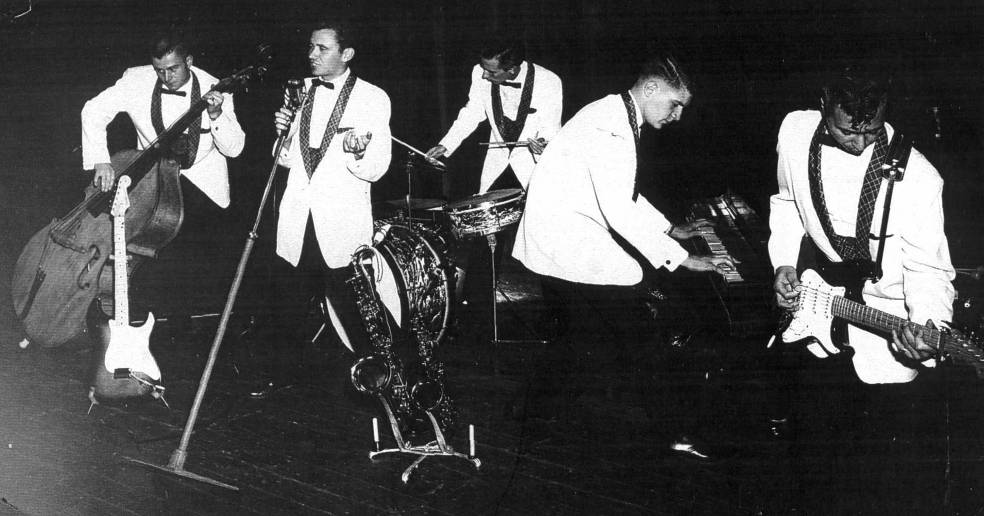
WRCO (100.9 FM) in Richland Center will be replaying part of a program on the first rock and roll band in southern Wisconsin Saturday from 6 to 8 p.m.
Southern Wisconsin’s first rock and roll band, as you know, is …
… first known as Vilas Craig and the Vicounts, then as the Kollege Kings, part of the richer-than-you-might-believe tapestry of Wisconsin-based rock music.
(The piano player has my body type but looks more like my brother. I look more like my mother’s side of the family.)
Forty-nine years ago at 12:30 p.m., John F. and Jacqueline Kennedy were riding in a motorcade in downtown Dallas.
At the same time, those watching a CBS-affiliate TV station (including probably my mother and grandmother) were watching this:
About seven minutes later, listeners to ABC radio stations heard this:
About three minutes after that, the aforementioned CBS viewers saw this:
Those listening to the biggest Top 40 station in Dallas had their listening to the Chiffons interrupted:
Those watching whatever their NBC-TV station was carrying around 12:45 heard this …
… while those watching WFAA-TV in Dallas at the same time saw this:
Those watching ABC-TV’s rerun of “Father Knows Best” saw this:
From then on, for the first time in history, all three TV networks presented wall-to-wall (or as close as possible; most TV stations went off the air after midnight) coverage of breaking news:
I have great interest in JFK’s assassination and coverage thereof for a couple of reasons. I went to John F. Kennedy School in Madison, so that may be part of it, in addition to my being a media geek.
Coverage of Kennedy’s assassination came a year after the Cuban Missile Crisis, which would have qualified for breaking news had the technology existed to bring live bulletins beyond someone sitting in front of a camera or microphone reading a script.
What is interesting from viewing the coverage is the quality of most of the TV coverage for an unprecedented (for TV) event. It was far from perfect (the ABC-TV coverage is particularly difficult to watch early on), but live remote reports were rare even when they could be set up in advance, let alone when they needed to be set up on the spur of the moment. NBC had its own problems getting a telephone report from Robert MacNeil (later of PBS’ MacNeil–Lehrer Report).
In comparison, the local radio coverage left something to be desired. Perhaps it’s because coverage standards have changed, but it blows my mind (pun not intended) that radio stations would report that the president had been shot in their own city, and then go back to their usual programming (music and, in one case, a Bible program). One reason is that radio news reporters were strewn all over the area to cover Kennedy’s several appearances in Fort Worth and Dallas. One station went between its own coverage and CBS radio coverage, while another went between its own coverage and NBC radio coverage, which also incorporated NBC TV coverage.
TV initially did the same thing. Imagine today watching, say, reports that a plane has crashed into the World Trade Center in New York, and then being asked to stay tuned for later bulletins. In the nearly five decades since today, viewers expect wall-to-wall coverage, whether or not actual news is broadcast or repeated endlessly intertwined with less-than-factually-based observation and speculation.
There were mistakes, because there are always mistakes in such coverage. Lyndon Johnson was reported to also have been shot and to have had a heart attack. (Imagine the panic that briefly created.) A Secret Service agent was reported to have died. (Oswald killed a Dallas police officer after shooting Kennedy.)
Since there was no such thing as a minicam and satellites weren’t in much use yet, there is no tape of the actual announcement from White House assistant press secretary Malcolm Kilduff:
Nearly everything (except for CBS-TV’s NFL games on Sunday, since, unlike the American Football League, the NFL did not cancel games Nov. 24, a decision NFL commissioner Pete Rozelle later regretted) was knocked off the air for the next four days. That included NBC’s “Bob Hope Chrysler Theatre” on Friday, CBS’ Jackie Gleason and “Gunsmoke” Saturday, and CBS’ Ed Sullivan and NBC’s “Bonanza” on Sunday.
One is struck on watching the coverage how Kennedy’s assassination emotionally affected those covering it in a way I doubt would be repeated in today’s cynical age:
From nearly 50 years later, some reporters and commentators sound as if they were in the tank for Kennedy — or, more accurate, Kennedy the image:
A rather clear-eyed, even cold commentary came from NBC’s Edwin Newman, a UW grad:
Had I been a columnist or commentator (who might have actually voted for Kennedy instead of Richard Nixon) in late November 1963, I might have peered through my glasses or newfangled contact lenses, puffed on my pipe, and typed out something like this:
On Monday, Americans will get to witness on television something most have never seen before, except possibly in a theater newsreel — a state funeral. This country’s last state funeral took place in 1945 upon the death of Franklin Roosevelt.
It was noted at the time of President Kennedy’s inauguration in 1961 that this country had an unprecedented number of living former presidents — Dwight Eisenhower, Kennedy’s predecessor; Harry Truman, Eisenhower’s predecessor; and Herbert Hoover, Franklin Roosevelt’s predecessor. It is one of many cruel ironies of this weekend that all three have outlived our youngest elected president.
Kennedy was not our youngest president; that was Theodore Roosevelt, who became president upon the assassination of William McKinley, the last president to have been assassinated before Friday. However, our youngest elected president is also the youngest to have died in office.
Those men who fought in and survived World War II will note the additional irony of one of their own, who had his PT boat cut in two and sunk by a Japanese destroyer 20 years ago, surviving that only to die of violence back in this country.
When you reach the age of President Kennedy, you start to notice when people of your own age show up in the obituary columns. Usually, their deaths are because of heart attacks or car accidents or cancer. President Kennedy projected youth, energy and vitality, thanks in large part to his family. Whether or not you voted for him, most men of President Kennedy’s age or with a young family identified with him much more than with any other president of our memory. And now, Mrs. Kennedy will have to raise their two young children by herself, a widow thanks to, according to the wire reports, a former Marine who left this country for the Soviet Union.
President Kennedy knew much tragedy in his short life. Two of his men on PT 109 were killed in the collision with the Japanese destroyer. His older brother, Joe, died during World War II. One sister, Kathleen, died in a plane crash. Another sister, Rosemary, is retarded and in a nursing home. Mr. and Mrs. Kennedy had a stillborn daughter and another son, Patrick, die shortly after birth earlier this year. The president’s father suffered a massive stroke earlier this year. This latest Kennedy family tragedy is now the nation’s tragedy as well.
Those readers who were around in the 1940s remember where they were when news was reported about the Pearl Harbor attack and the death of Franklin Roosevelt. Now, this generation has its own where-were-you-when moment. This moment, though, reflects poorly on the United States of America.
I tried to write that what-if column from the viewpoint of 1963. (Hence the term “retarded” to describe Rosemary Kennedy, who had a low IQ and was the victim of a lobotomy ordered by her father.) Americans then and now like to think of ourselves as idealists. A lot of Americans got into government because of Kennedy and what he seemed to represent. Even though Kennedy defeated a presidential candidate just four years older, Kennedy represented to most Americans youth and vigor. (We know now from his medical record that that was an inaccurate representation, as was a great deal of his life story.) He also represented nearly unlimited possibility, such as his embracing a flight to the Moon.
Those of my generation have never experienced an assassination of a president, though an attempt was made on Ronald Reagan’s life. So it’s hard to say how we’d react today to a similar event. Much of the reaction would be based on our political worldview, which is the wrong motivation. We are much more cynical today for good reason, and we see politics as a zero-sum game — one side wins, which means the other loses.
It’s strange for this to come up the same week I have something approximating stomach flu. (Hey Wally: You said you weren’t contagious anymore? You were wrong.) But someone on Facebook mentioned …
Crystal Pepsi lasted a year before joining Like Cola, New Coke and various other products in the culinary graveyard. Apparently despite the beliefs of Pepsico’s product development people, the world was not interested in a drink that looked like Pepsi’s Sierra Mist (which replaced Slice) but tasted sort of like Pepsi.
Two categories of these foods come to mind — foods that now don’t taste the same because of health-related “improvements,” and foods discontinued because nobody bought them. (This is not a blog about Regrettable Foods. That’s a subject for another time.)
The former category includes, well, lots of things you can buy in the store. We are drinkers of Throwback Pepsi because soda made with sugar tastes better than soda made with corn syrup. The late Purity Bakery in Lancaster made exceptional doughnuts when I got there in 1988 because they fried with lard. The new owner replaced the lard with vegetable oil, and the results were not the same. (The fact I gained 15 pounds in three months in Lancaster in the Lard Era is, I’m sure, coincidence.)
A related example is McDonald’s food, which for some reason isn’t filling to me anymore. Quarter Pounders still have a quarter-pound of beef before cooking, right?
(Back when Mrs. Presteblog and I were in those happy child-free years, we would meet for lunch at McDonald’s when Fox Cities McDonalds had a promotion in which the second Quarter Pounder cost the same as the previous day’s high temperature — free on days at or below zero. During one cold snap, we had lunch there a lot. The fact I gained 20 pounds in five years in Appleton is, I’m sure, coincidence.)
Certain McDonald’s offerings also make the list of foods that have gone to the Great Restaurant in the Sky. In the late ’80s McDonald’s rolled out the McDLT, which …
(Which was more of a shock: (1) Jason Alexander “singing,” or (2) Jason Alexander with hair?)
Unfortunately, the enviroweenies killed the McDLT due to the double-size Styrofoam packaging. Thereafter McDonald’s resolved to use only paper. (Which is more common in landfills: Styrofoam or paper? The latter.)
The McDLT was replaced by the Lean Deluxe …
… which used seaweed to make it “91% Fat Free.” Consumers voted with their feet, or more accurately their mouths.
It shouldn’t shock you that severalwebsites have lists (because everyone writes lists these days), even an entire website, of gone-but-not-forgotten foods, such as …
New Coke/Coke 2 (Coke II) was either failed attempt to improve on perfection or a clever marketing ploy. Proof that people really hate change – this caused quite a stir. Coke introduced New Coke to replace the original formula. People were pissed, so they just called it Coke for awhile and brought back the original formula and called it Classic Coke – that shot sales of the original formula through the roof. They later called the new formula Coke 2 before finally dumping it. Nobody really misses it.
I’m surprised they don’t make this anymore… It looks delicious.
Some crazy scientist with Asperger’s came up with this and they let it out on shelves for about a year in 2006 before coming to their senses.
I’m less surprised that this ever existed than I am that they made a “Diet” version.
McDonald’s FRIED Apple Pies
In 1992, some McFool decided these should be baked instead of fried, hence a companywide transition. But wait: Certain oddball Mickey D’s locations at Wal-Mart stores, airports, and various overseas branches still have them. Since these holy spots are too cramped to fit ovens, they can’t sell the baked doosies! Only the fried, cinnamon-dusted nostalgia.
Ecto Cooler
Was it the ectoplasmy shade of green or Slimer’s possessed face that make us miss these juice boxes so? The Ecto Cooler went so well with peanut butter sandwiches, barbecued chicken, chocolate cake, Chinese food, anything. Lasting for two decades, Minute Maid finally yanked them in 2001, replacing them with some lame Shoutin’ Orange Tangergreen flavor.
Crispy M&Ms
Met its tragic, untimely death in the United States in 2005.
Pepsi Blue
Discontinued in the US and Canada in 2004.
In the ’70s Pepsi also made …
Oreo O’s
The most delicious cereal of all time met its end in 2007. Except in South Korea!
Orbitz
This ground breaking soft drink/floating dots hybrid met its end in 1997. Who cares if it tasted bad, it looked so DAMN COOL.
(Under no circumstances am I drinking anything that comes with floating stuff in the bottle.)
Gatorade Gum
Gatorade was the first to learn that drinks and gum don’t mix so well in the late 90’s.
Heinz EZ Squirt
There is something just so damn awesome about colorful condiments. Or maybe just so damn gross. Either way, barf ketchup was discontinued in 2006.
(We somehow got a bottle of green and a bottle of purple ketchup. They tasted like ketchup, but the visual was a bit strange.)
Perhaps because I’ve never been a big junk food eater (though I managed to gain 80 pounds in the years since high school graduation nonetheless), I missed most of these foods. I didn’t eat any kind of pie until I ate my stepgrandmother’s Dutch apple pie with ice cream. Since I like Nestle Crunch bars, I probably would have liked Crunchy M&Ms, but I don’t think my life is worse off as a result of their death. I preferred my mother’s chocolate chip cookies to store-bought cookies, including Oreos. (However, I later discovered that crushed Oreos, ice cream and Kahlua mixed together is really good.)
You’ll notice, by the way, that most of the foods on these lists are sodas, snack foods, or breakfast cereals. That suggests most were purchased for use by the younger-than-adult set.
One breakfast cereal that is around no longer is …
… Kellogg’s Sugar Smacks. I wasn’t hooked on them, but they were on a cereal rotation that included Sugar Corn Pops and Wheaties. (Sadly, Kellogg’s is discontinuing Corn Pops too.) I may have eaten them first as the result of our touring the Kellogg’s factory in Battle Creek, Mich. Kellogg’s doesn’t do tours anymore either.
Jell-O used to sell Jell-O 1-2-3, which separated into three layers. Apparently, though, you can do it yourself.
In my pre-Mrs. Presteblog days, one day while shopping I discovered a microwave Chinese sweet-and-sour chicken dinner for which you purchased your own chicken and rice. I don’t remember who made it, but if I remember correctly it involved three steps — cutting up the chicken, putting some sort of powder seasoning on it and microwaving it, and then dumping that into a pouch with the sweet-and-sour part (pineapples, maraschino cherries, etc., and sauce) and microwaving that. It tasted good, and it was more accessible than the nearest Chinese restaurant, 35 minutes to the south in Dubuque. There may have been a couple of other flavors, but whatever they were, they’re all gone now.
Speaking of chicken, there was a product Ragú made called Chicken Tonight, which involved cutting up and frying chicken, adding the sauce in a jar, and then putting it on top of your favorite rice. Chicken Tonight came with its own earworm commercial:
I didn’t realize until viewing that commercial that Chicken Tonight offered eight flavors. We concentrated on Country French Chicken, with a cream-like sauce, and a similar sauce that I think had mushrooms in it.
Chicken Tonight is apparently still available in some countries, just not this one. And we’ve been unsuccessful in figuring out how to duplicate it. (There is at least one recipe, but this is entirely beside the point of Chicken Tonight, to have a fast meal.)
Most of the gone-but-not-forgotten foods are gone because they didn’t sell enough. Tastes change. (Fortunately, in the case of Urkel-Os and Orbitz.)
Breaking food news: Hostess, which brought the world Twinkies and Ho-Hos (plus Wonder Bread, which only meets the most general definition of “bread”), is closing. Head to the stores as soon as you can; we know that Twinkies last forever.
The first is from “Hawk,” a 1966–67 ABC-TV series about a New York City police detective, played by Burt Reynolds. “Hawk” was replayed in the summer of 1976 on NBC, in order to capitalize on Reynolds’ popularity, and because, well, NBC had nothing better to show at the time.
The second is from “NYPD,” a 1967–69 ABC series about a group of New York City police detectives. I remember seeing “Hawk” on NBC, and years later in syndication. I have never seen “NYPD,” one of TV’s last half-hour dramas, anywhere except YouTube.
From those two series lies a tale from the Classic TV History blog about how Hollywood operated in the 1960s. Long story short: “Hawk” lasted only one season for various reasons, even though …
Hawk was a cop show that debuted on ABC on September 8, 1966. It had a simple premise. John Hawk (Burt Reynolds) was a tough young plainclothes detective who caught killers, thieves, and other felons. There were two gimmicks. One, Hawk was a full-blooded Native American. Two, he worked the night shift. Hawk never saw daylight, and neither did the viewer.
Let’s look again at the credits of the Hawk pilot, which was titled “Do Not Spindle or Mutilate.” Hubbell Robinson was one of television’s most respected independent producers, a former CBS executive whose championing of Playhouse 90 (which he created) and other quality television had damned him as, perhaps, too cerebral for the mainstream. The writer was Allan Sloane, a recent Emmy nominee for an episode of Breaking Point. Sam Wanamaker, who had spent his years on the blacklist as a distinguished Shakespearean actor in England, directed. Kenyon Hopkins, composer of East Side / West Side’s brilliant, Emmy-nominated jazz score, wrote the music, and The Monkees impresario Don Kirshner is in there as a “music consultant,” whatever that means. Oh, and the guest villain, the guy who bundles up a bomb in a brown paper wrapper before the opening titles? Gene Hackman.
And what about that missing name? He had some Emmys on his shelf, too. The producer of “Do Not Spindle or Mutilate,” the one who’s not mentioned in any reference books or internet sites, was Bob Markell, fresh off a stint producing all four seasons of The Defenders. The Defenders won multiple Emmy Awards every year it was on the air, including the statue for Best Drama (which Markell took home) during the first two seasons. Hawk was only Markell’s second job following The Defenders. So why was his name expunged?
“There are a lot of well-kept secrets about me,” said Markell in an interview last month.
The story is interesting, particularly because of what replaced “Hawk”:
Markell’s highlight reel sold the stripped-down N.Y.P.D. pilot to the network. Superficially, the new show was similar to Hawk. Both spilled out into the streets of Manhattan, updating the grimy, teeming urban imagery of Naked City and East Side / West Side with a burst of color. But Hawk courted a film noir sensibility – John Hawk was the lone wolf, hunting at night – and N.Y.P.D. was about the institution, the process. It followed three detectives of varying seniority as they plowed methodically through the drudgery of police work: legwork, surveillance, interrogation. …
Hawk ran on Thursdays at 10 PM, N.Y.P.D. on Tuesdays at 9:30. But it seems likely that ABC had only one “slot” for a stylish Manhattan police drama on its schedule, and that N.Y.P.D.’s pickup had been contingent upon Hawk’s cancellation. And the network probably told Markell as much.
What do all these series have in common? For one thing, they look and sound (as in their soundtracks) great from the beginning:
They all had a gritty view of New York before New York’s nadir in the 1970s and 1980s. (Did art imitate life, or did art precede life?) They were all in the Television Code days, before words you couldn’t then but can now say on TV, before things (and body parts) you couldn’t show then but can now show on TV.
It’s not as if we can go back, but one wonders why TV producers can’t combine the best of both worlds today.




 In 1992, some McFool decided these should be baked instead of fried, hence a companywide transition. But wait: Certain
 Met its tragic, untimely death in the United States in 2005.


 Steve Prestegard.com: The Presteblog