We begin this special national semifinal post with USA Today‘s attempt at race-baiting:
When the Final Four is played Saturday in Indianapolis, all five starters for Kentucky, Duke and Michigan State will be African American. Wisconsin’s starting lineup, by contrast, includes one African American, forward Nigel Hayes. (Traevon Jackson, who also is African American, was a starter this season before he missed two months with a broken foot.)
It’s a racial makeup that has been noticed, says Jordan Taylor, an African-American point guard who starred for the Badgers from 2008 to 2012. He plays for Hapoel Holon in the Israeli professional league and says he was needled by a teammate this week about Wisconsin’s chances against undefeated Kentucky.
“He was just saying we’ve got too many white guys,” Taylor says with a chuckle. “I still get kind of poked at, teased about it, because it always seems like there are about four white guys and a black point guard all the time (in Wisconsin’s starting lineup).”
Taylor and Kaminsky were among current and former players, former assistant coaches, authorities on the African-American experience at the University of Wisconsin and the state and others who spoke to USA TODAY Sports to answer: Why is the Badgers’ roster predominantly white?
The average Division I men’s basketball team this season includes nine African-American players and four white players, according to data provided by the NCAA. At Wisconsin, the roster includes five African Americans, 10 whites and one Native American.
“It’s an interesting question,” says Alando Tucker, an African American who was a forward for Wisconsin between 2002 and 2007 before playing three years in the NBA and later overseas. “It is surprising.”
What has become familiar is the Badgers’ success under coach Bo Ryan, whose teams have made the NCAA tournament in each of his 14 seasons, reached the Sweet 16 seven times and are in Final Four for the second year in a row.
“White, black, whatever,” says Jackson, a point guard for the Badgers. “We all worked hard, and Coach Ryan is a tough-nosed coach who gets the most out of you. We’re in back-to-back Final Fours, and we’re looking for more.”
USA TODAY
This year’s starting lineup is no aberration. When Wisconsin played Kentucky in the Final Four last year, it had one African American in the starting lineup. When the Badgers reached the Final Four under previous coach Dick Bennett in 2000 — in the school’s only other appearance since 1941 — it had one African-American starter.
A number of factors contribute to Wisconsin’s predominantly white teams, including: state and university demographics; coaching at the lower levels; and Ryan’s system, which features a methodical, half-court offense that is key to his success but according to players and coaches can make it a challenge to recruit top African-American players.
Ryan, through a Wisconsin spokesman, declined to comment.
“I think the misconception is that Bo just likes to recruit the big, white kids,” says Howard Moore, who was an assistant coach under Ryan from 2005 to 2010, played at Wisconsin from 1990 to 1995 and is African American. “Those (assistant coaches at Wisconsin) have done a great job of recruiting to Bo’s system and staying true to what Bo believes in and going and getting the kids that believe in what they do. That’s the key.”
THE SYSTEM
Statistics from this season show the essence of Ryan’s system: The Badgers ranked second in Division I in assist-to-turnover ratio, 12th in scoring defense and 17th in field goal shooting percentage.
For DeShawn Curtis, who offers private basketball lessons in the Milwaukee area and coaches on the AAU circuit, the numbers are further evidence that Ryan wants his recruits to have strong fundamentals. Curtis says that is not an emphasis on the AAU teams he has seen in the area, especially in the inner city of Milwaukee.
“They don’t teach their kids how to play basketball,” says Curtis, who has worked with Diamond Stone, a Milwaukee product and one of the nation’s top high school seniors. “The majority of the programs, it’s about, ‘We’ve got better athletes than you.’”
Top recruits — regardless of race — also tend to favor a uptempo style because they think it will help them get to the NBA, according to Curtis, other high school coaches and former Wisconsin players.
Taylor, who was an all-Big Ten Conference point guard for Wisconsin, says, “I think the style of play we have doesn’t appeal to the premier athlete.”
That’s what led Jerry Smith, a top-rated recruit from Milwaukee, to sign with Louisville in 2006, according to Smith’s high school coach, George Haas.
“Louisville, their push is, ‘We get you ready for the pros,’” Haas says. “For a lot of those kids, that’s the most important thing.”
Tucker, one of three players to be selected in the NBA draft during Ryan’s tenure at Wisconsin, says pro scouts complained about the Badgers’ style of play.
“It’s just hard to watch one of those (low-scoring) games,” Tucker says. “No one really wants to see a 55-50 game. They want want to see 80, 90 points scored.”
Yet Ryan’s style has helped elevate the program to among the elites, with the team being ranked in the Top 25 in 13 of his 14 seasons in Madison.
Wisconsin-Milwaukee coach Rob Jeter, a former assistant to Ryan, says there is a misconception about the Badgers’ game that dates to the 2000 Final Four. That’s where Wisconsin and its slowdown offense orchestrated by Ryan’s predecessor, Dick Bennett, managed 41 points in a loss to Michigan State.
Meanwhile, Ryan’s offense has opened up. This year the Badgers ranked fourth in scoring among the 14 teams in the Big Ten Conference at 72.4 points a game. And in its NCAA tournament victories, Wisconsin has averaged 80.5 points.
THE DEMOGRAPHICS
Numbers off the court might be contributing to the relative paucity of top African-American recruits at Wisconsin. African Americans represent 6.5% of Wisconsin’s population, about half the national percentage.
By far the highest concentration of African Americans in the state — about 240,000, almost 70% of the state’s black residents — live in Milwaukee. The city’s four-year graduation rate for black students in public high schools is 58%, among the lowest graduation rates in the nation’s urban cities, according to the Wisconsin and federal departments of education.
“We’ve got a lot of work to do on the ground level here as far as the quality of education and the coaches here preparing athletes before you get to high school,” Curtis says.
The problem is exacerbated at Wisconsin because of the school’s high academic standards, according to Curtis and high school coaches. In January, when Gary Andersen quit as Wisconsin’s football coach to take the same position at Oregon State, he cited Wisconsin’s admissions standards as motivation.
But even top African-American recruits from Wisconsin who are eligible out of high school elude Ryan. The latest disappointment was the loss of Stone, who had Wisconsin on his list of finalists but committed to Maryland, which has not made the Final Four since 2002.
Kevon Looney, a five-star recruit from Milwaukee who signed with UCLA coming out of high school in 2013, told the Milwaukee Journal-Sentinel that the lure of Southern California, UCLA’s campus, Bruins coach Steve Alford and the team’s style of play led to his decision.
J.P. Tokoto, a top-100 recruit who signed with North Carolina coming out of high school in 2012, said his decision came down to coaching style.
THE UNIVERSITY
The racial makeup of the student body at Wisconsin could be another underlying factor, says Ronald V. Myers Sr., founder of the University of Wisconsin’s African-American Alumni Association who remains active with the group.
African Americans comprise about 2.2% of the student body at Wisconsin — 956 of 43,193 students, according to the university. That percentage ranks last with Nebraska among the schools in the Big Ten, according to the U.S. Department of Education.
Myers, who was a Wisconsin undergrad and medical school student in the 1970s and ’80s, says the school’s history as an overwhelmingly white university means minority students “run into situations and circumstances where you face racism.”
“You also have situations where people will come and support you and go to bat for you,” Myers says. “But as an alumni, you’re not really that quick to tell a young man, ‘Hey, you’re a star player from Milwaukee, I enthusiastically push you to sign up for basketball at Wisconsin.’”
Craig Werner, chair of the school’s Afro-American studies program, says it has been difficult to attract African-American professors to his program. He notes he is one of the few white people in the country in charge of an Afro-American studies program.
Before an influx of African-American female professors that began in the 1980s, Werner says the low number of white professors in the Afro-American studies program was as visible as the number of white basketball players.
“Part of that is it was harder to recruit a first-rate black scholar to come to Madison,” he says. “They legitimately wanted to be somewhere where there is a large black professional class. It isn’t Madison.”
Taylor says the racial makeup of Wisconsin’s roster created an eclectic environment. As a freshman in 2008, Taylor says, he and an African-American teammate who supported then-Sen. Barack Obama for president engaged in good-natured banter with two white players who preferred Sen. John McCain.
“It was never anything that created dissension on our team, but we always had fun conversations,” he says. “Every Wisconsin team I played on from my freshman year to my senior year was like family.”
Gannett, USA Today’s owner, also owns the Green Bay Press–Gazette, Appleton Post~Crescent, Oshkosh Northwestern, Fond du Lac Reporter, Sheboygan Press, Manitowoc Herald Times Reporter, Wausau Daily Herald, Stevens Point Journal, Wisconsin Rapids Daily Tribune and Marshfield News Herald. Given that all of those newspapers run pages from the previous day’s USA Today (which makes it, yes, two-day-old news), I wonder how many of those will have the guts to run this story.
The C(r)apital Times did, but that’s no surprise, although it showed the (lack of) courage of its convictions by not allowing reader comments.
IF the Badgers win tonight and IF they win Monday night, it will be their first NCAA men’s basketball title … since 1941 …
Ask any college basketball fan about the championship legacies of Duke, Kentucky and Michigan State and the odds are good they’ll be able to rattle off many of those title-winning squads.
Ask any college basketball fan whether the fourth Final Four team — Wisconsin — has ever won an NCAA title and they’re likely to tell you the Badgers are still looking for their first crown.
Those people would be wrong.
Here’s an interesting piece of Final Four trivia you might be able to use to win some money this weekend:
Wisconsin actually won a NCAA title in 1941, the first of any of these four schools to do so. That’s seven years before Kentucky’s first of eight titles, 38 years before Magic Johnson led Michigan State to the first of two and 50 years before Mike Krzyzewski and Duke finally got on the board.
The NCAA tournament was much different back in 1941, of course. Established only two years earlier, the tournament was only an eight-team affair and the terms “March Madness” and “Final Four” were still decades away. The United States’ entry into World War II, meanwhile, was just a few months off.
That year’s Badgers were nowhere near as heralded as this year’s top-seeded squad. As researched by the Capital Times, they had gone 5-15 the previous season and their record stood at 5-3 after losing their Big Ten opener — a 44-27 road loss to Minnesota that saw Wisconsin held to zero field goals in the second half.
Wisconsin, however, would not lose again, ripping off 12 straight wins under coach Harold “Bud” Foster to finish the regular season (including defending national champion Indiana) and enter an NCAA field consisting of Dartmouth, North Carolina, Pittsburgh, Arkansas, Creighton, Washington State and Wyoming.
The UW Field House in 1941 (UW Library)
After beating Dartmouth and Pittsburgh at the UW Field House in Madison (where tickets were priced at two levels — 50 and 75 cents), Wisconsin headed to Kansas City, Mo., to face Washington State at Municipal Auditorium. The Badgers were considered underdogs, just like this year’s team in Saturday night’s matchup against undefeated Kentucky.
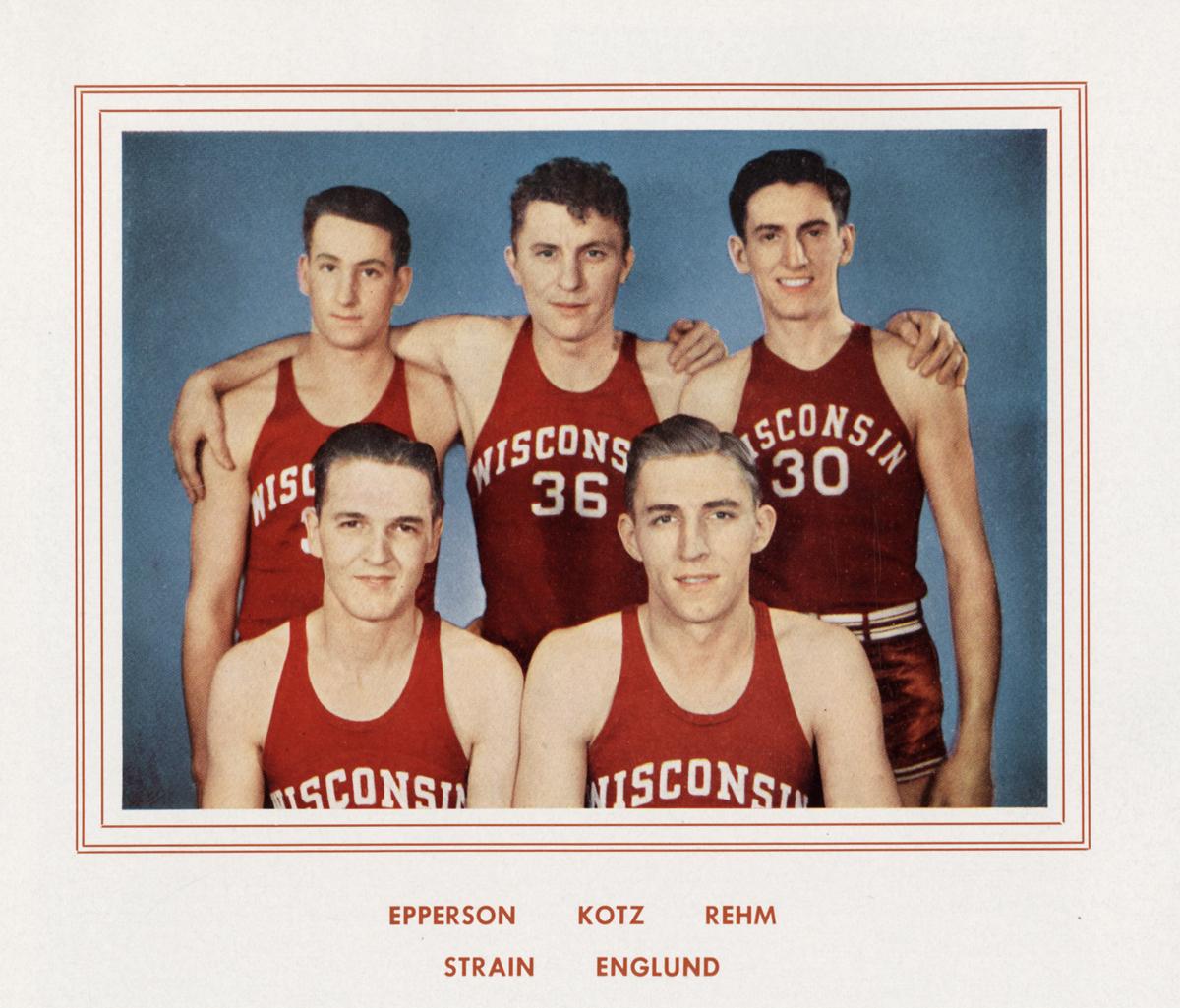
“Reading the newspapers, it was as though we were only going to Kansas City for the train ride,” said UW star Gene Englund, who later played for the OshKosh All-Stars in the National Basketball League before a refereeing career in the Big Ten and NBA. “That riled me up.”
A column in the Kansas City Star the morning of the game was titled “Don’t Go Cougar-Hunting With a Badger” and Wisconsin apparently used it as bulletin-board material. The Badgers took home a 39-34 victory in front of 9,350 fans for the school’s first and only NCAA basketball title.
Washington State uploaded footage of the game to YouTube three years ago. Needless to say, the action looks just a tad different from today’s game.
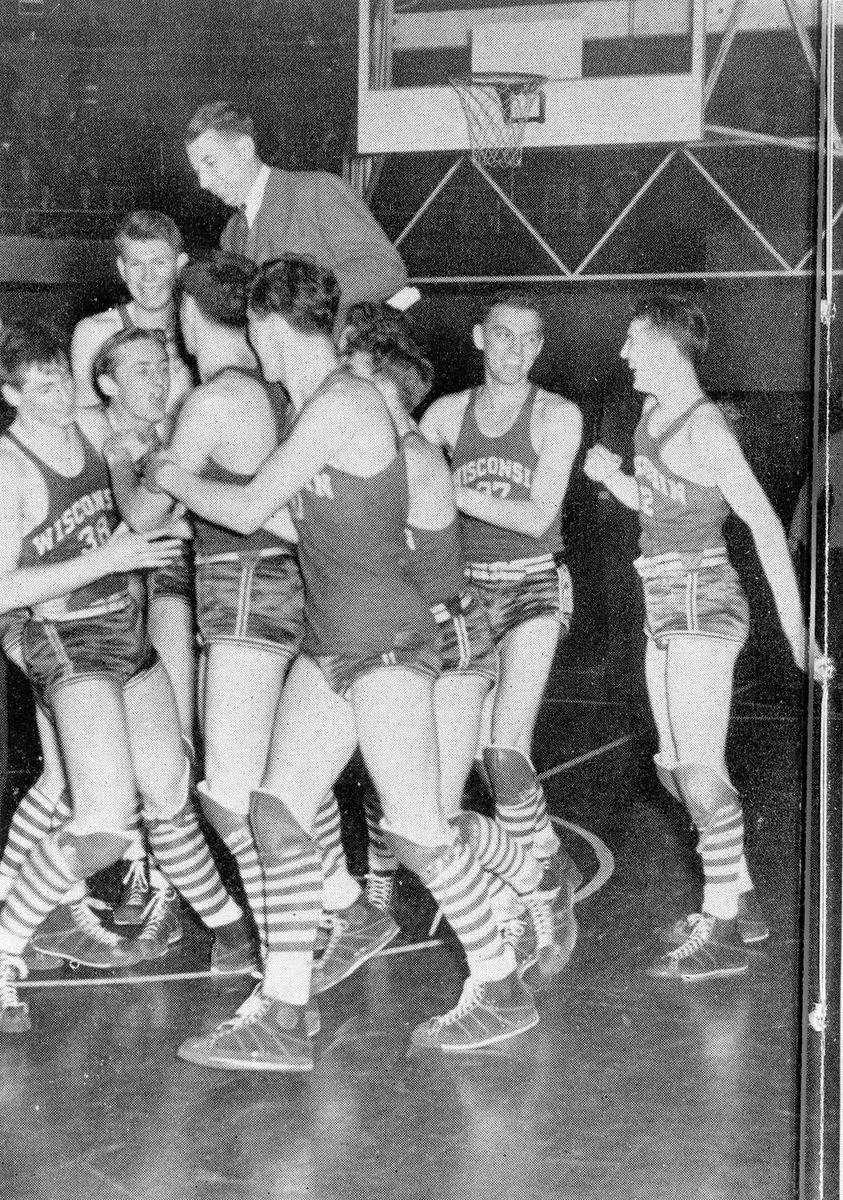
The Badgers then celebrated while wearing some pretty sweet socks:
After securing the title, the Wisconsin team returned to Madison where they were greeted at the train station at 1:20 in the morning by an estimated crowd of 10,000-12,000 people. “House mothers even suspended the rules and allowed female students to stay out for the event,” it was written.
Not all stories have happy endings, however. According to the Cap Times, the players hopped “on a fire truck for a ride around the Capitol that was cut short when the engine caught fire.”
Some footage of the 1941 champions (whose coach, Harold “Bud” Foster, I met back in 1986, when a Final Four berth seemed like a fantasy) can be seen here:
Wisconsin’s spring general election — which is also the presidential primary election in years with presidential elections — is on the first Tuesday in April.
In 1980, the spring election was on April 1. That was appropriate in 1980 because of what happened four days before that.
On the bitter cold Friday night of March 28, 1980, outside the State Capitol building in Madison, Wisconsin, the famed film director Francis Ford Coppola produced a 30-minute TV infomercial that effectively ended California Gov. Jerry Brown’s campaign for president.
For Brown, the production was a hideously embarrassing political disaster. It not only crashed his Democratic primary challenge to President Jimmy Carter, but also reinforced his Governor Moonbeam reputation and marked the start of a decade-long decline in his once-meteoric political fortunes.
Titled “The Shape of Things to Come,” the bizarre half-hour show was seen only by Wisconsin viewers who happened to tune in to the statewide broadcast, a pot-hazed crowd of 3,000 who showed for the event and a small group of political reporters who panned it the next day.
Dubbed “Apocalypse Brown,” after Coppola’s Vietnam War epic “Apocalypse Now,” the program has never been seen by most Californians, including even some of Brown’s closest associates. …
We got our DVD copy from TV consultant and Calbuzzer Peter Shaplen, a freelance network news producer who now teaches video journalism at the Art Institute of San Francisco. At the time, he was covering Brown’s campaign as an ABC News producer. As Shaplen recalls:
The governor and I got into a heated argument the following day aboard the campaign plane. He maintained the audience would see beyond the technology snafu and hear his message, respond and vote for him. I suggested that the audience was so busy laughing at the failure of any reasonable communication that it was impossible to listen and respond.
A Francis Ford Coppola Production: Using — or misusing — the technique of chroma key compositing, Coppola projected impressionistic images both on a big screen behind Brown, which was flapping in the strong wind, and in the simultaneous TV broadcast.
The signature moment of the infomercial comes about 11 minutes into it with the sudden appearance over Brown’s right shoulder of an astronaut, clad only in white boxer shorts, doing somersaults, flips and other gymnastic moves inside a space capsule while in a weightless state.
Just. Plain. Weird.
Things were going badly well before that, however.
Right before the broadcast begins, a voice from the crowd says, “America has lost its environmental ethic and also Wisconsin doesn’t grow enough sinsemilla.”
Then the titles go up and someone types on a dateline, which is misspelled “Madisno, Wisci” before being corrected; next an utterly grim looking Brown walks to the stage, wearing a serious trench coat apparently a size too big, and starts orating into a sound system that isn’t working.
“We can’t hear,” a few people yell, whereupon Brown is given a hand-held mic and ad libs: “Even the technology of this age needs some human assistance.”
Not long after, the stage lights go out for a while, as seemingly random images – a steel mill, a rural cabin, an old guy shucking wheat – appear behind Brown, while quadrants of his head mysteriously keep dissolving into gaping gashes of flickering black and white.
How the deal went down: Just three weeks before, Brown had appointed the 40-year Coppola, who’d by then won an Academy Award and produced, directed and written the first two “Godfather” movies, to the state Arts Commission.
Brown’s campaign against a Democratic president never really took off – not least because the late Sen. Edward Kennedy was also challenging the incumbent – but Coppola was doing his bit to help his political patron. …
The Brown manifesto. The following Tuesday, Brown won only 15 percent of the primary vote and dropped out of the race. But the 25-minute speech he delivered during the program, overshadowed by the technical debacle, was framed by many of the ideas and attitudes he still holds – and a few he long ago dumped on the Krusty ash bin of history:
1-Paddle to the right, paddle to the left: Brown’s commentary on global and national political economics, the absolutely humorless tone of which is at odds with the counter-culture crowd on hand, is a case study of how he combines conservative and liberal views in his politics.
His theme was rejuvenating America’s economy, then beset by a crippling combination of high inflation, skyrocketing energy prices and widespread unemployment. He proposed a Japan-like “new economic order,” led by government but including both business and organized labor, that would rebuild the nation’s manufacturing capacity.
“A call to arms, not for war, but for peace – we can re-industrialize this country,” he said.
Among the left-liberal elements of this policy: a “coupon rationing method” for gasoline; a “ban on import of foreign oil by private companies” in favor of a government-run “U.S. Oil Buying Authority,” and new mandatory conservation policies to curtail “profligate, scandalous, unnecessary” energy consumption.
At the same, however, he sounded fiscally conservative themes: stop the government “printing press” of inflationary monetary policy; “balance the budget” by ending “fiscal gimmickry, borrowing from the future (and) huge deficits.” He also called for private-public sector cooperation to sell “re-industrialization bonds (and to) double research efforts into information technologies.”
2-The value of service: Brown’s remarks about himself and his reasons for pursuing elected office echo across three decades.
He recounted growing up in a household dominated by the career of his father, the late Gov. Pat Brown, and his revulsion at what he considered the demeaning nature of much political interaction – “the political language we hear is debased.” He said this led him to his time in the Jesuit seminary.
“I didn’t like politics…I wanted to find God,” he said, an experience that resulted in “development (of) a commitment to be of service.” Railing against “consumerism,” he said that as president he would manifest this idea, which remains a central thread of his politics today, by creating a “domestic Peace Corps” to channel young people into “voluntary service.”
3-The vision thing: Brown’s 1980 speech is also notable for how much it foresees mega economic and political trends that were just then forming.
Speaking of how we all live in “a very small global village,” for example, he foresaw globalization and trade policies a generation into the future, calling for a “North American Economic Community” including the U.S., Canada and Mexico, and enthusiastically describing the possibilities of “co-generation, solar, photo-voltaic” energy sources, as well as the need for “mass transit, bullet trains, fuel efficient cars.” …
“I have the skill, the know-how, the commitment,” for high office, he said at one point; when a woman asked him what he will do to assure the passage of the Equal Rights Amendment, he presaged his get-them-all-in-a-room plan for solving the current budget deficit: “I’ll bring recalcitrant legislators to Washington and keep them there until they change their mind.”
Somewhat awkwardly, Brown concluded his remarks by reciting the Pledge of Allegiance – without inviting the crowd to join him. Then he left the stage, unaware that the technical meltdown of the program within a few hours would lead to widespread mockery of the event.
The Wisconsin State Journal’s Doug Moe starts by picking up the story after the “Ashtar” of live political TV:
On the cab ride from the Park Motor Inn to Four Lakes Aviation, where his private plane was waiting, the most celebrated film director in the world did not feel like celebrating.
It was close to midnight in Madison, March 28, 1980.
The cab driver studied the director in the rearview mirror, and said, “You know, this event tonight started out to be pretty interesting, but then something went wrong.”
“You’re telling me,” the director said. “It was a disaster. Just a disaster.”
Thirty-five years ago this week, Francis Ford Coppola, director of two revered “Godfather” movies, and with another film, “Apocalypse Now,” recently released amid great controversy and melodrama that only added to his legend, came to Madison to direct a live half-hour television show for his friend, California Gov. Jerry Brown, who was running for president in the Democratic primary in Wisconsin.
In the years since, the 30-minute program has itself become legendary. The events played out across three days in Madison. Coppola visited West High School and ate at local restaurants, even as technicians ensconced on the state Capitol lawn raced against the clock to ready the live production.
“I have no experience in this kind of thing,” Coppola announced cheerfully, during his time at West High. Later, anyone looking for a title for the extravaganza had one on a platter: “Apocalypse Brown.”
“There was a lot of hoopla building up to it,” Chuck Martin, a former State Journal journalist who covered the event, said this week.
When Jerry Brown decided to challenge incumbent President Jimmy Carter for the 1980 Democratic nomination, he first asked Coppola — whom Brown had appointed to the California Arts Council — to create some traditional, short television commercials for the campaign.
Brown’s team was happy with the spots, but the campaign itself, by mid-March, was foundering. They needed something dramatic to happen and figured the primary on April 1 in Wisconsin — a state with a history of appreciating mavericks — might be the place.
The idea for a half-hour event, to air live a few days before the primary, came from Coppola and was put together in just a few weeks, according to the production manager, quoted in Martin’s State Journal story.
The show was to be titled, “The Shape of Things to Come,” from an H.G. Wells futuristic short story.
Speaking of the director, a Brown staff member told a reporter from New York City’s Village Voice, “I have no idea what he’s going to do. All I know is that Coppola intends this thing to be one of the collector’s items of his career.”
Coppola arrived in Madison on March 26, a Wednesday. The show was set to air statewide on eight stations at 7 p.m. Friday. Wednesday night, Coppola spoke to students at West High.
Walt Trott covered the West High appearance for The Capital Times and quoted the director in the next day’s paper:
“We’ll center ourselves by the Capitol building,” Coppola said, “where we’ll put up this immense television set and we’re going to go on TV live with the governor making a statement that he wants to make. I’ll be in a truck where I can make a live mix, making any combination of things.”
Thursday morning, Coppola spoke at Russell Merritt’s film history class at UW-Madison. Throughout his time in the city, the director talked about evolving technology and how a new process, called chroma-key, would allow him to flash relevant images on a screen behind Brown as the governor spoke.
Thursday night, a Village Voice reporter was at the Capitol observing the frenzied crew trying to ready generators, search lights, and TV cameras, while Coppola gave Jerry Brown a tour of the set.
“After this,” Coppola said, “you’ll be the movie star and I’ll run for governor.”
Friday evening was chilly and damp. Fires burning in garbage cans provided heat on the Capitol lawn. Search lights pierced the sky. A young woman in the crowd of 3,000 told the Cap Times, “This is the weirdest thing I’ve ever seen.”
It got weirder. Eventually Brown, in a trench coat, took the stage. Not much went right after that. The chroma-key technology failed, even as the candidate talked about the need to re-industrialize and invest in new technologies. Images broke apart on screen. At one point an image of a Skylab astronaut doing weightless somersaults in his underwear appeared behind Brown.
Later, in a suite at the Park Motor Inn, Coppola and rock music promoter Bill Graham drank red wine and waited for Coppola’s cab driver. When he arrived, Graham offered some wine. “Even at Union,” Stuart Levitan said, “we’re not supposed to drink with the passengers.”
Yes, Coppola’s cab driver was Levitan, the Madison journalist and historian.
Levitan viewed the show from the Capitol lawn, and this week recalled how strange it was to watch “the most innovative politician of our generation self-destruct before our eyes.”
Additional technological insight comes from Greg Buzzell on the Facebook “If You Grew Up in Madison You Remember” page:
I was Chief Engineer at the time at WMTV channel 15. We were the station picked to do the state wide live feed of the show. From the outset we knew the program was in trouble. They had to borrow cable from us, because they did not bring enough. They were trying to do a chroma key outside in the wind, we knew that would not work. Everything was live, and being on headset with Coppola, it was evident he had never done anything live before. The chroma key wasn’t working, the graphics did not work, and we were struggling at the station to input live names into our character generator for lower thirds. After a few minutes in Coppola had lost his cool and started yelling at everyone which only made thing worse. Eventually he just took his headset off, and just left the set, and let the assistant director finish the show. It was a great embarrassment for Governor Brown, but also an embarrassment for the station. But we all learned that you can be a great movie director, and not be able to do something live. Obviously in live TV there are no do overs as there are in film.
So what did this TV train wreck look like?
While the debacle certainly ended Brown’s 1980 run for president (the winner was Brown’s predecessor as governor, Ronald Reagan), it didn’t end Brown’s political career. Brown didn’t run for reelection in 1982, but a decade later he ran for president again. Even more unpredictably, he is again governor of California.
I wrote about my experiences at the WIAA state basketball tournaments in this space last week. (Including, of course, my junior-year experience that ended with a big gold trophy and bigger plaque on the wall at my high school.)
After last week’s excellent experience (two teams, two state titles), I get to add another today and perhaps Saturday, because I am covering undefeated Mineral Point at 7:45 tonight on www.superhits106.com. (And Saturday if the Pointers win.)
This will be the first time I’ve announced the boys tournament since 1989, when the Class C field included three unbeaten teams, the first of which won when a 60-foot shot at the buzzer rimmed out. My game was a wild 81–79 win for Glenwood City over Iowa–Grant.
I also did a Class B game the same day featuring Cuba City and Clintonville. I didn’t know this at the time, but I would later end up living in Cuba City, getting to know the all-time-winningest boys basketball coach in Wisconsin history (whose memories of state can be read here), and covering Clintonville as an opponent of Ripon later. (In the space of a few days last week I interviewed said all-time-winningest boys coach, the all-time-winningest girls coach, and the coach who has the most gold trophies at Cuba City High School.)
Cuba City and Iowa–Grant are answers to a strange trivia question — in which tournament were all the state champions from Grant County. The answer is 1981 — Iowa–Grant won Class C, Cuba City won Class B, and Class A was won by … no one. Milwaukee Madison beat Wausau West to win the Class A title game, but Madison’s title was vacated for use of an ineligible player. The WIAA chose to not award the title to Wausau West, so officially there was no 1981 Class A champion.
(I just remembered the first time I’d ever heard of Cuba City, and it wasn’t at state. In the late 1970s I was part of an Explorer post hosted by WHA-TV. One of the things we did was to push a WHA float in a Madison Christmas parade the same year as Fidel Castro’s emptying of his prisons into boats for Jimmy Carter to deal with. Behind us was the Cuba City band, which spent much of the parade chanting: “Gimme an R! Gimme an E! … What’s that spell? REFUGEES!” Really funny, and of course you could not possibly do that today.)
The 1989 games (and 1981, and all of them between the move from the Big Red Gym and the move to the Kohl Center) were at the UW Fieldhouse, great for atmosphere and little else. The radio broadcast positions were at the front of the upper deck, great for visibility except for those with vertigo. The Kohl Center was built to follow the Fieldhouse’s sight lines as much as possible, which is why it’s a great place to watch basketball, though much larger than the Fieldhouse.
Mineral Point is making its first appearance since 1974. The Pointers that year won their first Class C game but lost to another unbeaten team, McFarland. If the Pointers win tonight, their next opponent is either third-ranked Eau Claire Regis or, more likely, three-time defending Division 4 champion Whitefish Bay Dominican, led by the state’s most sought-after senior, Diamond Stone. (Rumored to be choosing between Wisconsin, Maryland, Connecticut or Oklahoma State for college.) If Dominican and Mineral Point play Saturday, I will have to learn how to pronounce the last name of one of Stone’s teammates, Kostas Antetokounmpo, brother of the Bucks’ Giannis Antetokounmpo.
Wisconsinites might remember Gary Bender, who went from WKOW-TV in Madison to CBS-TV. He announced this state tournament, in addition to the Badgers and the Packers: When I was an intern at WKOW-TV, there was a black-and-white photo of Bender and some other people at state. Bender wore a white turtleneck, a blazer, plaid polyester bell-bottoms, and white shoes. I wonder if channel 27 still has that photo.
If you read this immediately upon publishing (and why wouldn’t you?), assuming I’m not running late I am on the way to the Resch Center in Ashwaubenon for the WIAA state girls basketball tournament.
I have two games to announce today — Barneveld vs. Fall River in Division 5 at 1:35 p.m. (to which you can listen here), and Cuba City vs. Fond du Lac Springs in Division 4 at 6:35 p.m. (to which you can listen here). If either wins, I announce their state championship game Saturday (to which you can listen here).
(It’s a bit illogical that given that creeks are smaller than rivers, Fall Creek is a bigger school than Fall River. I’m not sure what the over–under will be of my saying “Fall Creek” when I mean “Fall River” and vice versa.)
Next week is the 100th annual WIAA boys basketball championships, or at least the 100th anniversary of the tournament (held by Lawrence College, now University, in Appleton) that the WIAA recognizes as the first state tournament. That is not this …
… that is the 1966 WIAA quarterfinal between Grafton and number-one-ranked Madison East at the UW Fieldhouse. (It’s too bad there’s apparently no sound. I’m not sure about this, but given the rarity of the last name I’m pretty sure I covered the son and daughter of one of the East players, both of whom played for La Follette two decades later.) There was only one class in those days, and there was no girls tournament at all. And I’m sure I watched this, though I was nine months old. Other than the Packers (and my father’s swearing at the ineptitude of the post-Glory Days Packers), state is the first sporting event I remember watching, every March without fail.
State is sometimes called The Dance because, well …
Just as state is the pinnacle for a high school basketball player, announcing state is the pinnacle for a high school basketball announcer. (The trick is to get people to watch the game, but turn down the sound and listen to your broadcast.) I’ve done two state basketball games, one involving the boys counterpart to the Cuban girls. Earlier that day I announced two undefeated teams, 10 days after I announced one of those undefeateds against another unbeaten team in their regional final.
Readers know about my second trip to state, the excellent adventure that was the 1982 state championship. Since then I’ve gotten to watch state, cover state as a newspaper reporter and editor, and announce state. And I’ve covered teams that got to state and lost (which means they still got to state), and got to state and won.
My most unexpected state basketball trip (which weirdly paralleled my most unexpected state baseball trip two years later) was the 1987 Madison La Follette girls team that finished the regular season 9–11. But after an easy regional semifinal win, a regional final win in overtime (the third overtime win over Madison East, which finished above La Follette in the Big Eight), a win over conference champion Madison Memorial, and a win over the team that beat La Follette to go to state the previous year, there I was on Thursday afternoon (which was about 30 degrees colder than the previous Saturday) in the Fieldhouse covering a state game I never expected to cover.
I’m old enough to remember when state had three classes, with Class C starting Thursday and Friday daytime sessions. Then they created Breakfast at the Fieldhouse, moving all of Class C to Friday morning, with the first game tipping off at 9:05 a.m. Then they expanded to four divisions, with Division 3 Thursday and Division 4 Friday starting at 9:05. And now they have five divisions, with fewer state games (and thus lower gate receipts) than the old four-division days, because Division 1 had eight teams and the other divisions four teams each.
The format doesn’t matter, because thanks to what the WIAA calls the Magic of March (because “March Madness” is copyrighted), you get moments like these:
Last week, in her State of the Union response, Joni Ernst mentioned going to school with bread bags on her feet to protect her shoes. These sorts of remembrances of poor but honest childhoods used to be a staple among politicians — that’s why you’ve heard so much about Abe Lincoln’s beginnings in a log cabin. But the bread bags triggered a lot of hilarity on Twitter, which in turn triggered this powerful meditation from Peggy Noonan on how rich we have become. So rich that we have forgotten things that are well within living memory:
I liked what Ernst said because it was real. And it reminded me of the old days.
There are a lot of Americans, and most of them seem to be on social media, who do not know some essentials about their country, but this is the way it was in America once, only 40 and 50 years ago:
America had less then. Americans had less.
If you were from a family that was barely or not quite getting by, you really had one pair of shoes. If your family was doing OK you had one pair of shoes for school and also a pair of what were called Sunday shoes — black leather or patent leather shoes. If you were really comfortable you had a pair of shoes for school, Sunday shoes, a pair of play shoes and even boots, which where I spent my childhood (Brooklyn, and Massapequa, Long Island) were called galoshes or rubbers. At a certain point everyone had to have sneakers for gym, but if you didn’t have sneakers you could share a pair with a friend, trading them in the hall before class.
If you had just one pair of shoes, which was the case in my family, you had trouble when it rained or snowed. How to deal with it?
You used the plastic bags that bread came in. Or you used plastic bags that other items came in. Or you used Saran Wrap if you had it, wrapping your shoes and socks in it. Or you let your shoes and socks get all wet, which we also did.
I am a few years younger than Noonan, but I grew up in a very different world — one where a number of my grammar school classmates were living in public housing or on food stamps, but everyone had more than one pair of shoes. In rural areas, like the one where Joni Ernst grew up, this lingered longer. But all along, Americans got richer and things got cheaper — especially when global markets opened up. Payless will sell you a pair of child’s shoes for $15, which is two hours of work even at minimum wage.
Perhaps that sounds like a lot to you — two whole hours! But I’ve been researching historical American living standards for a project I’m working on, and if you’re familiar with what Americans used to spend on things, this sounds like a very good deal.
Consider the “Little House on the Prairie” books, which I’d bet almost every woman in my readership, and many of the men, recalls from their childhoods. I loved those books when I was a kid, which seemed to describe an enchanted world — horses! sleighs! a fire merrily crackling in the fireplace, and children frolicking in the snow all winter, then running barefoot across the prairies! Then I reread them as an adult, as a prelude to my research, and what really strikes you is how incredibly poor these people were. The Ingalls family were in many ways bourgeoisie: educated by the standards of the day, active in community leadership, landowners. And they had nothing.
There’s a scene in one of the books where Laura is excited to get her own tin cup for Christmas, because she previously had to share with her sister. Think about that. No, go into your kitchen and look at your dishes. Then imagine if you had three kids, four plates and three cups, because buying another cup was simply beyond your household budget — because a single cup for your kid to drink out of represented not a few hours of work, but a substantial fraction of your annual earnings, the kind of money you really had to think hard before spending. Then imagine how your five-year-old would feel if they got an orange and a Corelle place setting for Christmas.
There’s a reason old-fashioned kitchens didn’t have cabinets: They didn’t need them. There wasn’t anything to put there.
Imagine if your kids had to spend six months out of the year barefoot because you couldn’t afford for them to wear their shoes year-round. Now, I love being barefoot, and I longed to spend more time that way as a child. But it’s a little different when it’s an option. I walked a mile barefoot on a cold fall day — once. It’s fine for the first few minutes, and then it hurts like hell. Sure, your feet toughen up. But when it’s cold and wet, your feet crack and bleed. As they do if the icy rain soaks through your shoes, and your feet have to stay that way all day because you don’t own anything else to change into. I’m not talking about making sure your kids have a decent pair of shoes to wear to school; I’m talking about not being able to afford to put anything at all on their feet.
Or take the matter of food. There is nothing so romanticized as old-fashioned cookery, lovingly hand-prepared with fresh, 100 percent organic ingredients. If you were a reader of the Little House books, or any number of other series about 19th-century children, then you probably remember the descriptions of luscious meals. When you reread these books, you realize that they were so lovingly described because they were so vanishingly rare. Most of the time, people were eating the same spare food three meals a day: beans, bread or some sort of grain porridge, and a little bit of meat for flavor, heavily preserved in salt. This doesn’t sound romantic and old-fashioned; it sounds tedious and unappetizing. But it was all they could afford, and much of the time, there wasn’t quite enough of that.
These were not the nation’s dispossessed; they were the folks who had capital for seed and farm equipment. There were lots of people in America much poorer than the Ingalls were. Your average middle-class person was, by the standards of today, dead broke and living in abject misery. And don’t tell me that things used to be cheaper back then, because I’m not talking about their cash income or how much money they had stuffed under the mattress. I’m talking about how much they could consume. And the answer is “a lot less of everything”: food, clothes, entertainment. That’s even before we talk about the things that hadn’t yet been invented, such as antibiotics and central heating.
In 1901, the average “urban wage earner” spent about 46 percent of their household budget on food and another 15 percent on apparel — that’s 61 percent of their annual income just to feed and clothe the family. That does not include shelter, or fuel to heat your home and cook your food. By 1987, that same household spent less than 20 percent on food and a little over 5 percent of their budget on apparel. Since then, these numbers have fallen even further: Today, families with incomes of less than $5,000 a year still spend only 16 percent of the family budget on food and 3.5 percent on apparel. And that’s not because we’re eating less and wearing fewer clothes; in fact, it’s the reverse.
The average working-class family of 1901 had a few changes of clothes and a diet heavy on beans and grain, light on meat and fresh produce — which simply wasn’t available for much of the year, even if they’d had the money to afford it. Even growing up in the 1950s, in a comfortably middle-class home, my mother’s wardrobe consisted of a week’s worth of school clothes, a church dress and a couple of play outfits. Her counterparts today can barely fit all their clothes in their closets, even though today’s houses are much bigger than they used to be; putting a family of five in a 900-square-foot house with a single bathroom was an aspirational goal for the generation that settled Levittown, but in an era when new homes average more than 2,500 square feet, it sounds like poverty.
At that, even the people living in the last decades of the 19th century were richer than those who had gone before them. I remember coming across a Mauve Decade newspaper clipping that contained a description of my great-grandmother “going visiting” in some nearby town during the 1890s. On the other side of the clipping was a letter to the editor from a woman in her 90s, complaining that these giddy young things didn’t know how good they had it compared to the old days — why, they even bought their saleratusfrom a store instead of making it from corncobs like they did back when times were simpler and thrifty housewives knew the value of a dollar.
Joni Ernst, who is just a few years older than me, had a much more affluent childhood than the generation that settled the prairies, and more affluent still than the generations before them. But in many ways, she was much poorer than the people making fun of her on Twitter, simply because so many goods have gotten so much more abundant. Not just processed foods and flat-screen televisions — the favorite target of people who like to pooh-pooh economic progress. But good and necessary things such as shoes for your children and fresh vegetables to feed them, even in winter.
In every generation, we forget how much poorer we used to be, and then we forget that we have forgotten. We focus on the things that seem funny or monstrous or quaint and darling. Somehow the simplest and most important fact — the immense differences between their living standards and ours — slides right past our eye. And when Ernst tried to remind us, people didn’t say “Wow, we’ve really come a long way”; they pointed and laughed.
One may well ask: ‘How can you advocate breaking some laws and obeying others?’ The answer lies in the fact that there are two types of laws: just and unjust. I would be the first to advocate obeying just laws. One has not only a legal but a moral responsibility to obey just laws. Conversely, one has a moral responsibility to disobey unjust laws. I would agree with St. Augustine that ‘an unjust law is no law at all.’
Human salvation lies in the hands of the creatively maladjusted.
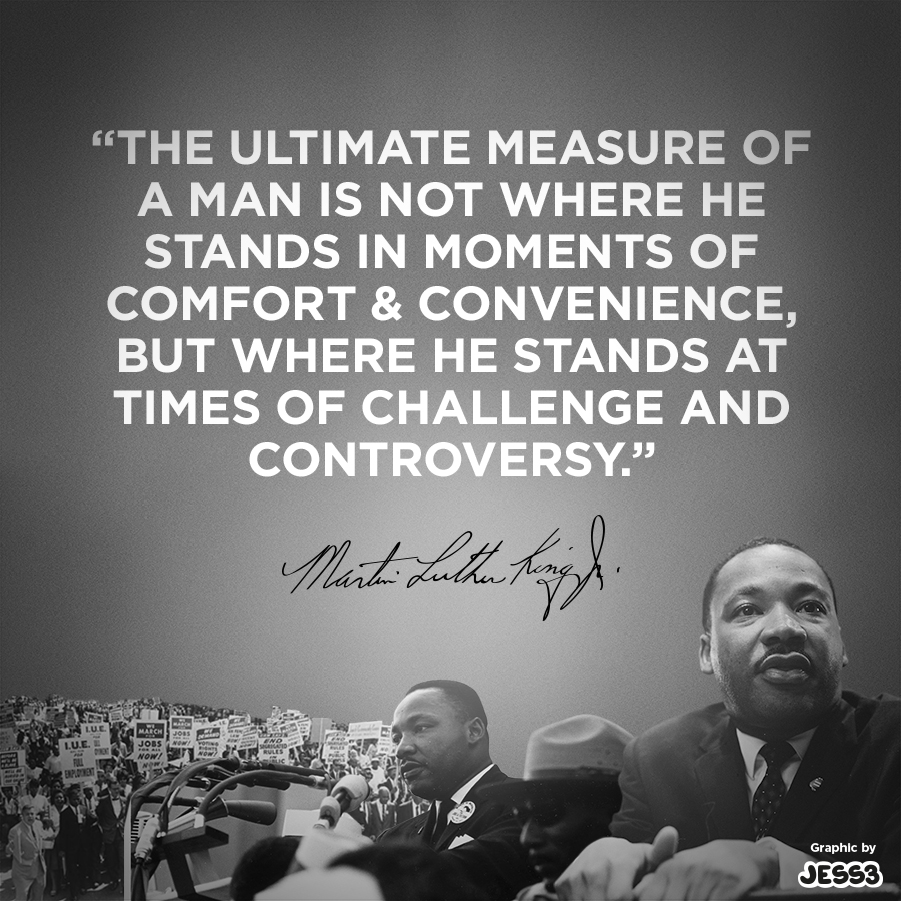
Whatever your life’s work is, do it well. A man should do his job so well that the living, the dead, and the unborn could do it no better.
Man is man because he is free to operate within the framework of his destiny. He is free to deliberate, to make decisions, and to choose between alternatives. He is distinguished from animals by his freedom to do evil or to do good and to walk the high road of beauty or tread the low road of ugly degeneracy.
Success, recognition, and conformity are the bywords of the modern world where everyone seems to crave the anesthetizing security of being identified with the majority.
“No work is insignificant. All labor that uplifts humanity has dignity and importance and should be undertaken with painstaking excellence.”
That Was the Year That Was, which is based on the old British TV show …
… is a tradition of, well, anywhere I’ve worked dating back to years beginning with the number 19.
Thanks to poor Internet connections (this means you, Centurylink) and my overloaded schedule, this will be more brief than previous years, which is too bad because 2014 was a really strange year.
The biggest Wisconsin political news of 2014 was obviously the reelection of Gov. Scott Walker, Wisconsin’s political Energizer bunny …
… or perhaps Wisconsin’s own Obi Wan Kenobi …
and Republicans controlling both houses of the Legislature again, in fact expanding their majorities in both houses.
Democrats tried to pick off Walker in Recallarama in 2012, and failed. Democrats then came up with the focus-group-tested Mary Burke — rich businessperson with suitable liberal credentials, or so it seemed — and failed again.
Burke represents a grotesque failure on the part of Wisconsin’s news media to investigate the background of a candidate for public office. It took the non-mainstream media to point out the giant holes in Burke’s resume at Trek Bicycle — for instance, why she left — and ask such inconvenient questions as why no non-Burke could attest to her work at Trek, or whether she was qualified to be governor. The voters decided she wasn’t.
The economy seems better this year only because of the steep drop in gas prices, something opposed by Barack Obama. There is really no other reason to think the economy is better other than more money in people’s pockets due to said gas price drop.
Obama proved himself as one of the most effective presidents ever by delivering the Senate to Republican control and expanding the GOP’s control of the House of Representatives. It makes one wonder why Democrats continue to slavishly, blindly, stupidly support him.
As it happens, I got to witness the two strangest Wisconsin political stories this year, both of which involved Sen. Dale Schultz (R–Richland Center). At the start of the year, Schultz announced he wasn’t running for reelection, and said he wouldn’t endorse Rep. Howard Marklein (R–Spring Green), who announced in April 2013 he was running for Schultz’s seat.
Democrat Ernie Wittwer of Hillpoint, a retired state employee, announced he was running for Schultz’s seat. Unimpressed, state Democratic Party officials convinced Pat Bomhack of Spring Green, former aide for the phony maverick Sen. Russ Feingold, to, instead of running for Marklein’s seat (for the second time, after Bomhack lost the 2012 Democratic primary), run against Marklein. Democratic Party chair (if there is such a thing) Chris Larson even endorsed Bomhack, choosing one Democrat over another.
The early morning after the Aug. 12 primary, Wittwer was announced defeating Bomhack by two votes. That margin grew to seven after the county canvasses. Then Bomhack requested a recount, and more than 100 ballots from Monroe disappeared. That and irregularities in other counties switched Wittwer’s nine-vote win to a 33-vote Bomhack win. Wittwer’s wife and campaign manager sent a letter to 17th Senate District newspapers that burned holes in the newsprint on which it was printed over how state Democrats treated her husband and favored a pretty obvious carpetbagger.
Then, two weeks before the general election, the state Democratic Party sent out a flyer with a picture of Schultz and Bomhack together, with a quote from a Schultz story in The Capital Times:
“Pat Bomhack is a good fit for the district because his values and positions on the issues that people care about, from my perspective, are similar to mine.”
Was that an endorsement? Both Schultz and his campaign manager weaseled out of using the E word, with Schultz saying, “I think people are smart enough to read between the lines, and I encourage them to do their research and come to their own conclusion.”
Well, here’s the conclusion: Marklein beat Bomhack, and Marklein is being succeeded by another Republican, Dodgeville Mayor Todd Novak. (Who won his race by 65 votes.) So Schultz went out the door 0 for 2 in trying to influence the 2015–16 Legislature.
That, I thought, had to be the strangest thing I would witness in 2014. (Other than, perhaps, having a tornado pass within one-half mile of me and another apparently pass over closer than that, three days after a murder.) Then, two weeks after the election, I went to a speech by Madison Catholic Diocese Bishop Robert Morlino. Or so I thought. A journalist is supposed to report on stories, not be the story, but I ended up doing both, continuing my professional tradition of making people really angry at me.
It was cold this year — hideously (though sadly not abnormally) cold in the winter, cold in the spring, and below-normal in temperatures in the summer. The fall was OK, November was cold and snowy, but December was warmer than normal, giving us a brown Christmas after the snow melted away. Of course, the wind chill is below zero outside today. Wisconsin weather sucks.
The Packers had a brief 2013 playoff trip (which took place in January), then won the NFC North for the fourth year in a row, thanks to a legendary last-game performance by quarterback Aaron Rodgers, who channeled his inner Favre by returning to the field after an injury. The Badgers made the basketball Final Four, which was cool. The Badgers had a reasonably good football season with another strange coda, the departure of coach Gary Andersen after two seasons. But that worked out much better than it could have. The Brewers, meanwhile, looked inconceivably good for much of the season, then deflated like the Hindenburg. One suspects, given the upgrades to the south, that there will be no potential postseason excitement for the Brewers in 2015.
As always, may your 2015 be better than your 2014. I would say “less interesting” too, but that would be against my professional interests.

 When I was an intern at WKOW-TV, there was a black-and-white photo of Bender and some other people at state. Bender wore a white turtleneck, a blazer, plaid polyester bell-bottoms, and white shoes. I wonder if channel 27 still has that photo.




 Steve Prestegard.com: The Presteblog
