A colleague of mine at my first journalism job had a boys basketball coach who would occasionally vent his displeasure with his team with this sportswriter. On occasion, when said sportswriter wanted to move on, the coach would say, no, I’m not finished with this yet.
Obviously Badger fans noticed that the sun came up Sunday, and will come up today, after Saturday night’s soul-crushing 74-73 loss to Kentucky in the NCAA Division I basketball national semifinal. Which doesn’t mean that Badger fans need not put away their anger with Saturday’s game.
For instance: I neither play nor coach basketball, but it would seem that a cardinal rule when you are leading by two points inside 10 seconds is don’t give up the three-point shot! The chance of giving up a three-point play (basket and free throw) are less than a team’s average success hitting threes, particularly a team that has hit clutch threes in the tournament. If you prevent the three, the worst that happens is that the Wildcats score, the Badgers don’t, and we head to overtime for the second consecutive game.
I’m not going to say anything about Traevon Jackson’s unsuccessful shot at the end. The chances of a team’s going 94 feet in 5.7 seconds and getting off a game-winner are very low. The game was lost 5.7 seconds earlier. Blame whoever you like for that.
One good thing about Saturday night was the chance to watch announcers who were not biased against Wisconsin. Wayne Larrivee and Mike Kelley sounded great on truTV, and as I have advocated here before, there is very little technological reason that the broadcasters cannot give the fans a choice of announcers. National broadcasts of Wisconsin games do not show enough, for instance, of the UW Band. In the same way that Fox announcers are perceived as biased for the Giants and Cowboys because bigger markets draw better, Wisconsin fans are pretty obviously tired of being disrespected by Fox’s, CBS’, NBC’s, ESPN’s, and everyone else’s announcers, right down to the pronunciation of “Wisconsin,” as viewers of the 1994 Rose Bowl can attest.
The game was maddening because it’s hard to imagine UW able to play much better than they did. They missed one free throw, and lost by one point. People with morals are also put off by cheaters, and that is how many basketball fans look at UK’s one-and-dones and their coach, John Calipari, who had two seasons of wins on his record vacated due to NCAA violations, at UMass and at Memphis. (Which got both UK and Calipari in trouble with the NCAA yet again when UK honored Calipari for his 500th win, which wasn’t officially his 500th win due to the aforementioned NCAA violations.
The game was saddening because, as sports fans know, “next time” is not guaranteed. The last time I saw UW lose to Kentucky, it was in the 1984 Hall of Fame Bowl in Birmingham. It was first bowl game I marched in. It was also the last bowl game I marched in, though no one knew that at the time. Yes, Wisconsin loses only starter Ben Brust to graduation. But what if Frank Kaminsky or, as some have speculated, Sam Dekker gets delusions of grandeur and leaves school for the NBA draft? That’s not likely in either case, but it’s not impossible.
Badger announcer Matt Lepay said after Wisconsin’s win over Arizona nine days ago that he honestly thought the Badgers were a year away. Few Packer fans seriously believed the 2010 Packers, needing to win their last two just to get into the playoffs, would win Super Bowl XLV. Most Packer fans probably thought the 2011 Packers, having gone 15-1 in the regular season, were a cinch for Super Bowl XLVI. There is no guarantee at all that, as one USA Today writer already predicts, UW will play in the 2015 Final Four in Indianapolis. Too many bad things, or too few good things, could happen, and regardless of that, UW will sneak up on no one next season. (Nor will they get any postseason home-like court advantage, given that the closest second- and third-round sites are Columbus, Ohio, Louisville and Omaha.)
I wrote last week that UW fans need to appreciate this Final Four trip, win or lose, because of its rarity, compared to the bad old days. Repeating that would be repeating myself. Still, it’s entirely possible that UW’s best chance of a national championship in basketball expired Saturday night.
… with the Badgers not merely in the Final Four, but a plurality fan favorite, at least according to ESPN.com’s SportsNation.
Because one good GIF …
… deserves another, SBNation asserts this is how Bo Ryan always looks:
The New York Times reveals the “student” side of the Badger student-athletes:
On the eve of their West Regional final Saturday against Arizona, the Wisconsin players were ensconced in a hotel down the street from Disneyland, in a meeting room with two walls of floor-to-ceiling windows. …
The basketball portion of their day was done, but the Badgers had more business to tend to. They put their heads down and resumed studying, ignoring the foot traffic outside, the chocolate chip cookies left over from the lunch buffet and the officials’ whistles coming from the television, tuned to a regional game featuring their Big Ten rival Michigan, filtering in from the lobby bar on the other side of the double doors.
As Tracey Maloney, the academic support staff member assigned to the team, looked on, the freshman guard Jordan Hill studied Italian vocabulary. Another freshman, Riley Dearring, researched Plessy v. Ferguson for a United States history class.
Frank Kaminsky, a junior forward whose game-high 19 points and career-high 6 blocks had figured prominently in the Badgers’ 17-point victory against Baylor the previous night, worked on a blog post assignment. The senior guard Ben Brust told Maloney about a Nascar podcast for an independent studies project that he had completed a few hours before scoring 14 points against Baylor.
And between emails with his project partners in Madison, the fifth-year senior Zach Bohannon, a reserve forward, helped the junior guard Josh Gasser with his accounting homework.
The term student-athlete is not an oxymoron in the N.C.A.A. tournament. Every senior on the Wisconsin men’s basketball team in the past two seasons graduated, and the team is on track to achieve that again this year. With their 64-63 overtime victory against the top-seeded Wildcats, the Badgers also managed a first for a Bo Ryan-coached team. They earned a trip to the Final Four, which means they will spend another week juggling classwork and tournament games.
“A lot of people think that it’s easy to be a student-athlete, that people just do things for you and this and that,” said Hill, a kinesiology major. “I don’t know about other schools, but at Wisconsin, that doesn’t fly.”
It should please UW graduates that our degrees aren’t reduced in value by athletes attending UW for the sole purpose of an illusory pro sports career.
The Wall Street Journal gets into the act by profiling Frank “The Tank” (though he isn’t) Kaminsky:
When Wisconsin takes on Kentucky in Saturday’s second national semifinal, the most skilled offensive player on the floor won’t be Kentucky’s prized NBA prospects but Kaminsky, a gangly big man who can score inside and out.
“Frank Kaminsky is the reason Wisconsin’s in the Final Four,” said coach Sean Miller of Arizona, against whom Kaminsky scored 28 points on Saturday.
But it wasn’t long ago when that would have sounded as absurd as the 7-foot Kaminsky playing point guard in high school. (Which he did.)
Kaminsky, a junior, barely played before this season, averaging 9 minutes a game as a freshman and sophomore. But he blew up this year, earning all-Big Ten honors while leading the Badgers in scoring and rebounding. In college basketball, only 22 players were used as little last year but as much this year as Kaminsky, according to Synergy Sports Technology.
Kaminsky’s development also represents a Wisconsin approach to team-building that couldn’t be more different from that of its upcoming opponent.
Kentucky coach John Calipari targets the country’s top high-school players, knowing full well they won’t stick around long. This leaves him with a starting lineup of likely one-and-done freshmen and a bench stocked with even more future pros. By contrast, Wisconsin coach Bo Ryan sees his recruits as projects, stashing them on the bench before they blend into the rotation as seasoned juniors and seniors.
Kaminsky was even more of a late bloomer than most. Unlike many college players, who are identified as top talents as early as middle school, Kaminsky, who is from suburban Chicago, made his high school’s varsity team only in his junior year. He had recently grown to 7 feet, but he still retained the dribbling skills and soft shooting touch of a guard, making him a fit for Wisconsin’s “swing offense,” a strategy that relies on big men capable of playing anywhere on the court. Kaminsky committed there early in his recruiting process before other schools could swoop in and steal him.
“I’d be a liar if I told you I saw him doing what he’s doing now,” said Illinois-Chicago coach Howard Moore, who recruited him as a Wisconsin assistant.
Yet there were signs that Kaminsky would eventually epitomize Wisconsin’s style. In a 2011 game between the No. 1 and No. 2 high-school teams in Illinois, Kaminsky’s Benet Academy played Simeon, a Chicago team that featured a young Jabari Parker, a high-school sophomore already seen as an NBA talent.
Wearing red uniforms not unlike Wisconsin’s, Kaminsky’s team was overwhelmed athletically but tried to slow the game down by dragging out possessions, a staple of Ryan’s system. Kaminsky drew double-teams by backing down defenders, then spotted teammates for open three-point shots, a scheme right out of Wisconsin’s playbook. On other possessions, he lingered on the perimeter, drilling a pair of three-pointers in the second half.
Kaminsky finished with 19 points, 10 rebounds and the biggest win of his high-school career. “He did it the Wisconsin way,” said Benet coach Gene Heidkamp.
Still, though, Kaminsky had to bide his time on Wisconsin’s bench, like the Badger big men before him. With a starting spot finally up for grabs before this season, he went home this summer and sought out an old coach for a series of rigorous training sessions. For four days a week, Kaminsky worked out with Titcus Pettigrew, a former college-football player who has known Kaminsky for so long that he calls him “little Frankie.”
As the summer started, Pettigrew asked Kaminsky what he wanted to achieve. He recalls being surprised by the response. But when Kaminsky returned to campus—after months of work on treadmills, with resistance bands and heavy ropes, and finally in the weight room—he had dropped 21 pounds and wasn’t far from reaching the goal he had confided in Pettigrew.
“I feel like I can be the best player in college basketball,” Kaminsky told him.
I don’t think Kaminsky’s the best player in college basketball, but he may now be the most difficult-to-defend player, because of his non-big-man skills of ball-handling and long-range shooting. With Kentucky’s starting center apparently out Saturday, Kaminsky might have another big night if he doesn’t get into early foul trouble. If he does, Sam Dekker and Nigel Hayes will have to pick up the slack.
USA Today’s Scott Gleeson explains why the Badgers can not only win Saturday, but Monday too:
Ryan’s teams have always been defensively-sound and that’s led to 14 consecutive NCAA tournament appearances and top-4 Big Ten Conference finishes.
The difference this year? The offense is as potent as it’s ever been, for starters. But the reason Wisconsin is more than a Final Four surprise is multi-faceted.
Wisconsin’s chemistry is championship material. So much of basketball can be broken down into Xs and Os but when it comes down to it team synergy and camaraderie can be the difference-maker. This group has that in its finest form. It’s obvious they love playing together and there’s a trust factor.
Frank Kaminsky. The 7-footer is the ultimate X-Factor, evidenced by his 28-point, 11-rebound performance vs. ‘Zona. He stretches the floor and when his jumpers are falling, there’s plenty of space for guards Traevon Jackson, Ben Brust and Josh Gasser to operate.
Defense wins championships. Wisconsin’s a safe bet to win the national championship because the team’s offense doesn’t have to be firing on all cylinders to win. The Badgers weren’t at their best against the Wildcats on Saturday but still hung tough. The team’s man-to-man defense is based on toughness and grit, which carries over on the offensive end.
The perimeter attack. With the exception of Nigel Hayes, any Wisconsin player on the court will launch a three-pointer comfortably and accurately. That inside-out ability is tough for any defense to matchup with and it keeps opponents’ defenses honest while providing more opportunity to get to the paint in the process. Arizona is one of the best perimeter defensive teams in the country and Wisconsin still excelled in its execution.
This team is clutch. Wisconsin has composure and poise down the stretch. That was on full display Saturday as well as the entire Big Ten Conference season. Let’s keep in mind this Wisconsin team has given Florida one of its two losses.
For what it’s worth, Sports Illustrated picks Kentucky to beat Wisconsin Saturday, on the way to losing to Florida. The Wildcats will be a defensive challenge at a level beyond what the Badgers have faced this year, because, in the words of a college scout, “they attack the paint from any position. … All of them are looking for opportunities, so you can never relax — miss one rotation, they see it and attack. Transition is one way to beat their defense. You negate some of their length when they’re not back and loaded up. When they’re set, you can’t see much, so you have to attack them in space.”
That doesn’t read like a good recipe for UW. Yes, the Badgers are not as leaden on offense as in past seasons, but they’re certainly not a running team. If Kaminsky gets into foul trouble because of the Wildcats’ aggressively attacking the lane, that’ll be bad news on both ends of the floor. The Badgers’ offense is most effective getting the ball inside, but that will be difficult due to their length.
The question is whether Wisconsin can beat Kentucky playing as Wisconsin plays. For one thing, it’s far too late to suddenly change the style of your offense, and Ryan wouldn’t do it anyway. If the Badger defense can’t limit the Wildcats to one shot per possession, it might be a long night in big D, or big AT&T, or wherever the Jerry Jones Dome is.
Regardless, UW fans need to appreciate whatever happens this weekend, because, Run the Floor asserts:
The Badgers own a national title (1941). They’re making their third Final Four appearance. They’ve never finished lower than fourth place in any Big Ten regular season since Bo Ryan became head coach (starting with the 2001-2002 campaign).
The other three programs at this Final Four have more Final Four appearances and national championships.
This is a high-legacy Final Four, even though it’s also a Final Four that’s low on individual superstar sex appeal. …
The Wisconsin Badgers did crash out of last year’s tournament in the round of 64 against Ole Miss. They did lose as a 4 seed to eighth-seeded Butler in the 2011 Sweet 16. Yet, even before Wisconsin won the West Regional final on Saturday against Arizona, this had already become the best March run for the Badgers under Bo Ryan.
Wisconsin made a Sweet 16 appearance in 2003 and then an Elite Eight showing in 2005. The Badgers also reached the Sweet 16 in 2008. What do those various details mean, though? For all of this program’s periodic journeys to the second weekend of the NCAA tournament over time, it is only now that the Badgers have found a greater measure of consistency.
Even before the win over Arizona, Wisconsin had made three Sweet 16s in a span of four seasons. Ryan had not been able to pull off that feat at any prior point in his tenure at UW. This is a program in the prime of its existence; a Final Four appearance will only magnify such a larger truth.
Bo Ryan is the most underrated coach in college basketball. Coach Ryan is in is 13th season as Head Coach of the Wisconsin Badgers. He has been named Big Ten Coach of the Year 3 times. In his first 12 years of coaching at UW, Coach Ryan has the most wins in UW history with 291, 5 Big Ten titles, the 9 winningest seasons in UW history, and has made the NCAA tournament every year, with 5 trips to the Sweet 16 and 1 to the Elite Eight.
… because, as Platteville’s newspaper had to point out, Ryan won four Division III national titles.
As for (most of) the rest of the list:
2. Bucky Badger is the best mascot in college sports.
Madison is one of the top party towns, and thousands of fans gathered on legendary State Street to celebrate the Badgers win to the Final Four without any major incidents. Imagine the party if the Badgers win the National Championship!
Throughout the tournament, the players have had their fun but dedicated a lot of their time to schoolwork. According to a New York Times article, every senior in the past two season have graduated, and this season will be no different.
With 228, Senior Ben Brust hold the school’s record for most three-pointers in a career. He has a niche for hitting the 3 at unbelievable moments.
8. Hayes for Days
Nigel Hayes, also known as Nigel Burgundy, has has an impressive freshman year both on and off the court. At least if basketball doesn’t work out, he has a career in sports reporting.
Sophomore Sam Dekker is just one of 4 true freshmen to start under Coach Ryan. His name is all over NBA mock drafts. Dekker made a name for himself in high school during the state championship and has surpassed the expectations of Badger fans.
Junior Frank Kaminsky is a beast. He is lethal not only under the basket but also from downtown. Kaminsky set a new UW scoring record for a single game with 43 points on 11/19/13 against North Dakota. In the win over Arizona, Frank has 28 pts, including 3 3 pointers. Kaminsky was named the West Regional Most Outstanding Player.
The Croatian born Junior,whose father is a Chicago Bulls executive, was a ball boy for the Bulls during the Michael Jordan years. When he was 6, he cried during the Championship celebration because Scottie Pippin spilled champagne on his shirt.
As a freshman, Koenig has stepped in when needed. He has made some big plays and is only going to get better. Koenig is a proud member of the Ho-Chunk Nation and has shared his love of basketball by assisting in basketball clinics for the tribe.
Junior Traevon Jackson, son of former Ohio State and NBA All-Star Jim Jackson, isn’t afraid to take be risky. Although not all of the risks have been successful, when they are, they are huge. He is aggressive on both offense and defense. Love him or hate him, he has been a key player in this tournament.
Bo Ryan went to the Final four to watch every year with his dad, Butch. Butch died just before this season started, and the Badgers won to get to the Final Four on what would have been his 90th birthday.
They understand they all need each other to win. There is not just 1 star, there are many. They respect each other and coaches. No matter what happens during the Final Four, Badger fans everywhere will be so proud of the success and accomplishments of this team. This season is one for the history books.
Today’s obligatory Final Four Post o’ the Day is from USA Today, which compares UW’s Final Four team to Bo Ryan’s five Final Four teams at UW–Platteville:
When Sam Dekker tried — and failed — to catch a pass with one hand the other night, Saul Phillips knew what would come next. The buzzer sounded. Another Badger entered the game. Dekker went to the bench. Bo Ryan followed him to his seat.
“Anybody who ever played for Bo knew what Bo was gonna tell him,” said Phillips, who played for Ryan at Wisconsin-Platteville and now is the head coach at North Dakota State. ” ‘Catch the ball with two hands!’ There are a lot of people out there who’ve experienced the exact same message.”
And now they’re experiencing the exact same euphoria. Since Wisconsin’s 64-63 overtime victory against Arizona sent the Badgers to the Final Four for the first time since 2000, much has been made of Ryan finally getting there, too. Right or wrong, it’s been cast as validation for the coach, as though the demarcation between good and great was the scissor snipping down the nets after a regional final.
Ryan has downplayed the accomplishment. But to those who knew him back when he built an NCAA Division III program into a four-time national champion, it’s huge.
“All of us from Platteville are proud of him,” Phillips said. “It’s as big of a deal to us as to his immediate family, because we’ve all known he was this good.”
They’re also proud to see Ryan has built Wisconsin’s program in the same way as he did at Wisconsin-Platteville, where the Pioneers won four national championships in 15 years: tough, overlooked kids, precisely executing fundamentals as simple as the proper way to throw and catch the basketball. The Badgers begin each practice by practicing just that, and it could be a bunch of middle-schoolers learning the game.
Or those kids back at Wisconsin-Platteville.
“It’s the worst thing in the world,” said Travis Schreiber, who played on two undefeated national championship teams for the Pioneers. “We would do ‘partner-passing’ to the point where our backs were sore. But you knew the value of the ball. You knew those little things meant a great deal. When you get to the Final Four level, the margin is very slim.” …
“He had some darn good teams at Platteville,” Ryan’s wife Kelly said Saturday night, recalling fondly the buses filled with fans that would follow the Pioneers. “People would say, ‘It’s (only) Division III,’ and I’d say, ‘You know what? The trophy is the same. Division I or Division III, it looks exactly the same.’ ” …
They also see the same system. There’s no one-to-one comparison to [center Frank] Kaminsky, of course. But in the head-fakes, the ball-fakes, the spins and especially the pivots, Schreiber and others see the four post moves taught with great precision by Ryan: the Moses (a drop-step), the Dominique (a step-through) the Sikma (a reverse pivot) and the McHale (a jump hook).
And that’s not the only thing. In the Badgers, they see the same close-knit chemistry they had in Platteville.
“The way the guys love each other and the way ‘Coach’ loves his players, that’s always been the case,” Schreiber said. “There’s really good camaraderie. You’ve got the right people in the locker room who are tough, and the right people who are funny.”
That apparently includes Ryan. Current players praise his consistency, and say he sometimes says things they don’t get, “but at the end of the day,” Dekker said, “it works.”
“What he said was never wrong,” said Phillips, who worked for Ryan at Wisconsin-Milwaukee and Wisconsin, and says Ryan has “a gift” for teaching. “In terms of teaching basketball, everything that comes out of his mouth, if you let your ego go, he was right.”
Phillips said Ryan always seemed to have the right thing to say, too. And sometimes it wasn’t instruction. Like the time when one of Ryan’s three daughters — Phillips wouldn’t disclose which — went through a brief phase when she was 3, or maybe 4, when she wanted to be a dog. She spent one game crawling, growling and barking on the other side of the gymnasium, in full view of, well, everyone.
After committing a turnover, Phillips was yanked from the game, just as he expected. But as he stewed on the bench, Ryan crouched, looked him in the eye, and then delivered the perfect message for, in Phillips’ self-description, “a high-strung kid who wanted to be better than I was.”
“You think you’ve got problems?” Ryan told Phillips. “My daughter thinks she’s a dog.”
Two weeks ago, Ryan got a technical foul toward the end of the first half of the Oregon game. He reportedly went into the locker room and asked his players who the greatest defender on the Badgers was. His answer: “I am.” After his technical foul, Oregon hit only one of the two technical free throws, and Ryan pointed out that meant he actually had stopped a Duck from scoring. As you know, the second half went better than the first half, otherwise you wouldn’t be reading this.
More on Ryan at UW–Platteville from this fine publication. And if you get Sports Illustrated, you will get …
How do you know a sporting event had lasting impact?
You know when people are discussing the game at 1 a.m. after the game on Facebook.
After the 20-minute-long heart attack that was overtime, the Badgers beat Arizona 64–63 for their first Final Four berth since 2000, and fourth in the program’s history.
Facebook was where, about four hours before that, I posted, after a 28–25 first half, that the first team that got to 60 would win. I was right, more right about that than whether UW would get that far specifically, or my brackets generally. (I was 1 for 4 in Final Four picks, getting only Florida correct.)
Let’s give the Wisconsin State Journal’s Tom Oates the first word:
After 13 years of seeing their NCAA tournament journey halted short of its destination, the Badgers looked like they might need some help from above — or from below or, quite frankly, from anywhere they could get it — to find their way back to college basketball’s promised land for the first time since 2000.
For a while, there were signs that second-seeded UW might be getting some assistance as it prepared for its Elite Eight matchup against top-seeded Arizona and its legion of raucous fans on Saturday night at the Honda Center.
It certainly looked like an act of God when, the night before the game, an earthquake measuring 5.1 on the Richter Scale hit the Anaheim area. Was that a sign that they were going to shake up the brackets with an upset of the Wildcats?
There was also the specter of UW coach Bo Ryan’s late father somewhere up there pulling a few strings to help his son get a monkey off his back and reach a Final Four for the first time on what would have been Butch Ryan’s 90th birthday.
Finally, there was Arizona’s record in Elite Eight games at the Honda Center. The Wildcats were 0-3 in such games since the program’s ascension as a national power in the 1980s.
But just when it looked like someone was lending a hand, the truth came out. UW didn’t need the help. In a classic struggle that will be remembered more for its ferocity than its skill, the Badgers had the talent, the tenacity and the big man — center Frank Kaminsky — to outlast the Wildcats 64-63 in overtime.
UW survived a shaky first half and a late replay review that went against it, then its surprisingly tough defense forced Wildcats guard Nick Johnson to use up so much time he couldn’t even get off an attempt at a game-winning shot before the final buzzer sounded. Once it went off, it was a signal that Ryan and the Badgers had earned a long-coveted trip to the Final Four in the Dallas suburb of Arlington, Texas.
“This means the world to all of us,” forward Sam Dekker said. “This is what we come here for. We told each other at the beginning of the year, ‘We can go to Dallas. We’ve got the team to do it.’ We just bought in and did this together. It doesn’t matter who gets the shot, it doesn’t matter who plays well, as long as we get a W. And that’s what happened.”
The Badgers’ previous Final Four berth, in 2000, defies explanation 14 years later. This year’s team is not a fluke, according to Jason King:
Wisconsin will have one of the more impressive resumes of any team in the Final Four. The Badgers finished second in the Big Ten standings and defeated Virginia, a No. 1 seed in this year’s tournament, in nonconference play along with NCAA tournament teams Michigan State, Michigan, Saint Louis and Florida.
USA Today’s Chris Korman might as well self-plagiarize his Friday story …
Above a tournament that has been defined by a veteran-laden, calculated Wichita State team losing to a young, instinctive Kentucky team, there hovers this idea that somehow the soul of college basketball is at stake.
As USA TODAY Sports’ Nancy Armour points out, that argument is hard to listen to. This is the NCAA tournament the NCAA has built. Only it can change the system.
But if you’re intent on finding a team — and a coach — committed to using four-year players employed in a traditional — and beautiful, when it works — system, then here’s Bo Ryan.
… because everything Korman wrote before Saturday’s regional final applies all this week, including the Kentucky reference.
The Milwaukee Journal Sentinel’s Bob Wolfley passes on postgame commentary:
Before the Badgers beat the Wildcats Saturday night to advance to the Final Four in the NCAA Tournament, Turner/CBS analyst Charles Barkley said in the pre-game show he thought UW would win.
After the telecast he upped the ante.
“They are really good,” Barkley said. “(Frank) Kaminsky was fantastic and they’ve got a great leader in Bo Ryan. They’re better than I thought they were.”
Barkley said the victory will “free them up mentally” for the Final Four.
“They’ve never been to the Final Four and that was a knock against coach Ryan,” Barkley said. “I think they are going to feel the least amount of pressure.”
Later in the show he said: “That team would beat the Bucks.”
Said Kenny Smith: “Wisconsin has the ability to play multiple ways. That’s one of the biggest keys to winning in the tournament. You’re going to play some games in the 50s and some games in 80s. Can you adapt to that? Wisconsin is one of the better teams that are able to do that with their ability to shoot the three and get the ball inside. They also have one guy who can do both in Kaminsky. The only thing that can hold them back if they get too deliberate in the Final Four and forget how they got there.”
Smith explains in that last paragraph Wisconsin’s problems in previous NCAA tournaments and how this team is different than Ryan’s other UW teams. UW has now beaten two teams that wanted to run, Oregon and Baylor. The Badgers also beat the number one team in defensive efficiency in winning Saturday.
The Badgers also appear to have a player who is, at least right now, impossible to defend, center Frank Kaminsky, who scored 19 against Baylor and 28 Saturday night. Anytime you have players who have more skills than their position usually features (for instance, three-point-shooting centers), that is a nightmare for opposing coaches.
The other thing this team has is a seeming inability to get rattled by misfortune on the floor. UW trailed Oregon by 12 at the half nine days ago, and could have been down farther than that. UW trailed Arizona by three at the half Saturday night, and again could have been down farther than that. The replayed call reversal on the out-of-bounds call with 2.3 seconds left was, if TBS’ description of the NCAA replay rules is accurate, the wrong call. If after watching every replay TBS offered, viewers could not tell who touched the ball last, the officials should not have reversed the call. And yet UW defended the last 2.3 seconds so well that the last shot wouldn’t have counted even if it had gone in because the clock ran out.
By the way: While the officials were trying to determine what could not be determined, they missed what happened before Sam Dekker’s inbounding pass:
No, defenders are not allowed to stand out of bounds to contest inbounds passes.
As you know, there’s a big basketball game tonight …
… thanks to Wisconsin’s domination of Baylor in the West Regional semifinal Thursday night.
Which inevitably means the rest of the country is being introduced to Badgers coach Bo Ryan.
(Before that, a note about last night’s 5-2 hockey loss to North Dakota: North Dakota needed Wisconsin to win the Big Ten title to get in the NCAAs. Had Ohio State won last weekend, the Buckeyes would have gotten the Big Ten’s automatic berth, Wisconsin would have been an at-large pick, and North Dakota would have missed the tournament entirely. And this is how the Fighting Sioux pay us back. May the Ralph Englestad Arena in Grand Forks sink underneath a blowing-out oil well.)
Now, back to the game, and the Denver Post’s Mark Kiszla:
Let me introduce you to college basketball’s invisible genius. His name is Bo. Oh, you know Bo. But we tend not to notice him, because Coach K hoards the championship rings, the silver tongue of John Calipari drops sweeter sound bites and Rick Pitino wears shinier shoes.
His name is Bo. He is a voice of reason in March Madness.
And there’s one more thing: Bo Ryan of Wisconsin just might be the best college basketball coach in America.
Bo loves fundamentals more than you love Mom’s chocolate-chip cookies fresh from the oven. Ryan is old school. His hair is gray. He teaches the nuances of the pump fake with enthusiasm Broncos quarterback Peyton Manning would admire.
“Having played quarterback, pump fakes work. It’s not that hard, and yet it’s amazing how many people don’t use them,” Ryan said Thursday, after his team demolished Baylor 69-52 in the West Regional semifinals.
Thanks to 19 points by 7-foot junior Frank Kaminsky and defense that’s harsher than a Wisconsin winter, the Badgers are one of the last eight teams standing in the NCAA Tournament.
Oh, you know this guy. Bo looks like your uncle who worked in the steel mill, back when America made stuff from steel rather than computer chips. Ryan is definitely the most accomplished Division I coach who has never taken a team to the Final Four.
“I’d be honored to be part of that,” Kaminsky said.
Baylor never had a shot against Wisconsin. Talk about lost in the woods: The Bears missed nearly 70 percent of their 57 field-goal attempts.
“The one thing you can’t control as a coach if they go in or out,” said Baylor coach Scott Drew, a great recruiter who wouldn’t know a teaching moment if a great coach diagrammed it for him on a white board.
His name is Bo. Until this season, his offense has traditionally moved slower than that interminable TSA security line at the airport. Bor-ing. But get this: The Badgers have gone to the Big Dance in each of the 13 seasons since Ryan landed the Wisconsin job at the over-the-hill age of 53.
Ryan does not sell million-dollar fantasies to his players. Unlike Calipari, who has built the NBA’s swankiest green room in Lexington, Ky., a hotshot prep prospect should not enroll at Wisconsin if his dream is one-and-done.
Here is what Ryan seeks in a recruit: “Good students, hard workers, good listeners. People that are pretty focused on what’s going to happen in the next 60 years as well as they are focused on what’s going to happen in the next couple years, because that’s what we’re preparing people for as coaches. We’re preparing them for when they’re in their 30s, 40s, 60s, 70s and 80s.”
This guy sells life lessons. Yeah, yeah, yeah. I’m making Ryan sound like Ward Cleaver. And your eye roll shouts: How quaint.
It’s easy to get cynical when watching the NCAA tourney, which is a license to print money, from the tailor who designs Pitino’s suits to the geek who runs your office pool.
Ryan, however, has never grown jaded, even as he toiled for years far removed from the spotlight as coach of Wisconsin-Platteville.
When rival coaches shake a head in disbelief when told Bo encourages Wisconsin players to skip practice to attend class, Ryan replies: “Don’t you at your school?”
Of course, Wisconsin basketball fans know all this. Ryan won four Division III national championships, two of them ending undefeated seasons, at UW–Platteville. (Even Badger fans sometimes forget that this is Ryan’s second stop at UW, his first starting in 1976 as an assistant to Badger coach Bill Cofield, and then Steve Yoder. Which makes one wonder what might have happened in 1982 when, instead of having first choice Ken Anderson of UW–Eau Claire quit, and then choosing Ball State’s Steve Yoder, what might have happened had UW just hired Ryan.)
Having announcedDivision III basketball in the past, I can tell you that coaching in D3 is harder in a lot of ways than coaching at the D1 level. There are no charter flights, no athletic dorms, no huge basketball staffs, and, of course, no scholarships in Division III. The only thing Ryan could offer is in-state tuition.
USA Today’s Chris Korman is now paying attention to the Badgers too:
Above a tournament that has been defined by a veteran-laden, calculated Wichita State team losing to a young, instinctive Kentucky team, there hovers this idea that somehow the soul of college basketball is at stake.
As USA TODAY Sports’ Nancy Armour points out, that argument is hard to listen to. This is the NCAA tournament the NCAA has built. Only it can change the system.
But if you’re intent on finding a team — and a coach — committed to using four-year players employed in a traditional — and beautiful, when it works — system, then here’s Bo Ryan.
His Wisconsin Badgers had few missteps in brushing past a confused Baylor team Thursday night. The Badgers looked every bit as well-schooled and relentless as the purists would have you believe every team in the field once looked.
Crisp passes through Baylor’s zone — manned by quick, long, superior athletes — led to open shots. Or to textbook pump-fakes. If an outside shot didn’t open up, the Badgers worked the ball inside to sublimely skilled forward Frank Kaminsky, and he worked toward the basket or kicked to an open wing. Kaminsky had 19 points and 3 assists.
Wisconsin was even better on defense. Baylor never found open shots. Guards accustomed to slashing through the lane encountered smartly played help defense, which pushed them right toward Kaminsky. He had six blocks. Baylor hit 31 percent of its shots.
He’s also one of the most interesting characters in college coaching.
Ryan likes to be pretend he’s irascible. A Philly guy, he’s actually just blunt. You almost always get an honest assessment of his team when you ask him for one. He’s witty, too, but maybe that’s lost on the rest of the country because he coaches in the same conference as Tom Izzo.
A trip to the Final Four would elicit Ryan’s best quips. His dry humor would be the perfect antidote for the overly charged atmosphere around the end of the tournament.
And how could you not love a guy with a smile like this?
Yes, that’s Packers quarterback Aaron Rodgers, who watched Thursday’s game and stopped in the locker room afterward.
Which prompted this comment: “Every time a team from Wisconsin beats a team nicknamed Bears, this guy Rodgers is in the winning locker room.”
(Is there a Rodgers photobomb in the Badgers’ future tonight?)
Earlier this season, USA Today’s Eric Prisbell pointed out:
The sixth-ranked Badgers (12-0) have done it the way they have always done it under 13th-year coach Bo Ryan, highlighting unglamorous skills like precise passing angles, adequate spacing and strong pivots. Ryan’s no-frills system is as effective as ever, even if no jump stops will find there way onto YouTube.
“It is not pretty,” says sophomore Sam Dekker, the team’s second-leading scorer. “It has some rough edges on it. But it’s what we do. It’s not so sexy. But winning is fun. If it’s not sexy, that’s fine with us. We’re not going to be dunking on everyone.”
What they will do is make more free throws than their opponents attempt (196-166). They will be among the nation’s leaders in fewest turnovers per game, as they are this season (third). And they will allow opponents so few open looks at the basket that Wisconsin players say they see the frustration in opponents’ facial expressions and body language.
“There is not this secret magic wand that we wave,” says Wisconsin associate head coach Greg Gard, who has worked with Ryan for two decades. “You follow the system. You work the plan … People get caught up in the flash and the glitter, those types of plays. When you simplify it and slow things down, frame by frame, it’s the basketball fundamentals that come into play.”
Ryan, 65, is among the most accomplished coaches yet to reach the Final Four. He has never finished worse than fourth in the rugged Big Ten. Iowa assistant Sherman Dillard says Ryan has ingrained his system into his players to such an extent that it’s like a “religion the way they play it. They don’t deviate.”
“If you go across the country, take anybody – I don’t care if you’re talking about (Mike) Krzyzewski, I don’t care if you’re talking about (John) Calipari,” Marquette assistant Brad Autry says. “A system. Recruit to that system. Be consistent with that system. I don’t know if there is anybody better than him (Ryan). Year after year, the names change, but it is the same.”
There is also a poignant fact noted by ESPN.com’s Rick Reilly:
Saturday will be 100 hours long for Bo Ryan.
For one, he and his 2-seed Wisconsin Badgers will play for a spot in the Final Four, and Final Fours are to Bo Ryan what fruit was to Tantalus.
Ryan has the highest conference winning percentage of any 10-year-plus Big Ten coach in history — .706 — yet he’s never made it to a Final Four. Thirteen Dances. Six Sweet 16s. Two Elite Eights. Zero Final Fours. The coyote never gets the roadrunner, and Bo Ryan never gets the Final Four.
For two, it’s his dad’s birthday. Butch Ryan — his unforgettable, never-met-a-stranger, life-of-any-party dad — would’ve been 90 Saturday. Butch, who died last August, was always Bo’s plus-one at Final Fours. Why? Because nobody could mend a heavy heart like Butch Ryan.
Butch laughed so hard one night at the Final Four he had to go to the hospital. He’d fly cheesesteaks in from his hometown of Philadelphia. Got in a dance-off one year with MC Hammer. Jumped up on stage with a trio of female singers in New Orleans once and sang so well with them that they let him keep all the tips, which he used to buy everybody hurricanes. Was voted Final Four All-Lobby every year.
Forget that. He was All-Bo every season. When his son coached the 1998 Division III UW-Platteville team to a 30-0 national championship (one of his four national titles there), Butch snuck into the background of the team celebration photo and held up a sign that said, “BRING ON DUKE.” Bo didn’t even know until the pictures came back.
Butch was a one-man Optimist Club. He always called Bo “Ace,” and every time the tournament knocked Bo on his butt, Butch would take him by the neck at the Final Four and go, “Ace, you’re gonna get here next year, just you watch.”
But Butch never did get to watch.
“More people knew my dad at Final Fours than me,” Ryan remembers after his Badgers crushed Baylor 69-52 Thursday night to make it to another Elite Eight. “It was our bonding time. Hell, I always had time there ’cause I’ve never been able to play in one of the dang things. But now he’s gone and it just seems like maybe this year …”
He didn’t finish the sentence, but you can. After all those years of going with his dad to the Final Four, all those years of Butch cushioning the blow of not making it, here Ace is with maybe his best chance yet to make one, and no Butch.
“It’s hard, man,” Bo says. “Sometimes I walk by all the pictures of him on the wall at home and, you know, it’s just hard. … But if we go, I gotta figure he’ll be there somewhere. No way he wouldn’t make it.” …
“We want that for Coach,” Badgers forward Sam Dekker says. “And he wants that for us.”
“I’d be honored to be part of that,” said 7-footer Frank Kaminsky.
Ryan, ever superstitious, won’t go there much, so that’s why you ask his old friend Wisconsin athletic director Barry Alvarez.
“Oh, he wants it bad,” Alvarez says. “Because, I would think he’s gotta get tired of hearing that bulls—. I mean, he’s a great coach. He goes down to the wire against Syracuse (in 2012), it goes down to the last possession, and it doesn’t go his way. Now all of a sudden he’s a lousy coach?”
No, Bo Ryan is a very good coach, partly because Butch taught him that — and a few tricks, too.
Such as the time Bo’s Little League coach had to work, and Butch took over. They were down 11-5 in the top of the last inning and nobody on the team seemed too worked up about it. So Butch had them pack everything up — bats, balls, all of it. If they didn’t care, he didn’t care. “Everybody on the team starts yelling, crying,” Bo remembers. “Not me. I knew what he was doing. … Sure as I’m sitting here, we come back and win 12‑11. So I learned early — sometimes you send messages in different ways.”
Bo’s message to Wisconsin this close to paradise?
“Thank you for giving me 40 more minutes of basketball with you guys,” he told his team.
As you know, I did not pick the Badgers to get to the Elite Eight. Thanks to the hockey team’s season’s ending last night, and thanks to my national champion pick, Louisville, getting punched out last night, I can enjoy tonight’s game undistracted by another game or my brackets, since my brackets are now officially as demolished as Baylor’s season.
Only one more thing to say:
The men’s basketball team plays Baylor in the NCAA West Regional semifinal in Anaheim at 6:47 p.m. on TBS, followed 15 minutes or so later by the hockey team’s facing off against former Western Collegiate Hockey Association archrival North Dakota in the Midwest Regional semifinal in Cincinnati at 7 p.m. on ESPNU.
The basketball Sweet 16 berth came after UW’s come-from-behind win over Oregon Saturday …
… which ended just before the Badgers’ 5–4 overtime win over Ohio State …
… to win the first Big Ten hockey title. The Badgers were going to get an NCAA berth anyway, but to win a tournament is cool, particularly when it ends the season of O!S!U!.
This is not usual for fans of Wisconsin sports. Recall that in 1982 the Brewers were playing in the American League Championship Series during a Badger football win at Ohio State, and in 2008 the Brewers were playing for a playoff berth during a Packer game. Those are the only two instances that immediately come to mind with two simultaneous huge games for Wisconsin fans. (Which means you should replace your TV remote batteries before tipoff.)
In 1982 and 2008 the Brewers had to win to keep playing. Tonight, the Badgers also have to win to keep playing. It is therefore possible that both teams could win, which would set up Final Four- and Frozen Four-berth-clinching games Saturday. (The West Region final appears to be at either 5 or 7:30 p.m., and the Midwest Regional final is at 5:30 p.m.) It is also possible that both teams could lose, depressing an entire state’s sports fans, who should nevertheless be thrilled that UW teams are playing far better than, in the case of the basketball team, their long and inglorious history. (As in 47 years between NCAA tournament berths.)
As you know, I didn’t have Wisconsin playing basketball after last Saturday. (Which demonstrates why you should be pessimistic about your teams — either you’re right, or you’re happy because you’re wrong.) Tonight’s game seems to be a repeat of Oregon, right down to the green uniforms, unless Baylor wears its black uniforms …
… though Baylor may be better than Oregon. Wisconsin’s traditional style of play usually requires the Badgers stay ahead the entire game to win; big second-half comebacks are usually not a recipe for a Badger win, though “usually” does not mean “always” …
Well, that’s embarrassing: This blog would have been great had I not incorrectly reported the Badger hockey game’s day of the week. It’s Friday, not tonight. Hopefully UW wins tonight and Friday to validate my premise.
While Wisconsin is preparing for its West Region semifinal game against Baylor Thursday night, archrival Marquette is preparing to find a new coach after the departure of Buzz Williams to Virginia Tech.
Since this is the Lenten season of confession and penance, I must admit that I hate Marquette. This photo symbolizes why:
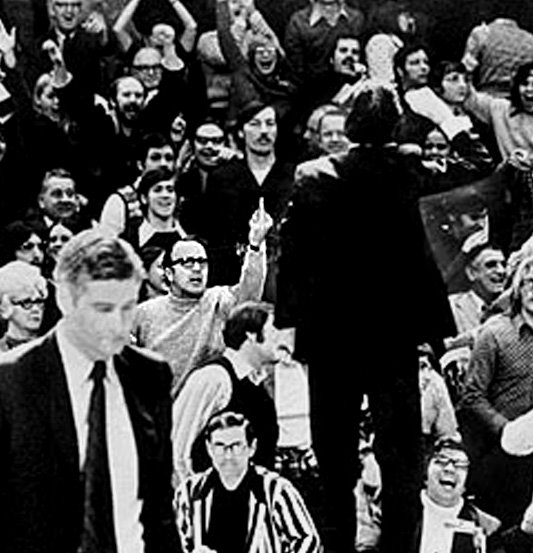
This is from a February 1974 Wisconsin–Marquette game at the Milwaukee Arena. The guy on the table is, of course, Marquette coach Al McGuire, celebrating Marquette’s 59–58 win. The guy walking off the floor is Wisconsin coach John Powless. (Who is still with us as one of the best senior tennis players in the country.) The guy giving McGuire the one-finger salute is Glenn Hughes, father of UW basketball players Kim and Kerry Hughes, who were on the losing end of this game.
McGuire was 20–4 against Wisconsin. When I looked that up, I couldn’t believe that statistic … that McGuire ever lost to Wisconsin. Indeed, when I started watching UW basketball, McGuire was in the midst of his personal 15-game winning streak over Wisconsin. Not until the 1978–79 season, two years after McGuire retired as the national champion coach, did I see Wisconsin beat Marquette.
There were some years in the ’70s when Wisconsin would play (and thus lose to) Marquette twice — once in the Milwaukee Classic (where Marquette and Wisconsin were supposedly co-hosts), and then alternating between Madison and, believe it or not, Milwaukee, presumably because it was theoretically possible that Marquette and Wisconsin wouldn’t meet in the Milwaukee Classic championship game. Glenn Hughes might have been particularly ticked because this Marquette win followed another Marquette win, 49–48, one month earlier.
There is some irony that Marquette has played a few games in Madison not involving Wisconsin. That started in 1969 when (for an unfathomable reason) the UW Fieldhouse (which was decaying even then) hosted the NCAA Midwest Regional. Marquette beat sixth-ranked Kentucky 81–74 before losing to Purdue 75–73 in overtime in the regional final. Then, in 1980, Marquette played a home game at the Dane County Coliseum and beat 10th-ranked Duke 80–77. (The Blue Devils, then coached by Mike Krzyzewski’s predecessor, practiced at my high school. The victim was one of our gym’s backboards, destroyed by Duke’s Gene Banks.)
That sort of playing in your archrival’s home is rare, but not unprecedented. In the years before North Carolina opened the Dean Smith Center, the Tar Heels would play home games in Charlotte and Greensboro, in part because the Dean Dome’s predecessor, Carmichael Auditorium, seated only 10,000. For a few years Kentucky played one home game per season in Louisville, in the days when Louisville and Kentucky didn’t play each other every season. For that matter, it wouldn’t be the craziest idea for Wisconsin to play one home game each season at the Bradley Center, for the same reasons it’s a good idea for Wisconsin to play one regular-season football game at Lambeau Field. It’s the University of Wisconsin, not the University of Madison, after all.
Regular readers know that I don’t really subscribe to the root-for-your-rival-after-you’re-out theory of fandom. I’ve never quite understood the logic of rooting for a team that whipped your butt earlier in a particular season. (And whether it was Michigan or Ohio State in football, Marquette and basically any Big 10 team in basketball, the Bears and Vikings over the Packers, or the Yankees over the Brewers, the team I was rooting for was almost always on the wrong side of the scoreboard.) The only way you should root for your archrival is if a particular game result benefits your team (for instance, the 1993 and 1998 Michigan–Ohio State games, which led to Wisconsin’s 1994 and 1999 Rose Bowl berths).
Even in the years when I worked for a Catholic college, supposedly on the same side as Marquette against the much better funded UW schools, I still cannot root for Marquette. Even when the Warriors won the 1977 NCAA title, I didn’t root for them. Even after his retirement, when McGuire revealed himself to be a fascinating person (you must read Dick Enberg’s book Oh My! for all the dimensions of McGuire) and, when paired with Billy Packer on college basketball games, to be a hilarious broadcasting experience, I would still rather eat lead paint than root for the Golden Eagles.
Thursday’s Louisville–Kentucky game, as you know, features Cardinal coach, and former Wildcat coach, Rick Pitino, who brought the UK program out of the hell of NCAA probation and won a national championship before leaving for the NBA (for the second time, which was no better an idea than the first). If you think it’s strange for a team to play a home game in its archrival’s arena, imagine the oddity of seeing your former coach on the wrong sideline.
The minister who married us was an Iowa fan when they had a church in Iowa. (No, I don’t root for the Hawkeyes either.) They now live in southern Indiana, and they’re big Louisville fans. He posted on Facebook earlier this week that he didn’t grasp the Kentucky–Louisville hatred given that, he claims, Iowa fans root for archrival Iowa State, and vice versa, outside when Iowa plays Iowa State.
To repeat how I started this meandering blog, Marquette is now looking for a new coach after Williams’ departure.
Why did Williams leave? The Milwaukee Journal Sentinel’s Bob Wolfley chronicles some theories from inside the media:
When asked about Buzz Williams’ decision to leave Marquette for Virginia Tech, college basketball analyst Dan Dakich said it seemed to him that Williams was running from a job rather than to one.
In his view, Williams was reacting more to a push than a pull.
“Buzz is smart,” Dakich said Saturday during a telephone interview. “In this day and age, win. If there is any difficulty at all, and I don’t know if there is or isn’t, if you feel it slipping or you feel like you are butting heads, then get out.” …
Dakich was asked if he thought coaching in the ACC, even in the bottom tier, rather than the new Big East, played a significant role in Williams’ decision.
“When you make a decision like that, everything comes into play,” Dakich said. “Everything is a body punch. There are a few knockout punches. Salary. Maybe TV opportunities. So absolutely I think that (conference affiliation) would come into play. Because think about what he is doing. Think about the dramatic shift to where he’s going. He’s going from an urban setting where it was kind of set up for him. Now he going to a place where it’s a rural setting. He’s really taking a culture leap. Not backwards step, just a 180-degree turn. When you do that, that tells me you are unhappy with a lot of things, your current employer. Or, as I say, you are just trying to get out before they get you.” …
Fran Fraschilla, a college basketball analyst for ESPN, said he was not surprised Buzz Williams left his job at Marquette, but he was surprised that it was for the job at Virginia Tech.
Fraschilla is a friend of Williams, in the network of coaches or former coaches with whom he regularly communicates. Fraschilla modestly does not claim the status of mentor in his relationship with Williams.
“There was something missing the last year or so,” Fraschilla said Friday night during a telephone interview. “I could see that Buzz was not quite as happy, for whatever reason. I don’t know what it was. I know he loves his team. Obviously he is a committed guy to his job. He took his responsibility at Marquette very seriously, understood the mission of the school. I just felt that it he thought he needed change. I don’t know why Virginia Tech was the spot for him. As you know Buzz is very (particular) about things, thinks things out. Must have seen something at Virginia Tech that made him feel like this is a good time to leave.” …
Fraschilla said Williams’ six year tenure at Marquette just reached a max point.
“At Marquette you have to grind every single day,” Fraschilla said. “It’s a great job. I have seen the place packed when (Tom) Crean was there. When Buzz was there. Some great tradition, great history. But sometimes you get a sense that five or six years is enough. You need a change. That’s the way things are. You know and I know there are people in Milwaukee who probably think he is a terrible coach. I can tell you as someone who has been around the game a long time he’s a heck of a young coach with tremendous energy.
“He always kept mentioning family to me the last few years,” Fraschilla said. “Asked me how much I missed coaching, why I loved TV so much. (I said) I love being around my family. He said, I don’t want to see my kids grow up without a dad. I don’t know what aspect of that relates to his taking that job.”
Other college basketball analysts offered their reaction to Williams’ decision.
“He’s a hell of a coach and a great guy,” Charles Barkley of Turner Sports said on air Friday night. “Virginia Tech got a really, really good coach.”
Said Clark Kellogg of CBS Sports: “It’s interesting when you think about the landscape of college coaching, it’s hard now because of the pressure that these coaches are under to stay in a place for a long period of time. The support starts to wane if you have a bumpy year or two.”
Williams succeeded Tom Crean after Crean left for Indiana. (Thus, hated archrival becomes hated conference archrival, though perhaps not for long.) Crean succeeded Mike Deane after Deane left for Lamar. Deane succeeded Kevin O’Neill after O’Neill (and his mouth) left for Tennessee. O’Neill succeeded Bob Dukiet after Marquette fired Dukiet.
That list of Golden Eagle begats in reverse proves that Marquette is not a destination job. Williams’ departure is a bit puzzling given that he apparently didn’t get a huge raise to go to Virginia Tech, but Virginia Tech plays in the ACC, and Marquette does not, with the implosion of the Big East.
This is also an awkward time to be choosing a coach, since Marquette presently has neither a full-time athletic director nor a president. If that sounds familiar, it should — that was where Wisconsin was while choosing a coach to replace the late Dave McClain, with AD Elroy Hirsch about to retire and the chancellor position about to be vacated. The football coach, Don Mor(t)on, and the athletic director, Ade Sponberg, were eventually fired by the chancellor, Donna Shalala. The backward hiring was probably unavoidable at the time, but the results were disastrous.
The leading candidate Monday was Virginia Commonwealth coach Shaka Smart, who is from Oregon. Tuesday’s reports indicated Smart was going to stay at VCU, moving attention to Syracuse assistant Mike Hopkins, though Boston College reportedly is pursuing Hopkins too.
So imagine this future scenario: Marquette hires a young coach. Wisconsin’s Bo Ryan retires, while the new coach puts in a few years at Marquette. Would a Marquette coach become a UW candidate?
This sort of almost happened. After UW fired Brad Soderberg, the hot UW candidate was Rick Majerus, who used to coach for … Marquette. (Majerus ended his Marquette tenure — he became the coach after replacing Hank Raymonds, who in turn replaced McGuire; both Raymonds and Majerus were McGuire’s assistants — to become a Bucks assistant coach. After Majerus decided the NBA wasn’t for him after all, he went to Ball State and then Utah, where he took the Utes to an improbable national championship game.)
What makes this unlikely is the different approaches Wisconsin and Marquette have taken in basketball since McGuire arrived in Milwaukee. McGuire recruited from New York (where he grew up) and Chicago until Milwaukee started producing players. Wisconsin hasn’t been able to get the best Milwaukee players for decades; if they don’t go to Marquette, they leave the state. (For that matter, UW hasn’t even gotten Madison’s best players, with Memorial’s Wesley Matthews, whose father played at Wisconsin and assistant coach Bo Ryan, and Vander Blue going to Marquette.) Whether because of UW’s academic standards (which don’t seem to be at the same level on the east end of Interstate 94), or the Badgers’ style of play dating back at least to the Dick Bennett days, or whatever other reason(s), the team that plays at the Kohl Center usually plods (this year being a notable exception), and the team that plays at the Bradley Center usually doesn’t.
Basketball is the number one sport at Marquette, so the basketball coach is the athletic department, and indeed perhaps the single most recognizable representative of the university. Bo Ryan is certainly recognizable, but he’s not the only UW athletic representative, let alone representative of the university.
It was a bummer, though not particularly surprising, that Wisconsin lost the Capital One Bowl in Orlando to South Carolina.
In fact, the Badgers were really only the fifth best team in the Big Ten, or 12, or 14 next season. That’s not as measured in football; that’s measured in finances, as the Wall Street Journal shows:
The only real surprise to me is that Iowa brings in that much more football revenue than Wisconsin with a smaller stadium. The other Big Ten universities ranked higher than Wisconsin all have larger stadiums, as does Penn State.
First, the Wisconsin quarterback who was not in the news this past week, from Fox Sports Wisconsin:
Q: I’m sorry, and I’ve written about this before, but Joel Stave just isn’t a big-time program quarterback. He is so uncomfortable back there and there are just too many things going on for him to handle. Yes, he does make some big plays at just the right moments, but he is by no means a “natural.” Anderson must see something, but what the hell is it?
— Bill Gailbreath, Madison
A: Well, here are just some of the things Andersen — and many others — are probably seeing from Stave:
• He has completed 62.9 percent of his passes this season, which ranks as the sixth-best single-season mark in Wisconsin history.
• His 61.4 percent career completion rate ranks tied for third with Darrell Bevell, behind only Russell Wilson and Scott Tolzien.
• He is third in program history in passing efficiency behind only Wilson and Tolzien.
• He already ranks in the top 10 in career touchdown passes with 21.
• He ranks fifth in the Big Ten this season in passing yards per game (203.8) and fifth in passing efficiency.
Look, I get it that people want to criticize Stave because he has made some errant throws this season and won’t match Wilson’s magical 33-touchdown, four-interception Rose Bowl season two years ago (who would?). But here’s a thought: Why not just appreciate Stave for the player he is and the player he is capable of becoming? The guy is a redshirt sophomore with two more full seasons to be Wisconsin’s quarterback. He keeps improving, coaches are happy with his play, and Wisconsin is 6-2 with a realistic opportunity to make a BCS bowl game.
For decades, Wisconsin football fans would have sold their souls for a quarterback capable of doing all these things. Keep that in mind as you watch Stave continue to get better.
Wilson arguably is the best quarterback in the history of Badger football. Yes, based on one season. When you throw eight times as many touchdown passes as interceptions, well, no one is going to match that over two to four seasons. It says volumes about the moribund state of the Badger passing game, even in the Barry Alvarez era, that after the equivalent of one season as a starter, Stave is already in the top 10 in career marks in passing efficiency, completion percentage and touchdown passes.
Bevell, Wilson, Tolzien, Stave and every other quarterback since Alvarez arrived in Madison have had the additional handicap of having only one wide receiver of any quality to throw to — in order, Lee DeRamus, Tony Simmons, Donald Hayes, Chris Chambers, Nick Davis, Lee Evans and Brandon Williams under Alvarez, and Nick Toon under Bielema. Bielema got Jared Abbrederis because Abbrederis originally was a UW track walk-on.
Stave is the Wisconsin-based quarterback most likely to win this weekend. Then there are the Packers, who now lack their franchise, Aaron Rodgers, thanks to his collarbone injury of uncertain duration.
First observation about Monday night: The loss to Da Bears wasn’t all Wallace’s fault. The defense was unable to get stops of an offense that really isn’t very good. Wallace can be blamed for his ineptitude on the Packers’ last drive, even though he wasn’t very well prepared. (I’d say that’s on coach Mike McCarthy, but it seems that no backup quarterback gets many snaps during the week because of the complicated nature of NFL offenses.)
Wallace’s having to play demonstrates an observation, ironically, from earlier this week — that there are more NFL quarterbacks than NFL-quality quarterbacks. The fact that McCown played better than Wallace also demonstrates that results of backup quarterbacks are usually better when they have the entire week to prepare than when they are thrown into the game.
The game also demonstrated, for all those who have ragged on the Packers for lacking a running game for years, that you win in the NFL based on your quarterback, not on the running game. The Packers have the best running game they’ve had since the Ahman Green-in-his-prime days of a decade ago … and they still lost, and they will continue to lose if Wallace can’t play better and/or Rodgers returns quickly.
The winner of the Irony or Jinx Award is Milwaukee Journal Sentinel sportswriter Bob McGinn, who wrote one week ago:
It’s a simple yet pervasive line of thinking in the event that quarterback Aaron Rodgers should suffer an injury sidelining him for most if not all of the season.
The theory goes that it makes no difference what players might be behind Rodgers. If No. 12 goes down, all hope is lost — the Green Bay Packers would be finished.
Every coach, player and executive working at 1265 Lombardi Ave. should take that as a personal affront.
We’ve seen Mike McCarthy, Ted Thompson, their staffs and the players overcome more injuries in the last four seasons than any National Football League team. Time and time again they’ve lost key players only to plug in well-prepared backups and keep on winning.
They’ve never had to make do without possibly the finest player in the league. Losing Rodgers to major injury would be the nightmare of all nightmares. He makes everyone’s job easier.
Yet, no organization would be better equipped to handle it than Green Bay. …
Having spent much of the week researching the long career of No. 2 quarterback Seneca Wallace and the brief career of practice-squad quarterback Scott Tolzien, the guess here is that even if the Packers were to lose Rodgers early Monday night against the Chicago Bears they’d find ways to finish 11-5.
That probably would earn them one of the top three seedings in the NFC playoff field. Then Green Bay would be a tough out.
It’s hard not to be bullish on the Packers at the midpoint of the season. Playing by far the meat of their schedule, they’ve gone 5-2 despite another unending succession of injuries. With Rodgers, they figure to go 14-2, 13-3 or 12-4. …
Should what some regard as a death knell strike at quarterback, the Packers would grieve, they’d cope and my feeling is they’d come together as an even more unified force.
Certainly, there is potential for a team to suffer some loss of hope without its leader and greatest player. As talented and committed as Rodgers is, and as rule changes increase the value of the quarterback position, the Packers are all but guaranteed no fewer than nine or 10 victories if he lines up 16 times.
I’d see it going the other way. This team is thinking Super Bowl all the way now, and to that end one could foresee a collective groundswell of emotion and effort with the express intention of proving the doomsayers wrong.
Injuries haven’t touched either line. Largely because of that, this team can run the ball and stop the run, maybe the best friends a backup quarterback can have. …
Which brings us to Seneca Wallace, 33, whose career was on life support before the Packers beckoned him Sept. 2 to supplant Vince Young and B.J. Coleman as Rodgers’ backup.
It would be far from ideal. There was no quarterback school or training camp for Wallace in Green Bay, and all he gets in practice now is about 55% of the scout-team reps and a stray snap here and there with the No. 1s.
“He’s a great person,” said left tackle David Bakhtiari. “But he’s never really been in the huddle for a game so I don’t know how he’d react in a game situation.”
Wallace, however, does have 1,573 regular-season snaps under his belt. Most of them came in Seattle, where coach Mike Holmgren and Thompson drafted him in the fourth round in 2003 because they wanted Matt Hasselbeck’s backup to have an entirely different set of skills.
After backing up Hasselbeck and Trent Dilfer for two years, Wallace moved up to No. 2 in 2005 and then started 14 games for an injured Hasselbeck from 2006-’09.
He was traded to Cleveland in March 2010 for a seventh-round draft choice and given a $2 million signing bonus a year later. In two seasons for bad Browns teams, he started seven games.
Wallace’s 6-15 record as a starter includes an 11-10 record against the spread. Thirteen of the teams that he started against finished with winning records, and 10 made the playoffs. His team was favored five times in those 21 games.
His career passer ratings are 81.3 in the regular season and 78.3 in exhibition games. His rushing totals are 293 and 256 yards, respectively. A speedy, gifted athlete with excellent toughness, he played about 30 snaps at wide receiver and made six receptions.
Wallace stands 5 feet 11½ inches and weighs 206.
“If you have (height) requirements you just move on from him,” Scot McCloughan, Seattle’s director of college scouting in 2003, said at the time. “But he’s a quarterback that’s a winner. Whatever it takes.”
The Seahawks saw Wallace pick up Holmgren’s complicated West Coast system after diligent application, throw better deep balls than Hasselbeck and consistently slip and slide to avoid rushers and run for first downs. He has a compact delivery, good snap on the ball and accuracy moving to his right.
Besides height, the reason scouts say Wallace was never handed a starting job was indecision and lack of patience in the pocket together with average overall accuracy.
“He was in a very similar offense to Green Bay’s for a long time,” one personnel man said. “I think that’s what Green Bay was counting on when they signed him.”
Last week, two scouts for AFC teams were asked to judge Wallace against the 31 other No. 2 quarterbacks.
The first preferred Wallace to 19 backups, took five over him and rated seven as a tossup. The second favored Wallace over 15 and the other 16 over him.
We’ll see. I picked the Packers for 10–6 because “The schedule to me includes three no-way-in-hell-will-they-win-there road games — at San Francisco, at Baltimore and at the Giants — and they will probably lose one divisional game they shouldn’t lose and one home game they shouldn’t lose.” The win at Baltimore was thus on the positive side, but Monday’s loss was a loss they should not have lost. so they cancel out each other. They should win Sunday, but that is now in serious doubt. Including Sunday, their next four games — Philadelphia, at the Giants, Minnesota and at Detroit Thanksgiving Day — now could result in just one win, Minnesota, which is terrible and unlikely to win outdoors.
Seneca Wallace may indeed be a capable backup quarterback. But until and if Rodgers returns, the Packers don’t need him to be backup; they need him to be an NFL-quality starting quarterback, and he’s really not been that before now.