In 1955, Ed Cole unleashed the Small Block V8 on the world and instantly turned General Motors’ ho-hum entry-level brand into a performance powerhouse. Throughout the following decades, his compact, 4.4-inch on-center bore spaced 90-degree pushrod V8 transformed badges like Bel Air, Camaro, Chevelle, and Corvette into some of the world’s fastest and most desirable cars. But no matter how lust-worthy these burbling, swaggering slices of American shock-and-awe became, Cole and his successors were sure to keep the company’s core mission of mass affordability front and center. As recently as 2017, one could walk into the local Chevrolet showroom and come face to face with six different cars powered by the decedents of Cole’s game-changing bent-eight. Most importantly, even after 62 years of progress, safety mandates, and inflation, all six eight-cylinder sleds still landed between “instant approval with proof of some regular income” and “something just about anyone could realistically aspire to own.”
Back in ’17, the Small Block Club was accessible from just $36,905. That humble sum secured a manual transmission, 455-horse 6.2L LT1-powered Sixth-Gen Camaro 1SS that was fresh off a Car of the Year title. Those who wanted to add all of the trimmings, like heated/cooled seats and wireless phone charging, to the mix could upgrade to a 2SS for $41,905. In the underappreciated masterpiece that was the Ausie-imported – and confusingly named – SS, 2017 also marked the last time you could get a new eight-cylinder sedan from Chevy; it came fully loaded for $46,625. At the same time, the award-winning base C7 Corvette Stingray carried an MSRP of just $55,450. If you thought some extra “juice” was worth squeezing your wallet a little, there were three options still on the table, starting with the 650 HP, $61,140 Camaro ZL1. On top of that were two varieties of widebody Corvette that you could get your hands on without having to cut a check over $80,000.
Looking back at that performance-per-dollar paints a bleak picture of our Bowtie buying power just seven short years later. The SS sedan, and Australian auto-manufacturing itself, is already a distant memory. As of this week, the Camaro has been re-retired, and the mid-engine replacement for 66 years of original recipe Corvette development, once heralded as the deal of the century, has seen $10,000 in price creep over its first four years on sale, putting its basement floor almost 26% above of its Stingray predecessor’s 2017 starting point.
Not only is Chevy’s once-proud blue-collar performance corral down to just three flavors of Corvette, where it previously served up more attainable sedan and 2+2 Pony Cars, but the two-door leftovers have had their economics of ownership significantly altered. Not only has the base Corvette left the previous model in the dust financially, but it now acts as the entry point for all V8 goodness. That makes the cheapest V8-powered Chevy 89% more expensive than it was in 2017. The Stingray also stands as the only option under the ceiling set by the previous Z06. Elsewhere, the new E-Ray trim replaces the once-popular Grand Sport in the middle of the Corvette pack. At $106,495, it starts a whopping $41,045, or 62.7%, higher than the first-year C7 GS was asking. Then there’s the Z06 that acts as top dog in ’24, as it did in 2017. A side-by-side comparison reveals the new car to be 40.59% more expensive, with its ballooning bottom line now totaling $111,695 before buyers check a single option box!
Looking ahead, the C8 Corvette family is expecting two more models to join the fold. The imminent twin-turbo ZR1 is set to take the Crossed Flags to new heights, but to do this, it’ll have to leave traditional ‘Vette customers out to dry. With the Z06 as a starting point and 850+ horses on board, we won’t flinch if the 2025 ZR1 starts at $200,000 or more. After that, the only other murmurings about future Corvettes revolve around a halo model called “Zora” that is set to join the ZR1 and E-Ray powertrains in unholy matrimony to the tune of four-digit horsepower. With the ZR1 already poised to cross the $200k barrier, what could Chevy have in mind for its AWD HyperVette? $250,000? $300,000? We aren’t sure, but in a world where Ford feels comfortable slapping a $300k price tag on a Mustang that isn’t half as technically impressive, there’s no telling where this thing could land!
As exciting as the prospect of a 1,000+ HP Corvette is to us as long-time fans of the Crossed Flags, Chevrolet’s C8 pricing strategy is equally disheartening to us as prospective owners. Despite our ingenious suggestion, it appears as if the sizable sub-Stingray space that the Camaro was forced to vacate AND the $37,000 gap between the Base ‘Vette and the E-Ray are going to continue getting the cold shoulder from the parent company. With the 1LT Stingray now swimming in $70,000 waters and nothing in the pipeline aimed at long-time customers who can’t spend more than $1,000 per month on what usually amounts to a weekend toy, Ed Cole’s “performance for all” blueprint just might have reached its expiration date.
And not just at Chevrolet. Chrysler is discontinuing the Dodge Challenger, whose Hemi V8-powered R/T stickers just below $40,000. That leaves just the Ford Mustang GT, which starts around $42,000 for a 5.0-liter V8 and six-speed manual transmission.
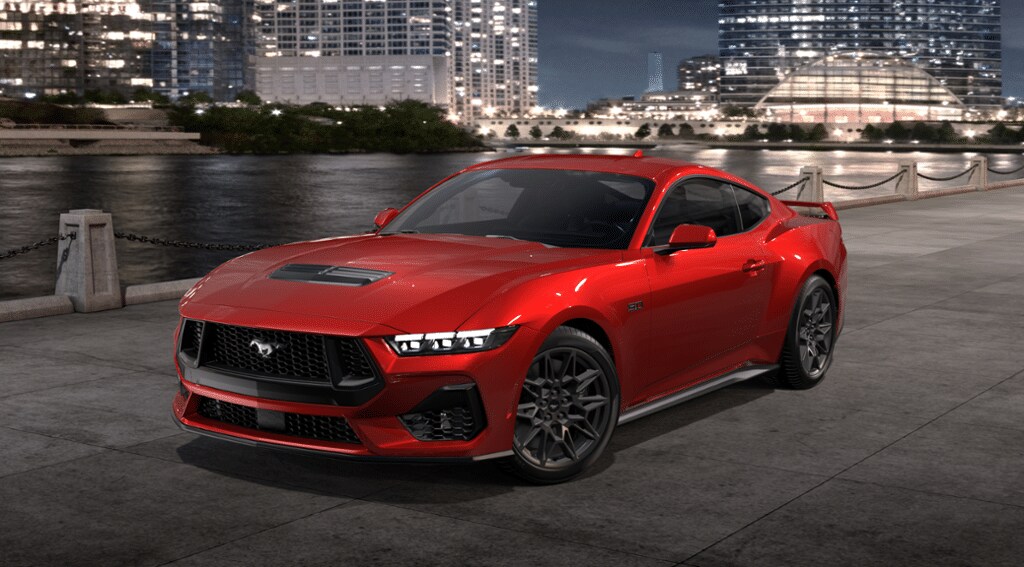
A choice of one beats a choice of none, but it’s not that much better.
 Steve Prestegard.com: The Presteblog
Leave a comment