Sept. 11, 2001 started out as a beautiful day, in Wisconsin, New York City and Washington, D.C.
I remember almost everything about the entire day. Sept. 11, 2001 is to my generation what Nov. 22, 1963 was to my parents and Dec. 7, 1941 was to my grandparents.
I had dropped off our oldest son, Michael, at Ripon Children’s Learning Center. As I was coming out, the mother of one of Michael’s group told me to find a good radio station; she had heard as she was getting out with her son that a plane had hit the World Trade Center.
I got in my car and turned it on in time to hear, seemingly live, a plane hit the WTC. But it wasn’t the first plane, it was the second plane hitting the other tower.
As you can imagine, my drive to Fond du Lac took unusually long that day. I tried to call Jannan, who was working at Ripon College, but she didn’t answer because she was in a meeting. I had been at Marian University as their PR director for just a couple months, so I didn’t know for sure who the media might want to talk to, but once I got there I found a couple professors and called KFIZ and WFDL in Fond du Lac and set up live interviews.
The entire day was like reading a novel, except that there was no novel to put down and no nightmare from which to wake up. A third plane hit the Pentagon? A fourth plane crashed somewhere else? The government was grounding every plane in the country and closing every airport?
I had a TV in my office, and later that morning I heard that one of the towers had collapsed. So as I was talking to Jannan on the phone, NBC showed a tower collapsing, and I assumed that was video of the first tower collapse. But it wasn’t; it was the second tower collapse, and that was the second time that replay-but-it’s-not thing had happened that day.
Marian’s president and my boss (a native of a Queens neighborhood who grew up with many firefighter and police officer families, and who by the way had a personality similar to Rudy Giuliani) had a brief discussion about whether or not to cancel afternoon or evening classes, but they decided (correctly) to hold classes as scheduled. The obvious reasons were (1) that we had more than 1,000 students on campus, and what were they going to do if they didn’t have classes, and (2) it was certainly more appropriate to have our professors leading a discussion over what had happened than anything else that could have been done.
I was at Marian until after 7 p.m. I’m sure Marian had a memorial service, but I don’t remember it. While I was in Fond du Lac, our church was having a memorial service with our new rector (who hadn’t officially started yet) and our interim priest. I was in a long line at a gas station, getting gas because the yellow low fuel light on my car was on, not because of panic over gas prices, although I recall that one Fond du Lac gas station had increased their prices that day to the ridiculous $2.299 per gallon. (I think my gas was around $1.50 a gallon that day.)
Two things I remember about that specific day: It was an absolutely spectacular day. But when the sun set, it seemed really, really dark, as if there was no light at all outside, from stars, streetlights or anything else.
For the next few days, since Michael was at the TV-watching age, we would watch the ongoing 9/11 coverage in our kitchen while Michael was watching the 1-year-old-appropriate stuff or videos in our living room. That Sunday, one of the people who was at church was Adrian Karsten of ESPN. He was supposed to be at a football game working for ESPN, of course, but there was no college football Saturday (though high school football was played that Friday night), and there was no NFL football Sunday. Our organist played “God Bless America” after Mass, and I recall Adrian clapping with tears down his face; I believe he knew some people who had died or been injured.
Later that day was Marian’s Heritage Festival of the Arts. We had record attendance since there was nothing going on, it was another beautiful day, and I’m guessing after five consecutive days of nonstop 9/11 coverage, people wanted to get out of their houses.
In the decade since then, a comment of New York City Mayor Rudy Giuliani has stuck in my head. He was asked a year or so later whether the U.S. was more or less safe since 9/11, and I believe his answer was that we were more safe because we knew more than on Sept. 10, 2001. That and the fact that we haven’t been subject to another major terrorist attack since then is the good news.
Osama bin Laden (who I hope is enjoying Na’ar, Islam’s hell) and others in Al Qaeda apparently thought that the U.S. (despite the fact that citizens from more than 90 countries died on 9/11) would be intimidated by the 9/11 attacks and cower on this side of the Atlantic Ocean, allowing Al Qaeda to operate with impunity in the Middle East and elsewhere. (Bin Laden is no longer available for comment.) If you asked an American who paid even the slightest attention to world affairs where a terrorist attack would be most likely before 9/11, that American would have replied either “New York,” the world’s financial capital, or “Washington,” the center of the government that dominates the free world. A terrorist attack farther into the U.S., even in a much smaller area than New York or Washington, would have delivered a more chilling message, that nowhere in the U.S. was safe. Al Qaeda didn’t think to do that, or couldn’t do that. The rest of the Middle East also did not turn on the U.S. or on Israel (more so than already is the case with Israel), as bin Laden apparently expected.
The bad news is all of the other changes that have taken place that are not for the better. Bloomberg Businessweek asks:
So was it worth it? Has the money spent by the U.S. to protect itself from terrorism been a sound investment? If the benchmark is the absence of another attack on the American homeland, then the answer is indisputably yes. For the first few years after Sept. 11, there was political near-unanimity that this was all that mattered. In 2005, after the bombings of the London subway system, President Bush sought to reassure Americans by declaring that “we’re spending unprecedented resources to protect our nation.” Any expenditure in the name of fighting terrorism was justified.
A decade later, though, it’s clear this approach is no longer sustainable. Even if the U.S. is a safer nation than it was on Sept. 11, it’s a stretch to say that it’s a stronger one. And in retrospect, the threat posed by terrorism may have been significantly less daunting than Western publics and policymakers imagined it to be. …
Politicians and pundits frequently said that al Qaeda posed an “existential threat” to the U.S. But governments can’t defend against existential threats—they can only overspend against them. And national intelligence was very late in understanding al Qaeda’s true capabilities. At its peak, al Qaeda’s ranks of hardened operatives numbered in the low hundreds—and that was before the U.S. and its allies launched a global military campaign to dismantle the network. “We made some bad assumptions right after Sept. 11 that shaped how we approached the war on terror,” says Brian Fishman, a counterterrorism research fellow at the New America Foundation. “We thought al Qaeda would run over the Middle East—they were going to take over governments and control armies. In hindsight, it’s clear that was never going to be the case. Al Qaeda was not as good as we gave them credit for.”
Yet for a decade, the government’s approach to counterterrorism has been premised in part on the idea that not only would al Qaeda attack inside the U.S. again, but its next strike would be even bigger—possibly involving unconventional weapons or even a nuclear bomb. Washington has appropriated tens of billions trying to protect against every conceivable kind of attack, no matter the scale or likelihood. To cite one example, the U.S. spends $1 billion a year to defend against domestic attacks involving improvised-explosive devices, the makeshift bombs favored by insurgents in Afghanistan. “In hindsight, the idea that post-Sept. 11 terrorism was different from pre-9/11 terrorism was wrong,” says Brian A. Jackson, a senior physical scientist at RAND. “If you honestly believed the followup to 9/11 would be a nuclear weapon, then for intellectual consistency you had to say, ‘We’ve got to prevent everything.’ We pushed for perfection, and in counterterrorism, that runs up the tab pretty fast.”
Nowhere has that profligacy been more evident than in the area of homeland security. “Things done in haste are not done particularly well,” says Jackson. As Daveed Gartenstein-Ross writes in his new book, Bin Laden’s Legacy, the creation of a homeland security apparatus has been marked by waste, bureaucracy, and cost overruns. Gartenstein-Ross cites the Transportation Security Agency’s rush to hire 60,000 airport screeners after Sept. 11, which was originally budgeted at $104 million; in the end it cost the government $867 million. The homeland security budget has also proved to be a pork barrel bonanza: In perhaps the most egregious example, the Kentucky Charitable Gaming Dept. received $36,000 to prevent terrorists from raising money at bingo halls. “If you look at the past decade and what it’s cost us, I’d say the rate of return on investment has been poor,” Gartenstein-Ross says.
Of course, much of that analysis has the 20/20 vision of hindsight. It is interesting to note as well that, for all the campaign rhetoric from candidate Barack Obama that we needed to change our foreign policy approach, president Obama changed almost nothing, including our Afghanistan and Iraq involvements. It is also interesting to note that the supposed change away from President George W. Bush’s us-or-them foreign policy approach hasn’t changed the world’s view, including particularly the Middle East’s view, of the U.S. Someone years from now will have to determine whether homeland security, military and intelligence improvements prevented Al Qaeda from another 9/11 attack, or if Al Qaeda wasn’t capable of more than just one 9/11-style U.S. attack.
Hindsight makes one realize how much of the 9/11 attacks could have been prevented or at least their worst effects lessened. One year after 9/11, the New York Times book 102 Minutes: The Untold Story of the Fight to Survive Inside the Twin Towers points out that eight years after the 1993 World Trade Center bombing, New York City firefighters and police officers still could not communicate with each other, which led to most of the police and fire deaths in the WTC collapses. Even worse, the book revealed that the buildings did not meet New York City fire codes when they were designed because they didn’t have to, since they were under the jurisdiction of the Port Authority of New York and New Jersey. And more than one account shows that, had certain people at the FBI and elsewhere been listened to by their bosses, the 9/11 attacks wouldn’t have caught our intelligence community dumbfounded. (It does not speak well of our government to note that no one appears to have paid any kind of political price for the 9/11 attacks.)
I think, as Bloomberg BusinessWeek argued, our approach to homeland security (a term I loathe) has overdone much and missed other threats. Our approach to airline security — which really seems like the old error of generals’ fighting the previous war — has made air travel worse but not safer. (Unless you truly believe that 84-year-old women and babies are terrorist threats.) The incontrovertible fact is that every 9/11 hijacker fit into one gender, one ethnic group and a similar age range. Only two reasons exist to not profile airline travelers — political correctness and the assumption that anyone is capable of hijacking an airplane, killing the pilots and flying it into a skyscraper or important national building. Meanwhile, while the U.S. spends about $1 billion each year trying to prevent Improvised Explosive Device attacks, what is this country doing about something that would be even more disruptive, yet potentially easier to do — an Electromagnetic Pulse attack, which would fry every computer within the range of the device?
We have at least started to take steps like drilling our own continent’s oil and developing every potential source of electric power, ecofriendly or not, to make us less dependent on Middle East oil. (The Middle East, by the way, supplies only one-fourth of our imported oil. We can become less dependent on Middle East oil; we cannot become less dependent on energy.) But the government’s response to 9/11 has followed like B follows A the approach our culture has taken to risk of any sort, as if covering ourselves in bubblewrap, or even better cowering in our homes, will make the bogeyman go away. Are we really safer because of the Patriot Act?
American politics was quite nasty in the 1990s. For a brief while after 9/11, we had impossible-to-imagine moments like this:
And then within the following year, the political beatings resumed. Bush’s statement, “I ask your continued participation and confidence in the American economy,” was deliberately misconstrued as Bush saying that Americans should go out and shop. Americans were exhorted to sacrifice for a war unlike any war we’ve ever faced by those who wouldn’t have to deal with the sacrifices of, for instance, gas prices far beyond $5 per gallon, or mandatory national service (a bad idea that rears its ugly head in times of anything approaching national crisis), or substantially higher taxes.
Then again, none of this should be a surprise. Other parts of the world hate Americans because we are more economically and politically free than most of the world. We have graduated from using those of different skin color from the majority as slaves, and we have progressed beyond assigning different societal rights to each gender. We tolerate different political views and religions. To the extent the 9/11 masterminds could be considered Muslims at all, they supported — and radical Muslims support — none of the values that are based on our certain inalienable rights. The war between our world, flawed though it is, and a world based on sharia law is a war we had better win.
In one important sense, 9/11 changed us less than it revealed us. America can be both deeply flawed and a special place, because human beings are both deeply flawed and nonetheless special in God’s eyes. Jesus Christ is quoted in Luke 12:48 as saying that “to whomsoever much is given, of him shall be much required.” As much as Americans don’t want to be the policeman of the world, or the nation most responsible for protecting freedom worldwide, there it is.
Today in 1956, London police were called to break up a crowd of teenagers after the showing of the film “Rock around the Clock” at the Trocadero Cinema.
That prompted a letter to the editor in the Sept. 12, 1956 London Times:
The hypnotic rhythm and the wild gestures have a maddening effect on a rhythm loving age group and the result of its impact is the relaxing of all self control.
The British demonstrated their lack of First Amendment by banning the film in several cities.
Talk-show host, attorney, and best-selling author Larry Elder said the breakdown of the family — fatherless families — is the number one problem in America, not racism or discrimination or bad cops. He added that when it comes to murder, nearly half of the homicides each year are black-on-black killings.
Commenting on The Rubin Report, Larry Elder said there is a liberal agenda at work and “the goal is to tell black people that we’re victims, that discrimination, racism remain major problems in America when, in fact, they don’t. And they want black people to vote for the Democratic Party.”
“The Democratic Party gets 95% of the black vote, and the reason they get it is blacks are convinced that the number one issue facing the country is social justice, racist white cops, discrimination, systemic racism, micro-aggression – whatever new word they come up with – and it’s a bunch of nonsense,” he said.
“The number one problem domestically facing this country is the breakdown of the family,” said Elder. “And President Obama said it, I didn’t. A kid raised without a dad is five times more likely to be poor and commit crimes; nine times more likely to drop out of school; and 20 times more likely to end up in jail.”
“So, you’re far more likely to end up in jail without having a dad, than you are because of a white racist cop,” said Elder.
When host Dave Rubin brought up the issue of “systemic” discrimination against blacks, Elder repeatedly asked him to provide a specific example. “Give me the most blatant racist example you can come up with right now,” he said.
Rubin then said, “I think you could probably find evidence that, in general, cops are more willing to shoot if the perpetrator is black than white.”
Elder said, “What’s your data, what’s your basis for saying that? I’m talking about what the facts are. Nine hundred sixty-five people were shot by cops last year and killed. Four percent of them were white cops shooting unarmed blacks. In Chicago, in 2011, 21 people were shot and killed by cops. In 2015, there were seven.”
“In Chicago, which is a third black, a third white, a third Hispanic, 70% of the homicides are black on black – about 40 per month, almost 50 per year – last year in Chicago and 75% of them are unsolved,” he said. “Where is Black Lives Matter on that?”
“The idea that a racist white cop shooting unarmed black people is a peril to black people is BS,” said Elder. “It’s complete and total BS. And the reason for these so-called activists saying this is the assumption that racism remains a major problem in America, and the media, CNN and especially MSNBC, runs down whenever a black cop shoots somebody, and it’s [then] some march in Washington. It’s ridiculous.”
“Half the homicides in this country are committed by and against black people,” said Elder. “Last year there were 14,000 homicides – not talking about suicides, I’m talking about homicides — half of them were black [and] 96% of them were black on black of that 7,000. Where’s the Black Lives Matter on that?”
Larry Elder, 65, is the author of the best-seller, The 10 Things You Can’t Say in America. He is the son of a janitor. He was reared in South Central Los Angeles. He earned his B.A. from Brown University and his JD from the University of Michigan School of Law. He has a star on the Hollywood Walk of Fame and is the host of the radio program, “The Larry Elder Show.”
Today in 1962, the BBC banned playing the newly released “Monster Mash” by Bobby “Boris” Pickett on the grounds that it was offensive. To use vernacular of the day, uncool.
Eleven years later, the BBC banned the Rolling Stones’ “Star Star,” but if you play the clip you can hear why (really):
Nick Gillespie watched Wednesday’s CNN town hall with the 296 Democratic presidential candidates on climate change, which …
… wasn’t just long (seven hours!). It was deeply revealing about how Democratic presidential candidates think about government’s power to regulate virtually all aspects of human behavior and how they approach policy and cultural change.
The Democratic contenders have laid out plans costing anywhere from about $1 trillion (Pete Buttigieg) to $16 trillion (Bernie Sanders) in direct federal spending on climate change over the next decade. About half of the candidates have endorsed the Green New Deal proposed by Rep. Alexandria Ocasio-Cortez (D–N.Y.) and Sen. Ed Markey (D–Mass.), which could cost as much as $90 trillion to implement. As important as any specific policy or position outlined last night were the general attitudes that were widely shared by the participants.
A number likened fighting climate change to the effort to win World War II, a metaphor that perhaps says more about their comfort with regimenting society than the speakers intended. During World War II, all industrial production was overseen by the federal government, food and fuel were rationed, and civil liberties were sharply curtailed in the interest of defeating the Axis powers.
In a related way, the candidates all bought into the apocalyptic premises of the questioners, who took for granted the idea that the world is likely to end in a decade or so unless massive, transformational change takes place. The resulting conversations were thus long on the need for action and short on the need to build consensus or to fully assess the costs and benefits of particular actions.
Here are four memorable moments involving the leading candidates:
1. Joe Biden: Here’s Blood in Your Eye.
Whatever the former vice president and Delaware senator actually said last night will forever be a footnote to the fact that his left eye apparently filled with blood during his time on the stage, leading Hot Air‘s Allahpundit to suggest that “individual Biden body parts are now generating their own gaffes.”
The bloody eye won’t help a campaign that has been plagued with questions about the 76-year-old’s mental and physical health, but the less we remember about what Biden actually says on the campaign trail, the better. Indeed, the nation’s only fully satisfied Amtrak rider had barely started talking when he announced, “We can take millions of vehicles off the roads if we have high-speed rail.” That’s a callback to President Barack Obama’s high-speed rail plans, which went nowhere even when the Democrats controlled the White House and Congress. There’s simply no reason to believe that high-speed rail will ever be successfully built in America (California alone has spent a decade and billions of federal, state, and local tax dollars while making effectively zero progress on its high-speed rail project)—and even if it does get built, there’s little reason to expect it to yield meaningful environmental benefits.
2. Elizabeth Warren: “We only have 11 years to cut our emissions in half.” So let’s … stop using nuclear power?
Sen. Elizabeth Warren (D–Mass.) famously has a plan for everything. While the former Harvard Law School prof sidestepped questions about whether the government would continue to dictate what light bulbs Americans can buy (so that’s a yes), she stressed that we’ve “got, what, 11 years, maybe, to reach a point where we’ve cut our emissions in half.” In suggesting that the world will end in 2030 unless we dramatically reduce greenhouse gas emissions, Warren is invoking Ocasio-Cortez’s stunning misreading of a 2018 Intergovernmental Panel on Climate Change report. Far from declaring that the planet would soon be fried, the report theorizes that, as Reason‘s Ronald Bailey writes, “if humanity does nothing whatsoever to abate greenhouse gas emissions, the worst-case scenario is that global GDP in 2100 would be 8.2 percent lower than it would otherwise be.”
Whether or not such a projection is reliable, Warren clearly believes in the 2030 apocalypse. That makes the stance she took last night against nuclear power puzzling, since nuclear is much cleaner than fossil fuels or coal. “In my administration, we won’t be building new nuclear plants,” she said. “We will start weaning ourselves off nuclear and replace it with renewables.” Which is to say, she’s in line with many progressives (including Bernie Sanders, Ed Markey, and AOC), who say simultaneously that the world is ending but nuclear power should remain off the table, even as they push “solar panels, [which] produce 300 times more waste for the amount of energy created than do nuclear plants,” according to environmentalist researcher Michael Shellenberger. Staring down a supposed existential threat, Warren and her anti-nuke allies still have principles, or something.
Sen. Elizabeth Warren: “The fossil fuel industry… want[s] to be able to stir up a lot of controversy around lightbulbs, around your straws, and around your cheeseburgers when 70% of the pollution of the carbon that we’re throwing into the air comes from 3 industries.” pic.twitter.com/DhQXbLJO3P
3. Bernie Sanders: Aggressively fighting the phantom menace of global overpopulation.
A teacher at the town hall said world population was growing beyond the planet’s carrying capacity and asked Bernie Sanders the following:
“Empowering women and educating everyone on the need to curb population growth seems a reasonable campaign to enact. Would you be courageous enough to discuss this issue and make it a key feature of a plan to address climate catastrophe?”
Pro-life right-wingers are hot and bothered over the Vermont senator’s willingness to support taxpayer-supported birth control, including abortions, in his quest to defeat climate change. For those of us who believe in female autonomy and reproductive rights, that’s far less troubling than watching him buy into the idea that global overpopulation is in any way a problem.
As the folks at Our World in Data note, “global population growth reached a peak in 1962 and 1963 with an annual growth rate of 2.2%….For the last half-century we have lived in a world in which the population growth rate has been declining.” The United Nations has changed its projections for population growth; it now even suggests a 27 percent chance that global population will peak and start to decline by 2100. And there’s this:
Demographer Wolfgang Lutz and his colleagues at the International Institute of Applied Systems Analysis (IIASA) believe that the United Nations’ projections are likely to be too high. In their 2018 demographic assessment, IIASA calculates a medium fertility scenario that would see world population peak at 9.8 billion people at around 2080 and fall to 9.5 billion by 2100.
If worries about the world ending by 2030 are overstated, so too are fears of a planet that can’t support its population, especially given the incredible strides we’ve recently made in reducing global poverty and increasing general living standards.
4. Kamala Harris: “I think we should” ban plastic straws.
“Plastic straws are a big thing right now,” said CNN’s Erin Burnett to Kamala Harris. “Do you ban plastic straws?” “I think we should, yes,” replied the California senator, who then proceeded to laugh uneasily as she said paper straws were not very good.
The moral panic about plastic straws exemplifies how discussions of environmental issues go off the rails. As Reason‘s Christian Britschgi revealed in January 2018, the erroneous idea that Americans used 500 million straws a day was based on a school project done in 2011 by a nine-year-old boy in California. America in fact contributes only a small portion of the world’s plastic pollution problem, and straws represent just a tiny fraction of that. And yet by the end of last year, plastic straws were “an endangered species” around the country due to outrage over a made-up number.
But Harris wasn’t simply trash-talking plastic straws. She also spent time attacking the eating of red meat, calling for the end of land sales for oil and gas drilling, and pledging to end fracking, the very technology that helped lower U.S. greenhouse gas emissions to record-low levels.
Democrat presidential candidate Kamala Harris wants to ban plastic straws, says about paper straws: “If you don’t gulp it down immediately it starts to bend” pic.twitter.com/cnIddUuj1s
The libertarians might gloss over Sanders’ views about abortion as population control. Leah Barkoukis did not:
President Trump’s re-election campaign already took advantage of the content and made some great videos of all the crazy things Democrats said during the program—from vowing to get rid of plastic straws, banning offshore drilling, and ending all fracking, to disincentivizing meat eating. But some Democrats, including Sen. Bernie Sanders, took the issue of population control to new levels.
A member of the audience, Martha Readyoff, who was identified as a teacher, told Sanders the planet has experienced a doubling of human population growth in the last 50 years and this is unsustainable.
“I realize this is a poisonous topic for politicians but it’s crucial to face,” she said. “Empowering women and educating everyone on the need to curb population growth seems a reasonable campaign to enact. Would you be courageous enough to discuss this issue and make it a key feature of a plan to address climate catastrophe?”
“The answer’s yes,’” Bernie answered. “Women in the United States of Americas, by the way, have a right to control their own bodies and make reproductive decisions.”
“And the Mexico City agreement — which denies American aid to those organizations around the world that allow women to have abortions or even get involved in birth control — to me is totally absurd,” he continued. “So, I think, especially in poor countries around the world where women do not necessarily want to have large numbers of babies and where they can have the opportunity through birth control to control the number of kids they have, it’s something I very strongly support.”The response shook Twitter users.
Democrat Voter: There are too many humans on earth.
Bernie: I agree. We need to fund abortions to poor, third world countries.
Let’s just state for the record: talking about needing “population control” through ABORTION for the sake of CLIMATE is talking about EUGENICS. The fact that @BernieSanders is willing to entertain this vile idea is not only disgusting, it should be disqualifying.
A woman asks Bernie Sanders how he would help curb overpopulation of the earth. Sanders replies—I kid you not—that we need increased access to ABORTION to curb population growth in order to prevent climate change.
Whether or not ending abortion is likely, or whether you support or oppose abortion rights, the concept of abortion as population control should be beyond the pale. It’s as if Margaret Sanger is Sanders’ eugenics advisor.
Today in 1926, Radio Corporation of America created the National Broadcasting Co. …
… which later returned to RCA’s parent, General Electric Co. (from whose name came the famous NBC chimes), and now is part of what used to be Universal Studios …
… and is part of Comcast cable TV.
The number one single in Britain today in 1965:
Today in 1971, five years to the day after John Lennon met Yoko Ono, Lennon released his “Imagine” album:
Another NFL season gives us the opportunity to return to the Presteblog tradition of examining big sports wins from the perspective of the losing side.
This tradition started with the Chicago Bears because no sports media eviscerates the home teams quite like Chicago does, as proven by the Chicago Tribune’s Brad Biggs:
Be careful. Don’t blame Matt Nagy for sitting his frontline players throughout nearly all of the preseason for the pitiful performance by his offense.
I’m positive that is what some folks are already doing, rationalizing a terrible showing by the offense on a little rust that wasn’t knocked off in preseason. The Bears were so bad on offense that it’s not something 40 or 50 snaps in preseason games would have cured.
It’s a best-case scenario that the reason the offense was disjointed and terribly ineffective on third down and suffered from communication breakdowns because the starters were observers throughout the preseason. But it’s really difficult to imagine how the Bears — who had since April to prepare for the rival Packers — could come out and look simply awful.
Nagy was the NFL’s Coach of the Year last season, an award he deserved. He didn’t forget what he was doing since then. But there’s no other way to describe it other than to say he was completely outclassed in this game. Never before had the Bears been held to three points or less in the season opener at home and this was in front of a national television audience with a huge crowd in Grant Park watching an offensive implosion.
Credit is due to the Packers, who reshaped their defense in the offseason with some bold moves in free agency, including a $36 million, four-year contract for former Bears safety Adrian Amos. Green Bay also made moves to bolster the front seven, signing outside linebackers Za’Darius Smith and Preston Smith. But the Packers don’t have the 1985 Bears defense. Heck, they don’t have the 2019 Bears defense.
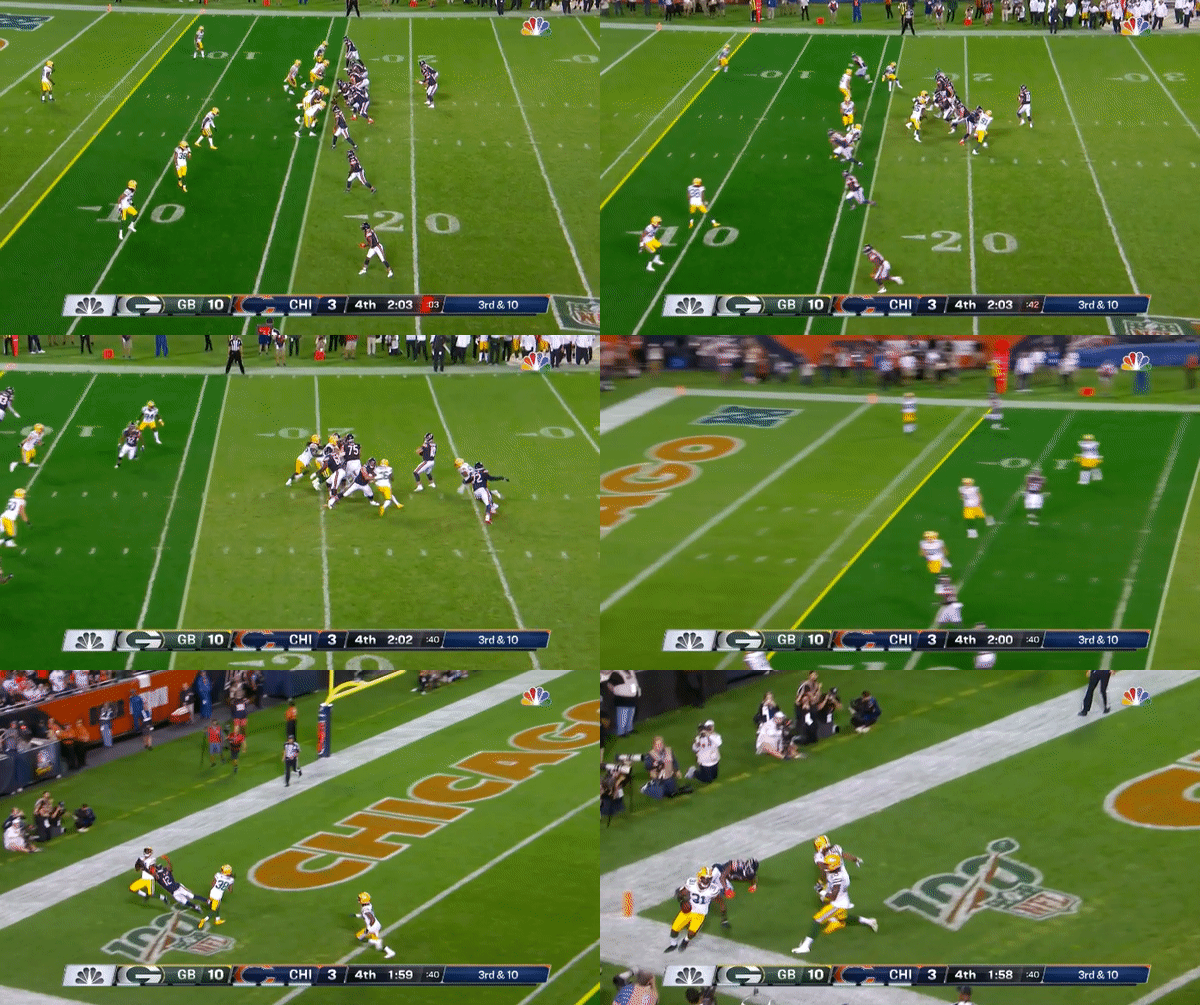
Quarterback Mitch Trubisky was as bad as he was in the playoff loss to the Eagles last January. He completed 26 of 45 passes for 228 yards and was sacked five times, a couple of them avoidable losses. Amos picked him off in the end zone with 1:58 remaining to just about end the game. A good chunk of his 228 yards came on check-down throws.
Wide receiver Allen Robinson, the intended target on the interception, had a nice game with seven catches for 102 yards. But that’s about it if you’re searching for offensive highlights. I told Robinson folks will be wondering if a preseason without any action would be an explanation for a poor showing.
“They can keep wondering that,” he said. “We can’t change that. I felt very prepared to go out here and make plays and I think everyone else did the same. But we just got behind the sticks, whether it was a penalty, no matter what it was. In a crucial situation, for whatever reason, we end up getting — what — first-and-40? You know what I am saying? We were down four points at that time. First-and-40? It’s hard like that. We’ve gotta do a better job on first and second down to give ourselves a shot on third down. And we also have to do a better job on first and second down to stay out of some third downs too.”
Said Trubisky: “I know you guys are going to try to draw comparisons like that, but really it had — I wish I could have said this before, the snaps in the preseason has nothing to do with the way we execute or the sloppiness of tonight because we weren’t doing that in practice. We were smooth in practice, it was crisp getting in and out of the huddle, getting calls in and just everyone doing their job and executing our plays. So it just seemed a little scattered tonight with all our personnel (groups) and just trying to find a rhythm and trying to find our identity on offense, and we just put ourselves in bad situations and shot ourselves in the foot.
“You could maybe attribute it to that, but I think it’s kind of a stretch. It’s just we were uncharacteristic of usually who we were tonight as an offense, and I think we just need to do our job. But we just couldn’t find a rhythm, and I don’t think it’s because we didn’t play in the preseason, because we were rolling in practice, and it just didn’t translate the week of practice we had to the game. We’re going to look at the film and try to find out why and make sure it doesn’t happen again.”
None of the other wide receivers distinguished themselves. Taylor Gabriel has only been over 52 yards once in the last 13 games, including the playoff loss. Cordarrelle Patterson caught one pass for three yards and Anthony Miller and Javon Wims were held without catches.
Robinson is right — the Bears were abysmal on third down, converting only 3 of 15. They failed on third-and-1 on two occasions. On one of them, Patterson lined up as the only running back and took the handoff on what was essentially a dive play. That didn’t work and it might not be the best use for Patterson. Yes, he carried the ball some for the Patriots last season, but if New England’s coaches, who are genuinely regarded as pretty sharp, can’t get a ton out of him, maybe the Bears can’t. On another failed third-and-1, the Bears ran an RPO that turned into a sack.
“Just trying to do too much with the pull,” Trubisky said. “It should have just been an easy hand and ride the wave and convert on the one I pulled. It kind of looked like I was going to have a throw with the RPO, so I know that one was on me.”
One thing the Bears wanted to improve this summer was huddle efficiency. They wanted to get in the huddle and get out of it quickly, giving Trubisky more time at the line of scrimmage to survey the defense in order to get an edge in the pre-snap process. The Bears had two delay of game penalties; that’s not managing the huddle.
What’s done is done in terms of the preseason. The Bears have a healthy roster, so maybe Nagy tweaks his approach next summer. But this was so bad in so many ways that I refuse to believe preseason is the explanation.
“It was terrible, absolutely terrible,” Nagy said. “It’s unacceptable. There’s no excuses. Every fan that showed up from Chicago today, that was a Chicago Bears fan, they should be upset, because that’s not who we are. We’re better than that. And like I said, it starts with me. Again, I told the guys that. “We didn’t have that all year last year. So, is it a preseason thing? No, it’s not a preseason thing. Our defense, they played pretty well today not playing in the preseason. But what it comes down to is just us needing to be better. If there’s one thing that I feel like is one of my strengths, it’s being able to accept this kind of stuff and then try to do everything you can to fix it. You man up, you talk to your players, you get input, you talk to your coaches, and you demand better, and that’s what we need to do.”
That sure seemed to be the case once again as the Bears handed the ball off five times on the first two possessions and then just seven times the rest of the game when they never trailed by more than seven points. It was a four-point game most of the way, but Mitch Trubisky dropped back to pass 53 times and there were a total of 12 handoffs.
“I think it was the flow of the game,” Nagy said. “We just couldn’t get in a rhythm. It’s as simple as that. And then you have a big play — I think we had that play to (David) Montgomery down the seam and then it happened, and then we have the miscommunication, the personnel, and then it’s just like, here we go again. We had a third-and-40 at one point. I don’t have a play call for third-and-40. You know, now you’re just trying to flip the field and do whatever you can.”
It’s hard to see what they have in the rookie Montgomery when he gets a total of six carries and only one in the second half. His 27-yard reception on a seam route was nice, but he didn’t get the ball enough, especially when the passing game was backfiring. This has to be a point of emphasis for Nagy and his coaching staff over the weekend and into next week because Trubisky isn’t good enough for the Bears to win this way consistently and the defense is good enough to carry the team to victories if they are more balanced.
“When (Montgomery) had his touches, which I think there was six of them, he did well,” Nagy said. “He had that nice catch down the sideline. It’s hard for me because I want to watch the tape and truly see, again, all three of those (running backs). That part is new to us a little bit, so we’ve got to make sure that, again, we figure out how to get that thing right. And luckily it is the first game of the year.”
Perhaps in Nagy’s evaluation he will determine that the running game needs to be a bigger factor, even if the flow of the game is choppy or worse.
“We’ve got to get the run game going a lot more,” Trubisky said. “I think when this offense is at its best, it’s a balanced attack with the run game and the pass game, and we just didn’t do a good enough job to get in a rhythm, and we had to lean more on the pass, which made it easier on the defense because they know it’s coming. When this offense is at its best, it’s balanced, it’s running, it’s passing, and we’re definitely getting the run game going.
“So I think that’s something we’ll look at. I’ve still got to watch the film and see exactly what happened. But we’ve got three great running backs. We definitely need to get them going and get the ball in their hands, and we’ve just got a bunch of playmakers, and it’s frustrating when we have all these playmakers and you just feel like you left a lot of plays out there with not getting the ball in these guys’ hands.”
Amos did just that and the irony is that if there was a consistent knock on Amos’ game during four seasons with the Bears, it’s that he didn’t make enough plays on the ball. This wasn’t a particularly difficult play. Trailing by seven, the Bears were facing third-and-10 from the Packers’ 16-yard line just before the two-minute warning. Allen Robinson ran a corner route and was fronted by cornerback Tramon Williams. Amos bracketed him on the back side and it was an easy catch for what turned into a game-sealing interception.
“I had a real feeling that play was coming and I felt right,” Amos said. “I wanted to make a big play to help us win.”
Amos figured Robinson, lined up in the slot to the left, would try a corner route as he had earlier in the possession.
“He called it,” Williams said. “He came to the sideline and said it. He came up with the play. Big play for Amos, especially here in Chicago.
”We wanted to make Mitch play quarterback. We knew they had a lot of weapons. We knew they were dangerous. We knew all of those things. We knew if we could make Mitch play quarterback, we would have a chance. Plus we got some new toys up front. They did their thing today.”
The Packers did get good pressure on Trubisky and I think what Williams means is they wanted to keep the quarterback in the pocket and make him beat them that way. They brought only four rushers on a zone pressure on the interception.
“That was a frustrating one,” Trubisky said. “I wish I would have had that one back. It felt really good when it left my hand and I thought I put it in a good spot for A-Rob. Didn’t keep my eyes on the safety (Amos) long enough, and it looked like there was a little contact there, that maybe I should have went in a different spot.
“But we kind of were in our stuff rolling there, and that’s one where I’ve just got to protect the ball and try to find the completion, to allow us to stay on the field. That’s one of the tough ones that I’m just going to have to look at on film, see what actually what happened, and then see if it was what I saw on the field at the time and just make a better decision next time and come back and can’t put my team in a position like that. It’s very frustrating. You don’t want that stuff to happen.” …
This one ranks worse, in my opinion, for the simple reason that the Bears performed so poorly at home. They scuffled in San Diego that day and Rex Grossman was hammered by outside linebacker Shaun Phillips on one of the hardest hits I’ve ever seen a quarterback take.
There are some similarities, though, as that Bears team was coming off a Super Bowl appearance and expectations were sky high. Expectations for this Bears team are massive, but there’s a difference between laying an egg on the road and doing it at home. That Chargers team had Ron Rivera as an inside linebackers coach and he had a good idea what the Bears were doing on offense. In that regard, you better believe Broncos coach Vic Fangio has an idea of what to expect next week when the Bears travel to Denver.
“There’s humility there just for the fact that I know that our guys — we feel really good, we felt good going into it,” Matt Nagy said. “I don’t know what the exact word is for it other than that what you can’t do and what you can’t fall into the trap of is all of a sudden making this seem like it was the Super Bowl and we just lost the Super Bowl. We didn’t lose the Super Bowl, we lost the first game of the regular season. We just need to make sure that we pull back and understand, okay, we’re 0-1, we were 0-1 last year, let’s go ahead and figure out how we rally together.” …
The Packers were a runner-up in the Khalil Mack sweepstakes last September, making a strong bid to acquire him from the Raiders. The thinking is one of the reasons Oakland dealt with the Bears instead is that the Raiders figured draft picks they acquired in return would be better than those they’d potentially receive from Green Bay. Packers general manager Brian Gutekunst was asked earlier this week about missing out on Mack.
“We kind of talk about, there’s deals every week, over the last week every day, that you’re talking about,” Gutekunst told Green Bay media. “I’ve always looked at it, you just keep moving forward. The one thing whether it was (former Packers GMs) Ron (Wolf) or Ted (Thompson) that I learned, there’s always opportunities coming your way so you don’t know what the next one is going to be. You can’t really worry about the ones that were behind you, you just worry about the ones that were coming.
“And so, whether it be the guys we acquired this offseason or this year’s draft or next year’s draft, you just keep moving forward looking at your team and seeing how you can make it better. For every kind of door that’s shut, there’s a window that’s open, you know what I mean? That’s kind of how I look at it. Where we are today, if we would have made a move, we might not be where we are today. And I kind of like where we are today.”
It’s not good when the operative word of an enormously hyped football game is “boo.’’ It’s not good when the object of a crowd’s disgust is the quarterback of a team with Super Bowl aspirations and the head coach whose offensive creativity is supposed to make a team rise above.
It’s not good when boos are raining down on the Bears during and after a 10-3 loss to the hated Packers at home in the opening game of the NFL’s 100th season, which happens to be the Bears’ 100th season, too.
It’s not good when, afterward, coach Matt Nagy is talking about his “high character players’’ and the great week of practice the Bears had leading up to Thursday night’s opener.
It’s not good when the burning question of a year ago is still raging: Is Mitch Trubisky any good?
From beginning to end Thursday night, the quarterback was not good. Very not good.
“I definitely feel like I let my teammates down and the fans down with the way I played,’’ said Trubisky, who finished with 228 passing yards and a 62.1 passer rating.
If it’s hard to believe we’re still having this discussion about Mitch, you either haven’t been paying attention or you’re in denial.
“We knew if we could get Mitchell Trubisky to play quarterback, we could win,’’ Packers cornerback Tramon Williams told reporters after the game.
Very, very not good.
Nagy came up with a lot of wimpy play-calling against the Packers, but Trubisky didn’t ever look like he was capable of carrying the Bears to victory. That’s a massive red flag, even if it was the first game of the season.
“Three points is ridiculous,’’ Nagy said.
The start and the end of the game tell the story.
Before the Bears were forced to punt on their first series, Trubisky had a pass batted down, overthrew a receiver, had a run stuffed rudely by former teammate Adrian Amos and was sacked for a six-yard loss.
His last two series of the game ended in an interception in the end zone by Amos and a sack at his own 5-yard line. The interception was thrown into double coverage.
In between those ugly bookends was a lot of nothingness from the quarterback and a bizarre lack of energy from Nagy. It looked like a case of a coach trying to protect a quarterback in over his head. But that can’t be because Nagy has told us over and over again that Trubisky is on the verge of making big progress.
“I think he saw (the field) OK,’’ Nagy said after Thursday’s loss. “But I didn’t help him at all. I didn’t help him. I’ve got to help him.’’
Trubisky’s struggles in training camp were chalked up to the excellence of the Bears’ defense. The rationale for his unevenness in Bourbonnais was shouted from the rooftops by the team and by various analysts: You try being a good quarterback going against Khalil Mack, Akiem Hicks and Eddie Jackson every day!
Thursday’s opener against the Packers was supposed to be a chance for Trubisky to finally breathe without concerning himself with the loss of any more self-esteem. Even though he didn’t throw a pass in a preseason game, the Packers defense, though improved from last season, wasn’t nearly the Bears’ defense. That was the thinking, anyway.
By the first drive of the third quarter, Bears fans were booing the offense. They booed a Trubisky pass on third-and-10 that went for a two-yard gain. If you were a veteran boo reader, you sensed a good deal of frustration was with Trubisky, who, to that point, had almost been picked off twice.
If Trubisky had been overly amped, it would have been understandable. Just before kickoff, members of the ’85 Bears, waving white towels, walked out of one of the Soldier Field tunnels. You know, in case the crowd wasn’t at full froth already.
Maybe that’s why Nagy, having seen the ugly first “drive,’’ had Trubisky hand off four straight times to start the Bears’ second drive. Trubisky then completed his first pass of the night, for one yard to Tarik Cohen, but it fell short of a first down. That was OK because it allowed rookie Eddy Pineiro to make a 38-yard field goal and Chicago to forget about Cody Parkey for a moment.
You figured 3-0 would hold up for the victory. The Bears’ defense was that good.
When Packers quarterback Aaron Rodgers hit Marquez Valdes-Scantling with a 47-yard completion in the second quarter, there were shrieks of disbelief from the Soldier Field crowd, as if it had never occurred to fans that the Bears’ defense could be breached. And when Rodgers hit Jimmy Graham with an 8-yard touchdown pass on the drive, the crowd went into mourning. Black shawls. Keening. The works. It was 7-3 Packers.
Trubisky’s halftime stats – 11-for-16 for 73 yards – didn’t inspire music or literature. It wouldn’t get much better.
Rust could have been an issue. But some of his problems against the Packers looked suspiciously like some of his problems in the first two years of his Bears career. It was disconcerting.
So was the play of the offense, which managed just 46 rushing yards.
Against a revamped, hyped and young Packers defense, Trubisky went 26 for 45 (57.8 percent) for 228 yards (an ugly 5.1 yards per attempt), no touchdowns, a game-losing interception and a fitting 62.1 passer rating. It was as awful a performance as the numbers suggest.
Bears coach Matt Nagy deserves blame for his play-calling (a third-and-1 running play up the gut with Cordarrelle Patterson, to name one example), decision making (his decision to go for a fourth-and-10 instead of trying a long field goal, to name one example), and his eagerness to abandon the running game (the Bears ran the ball 12 times, not including Trubisky’s keepers). And the offensive line was overrun by the Packers’ defensive front. However, most coaches and O-lines wouldn’t have been able to win a game with that version of Trubisky.
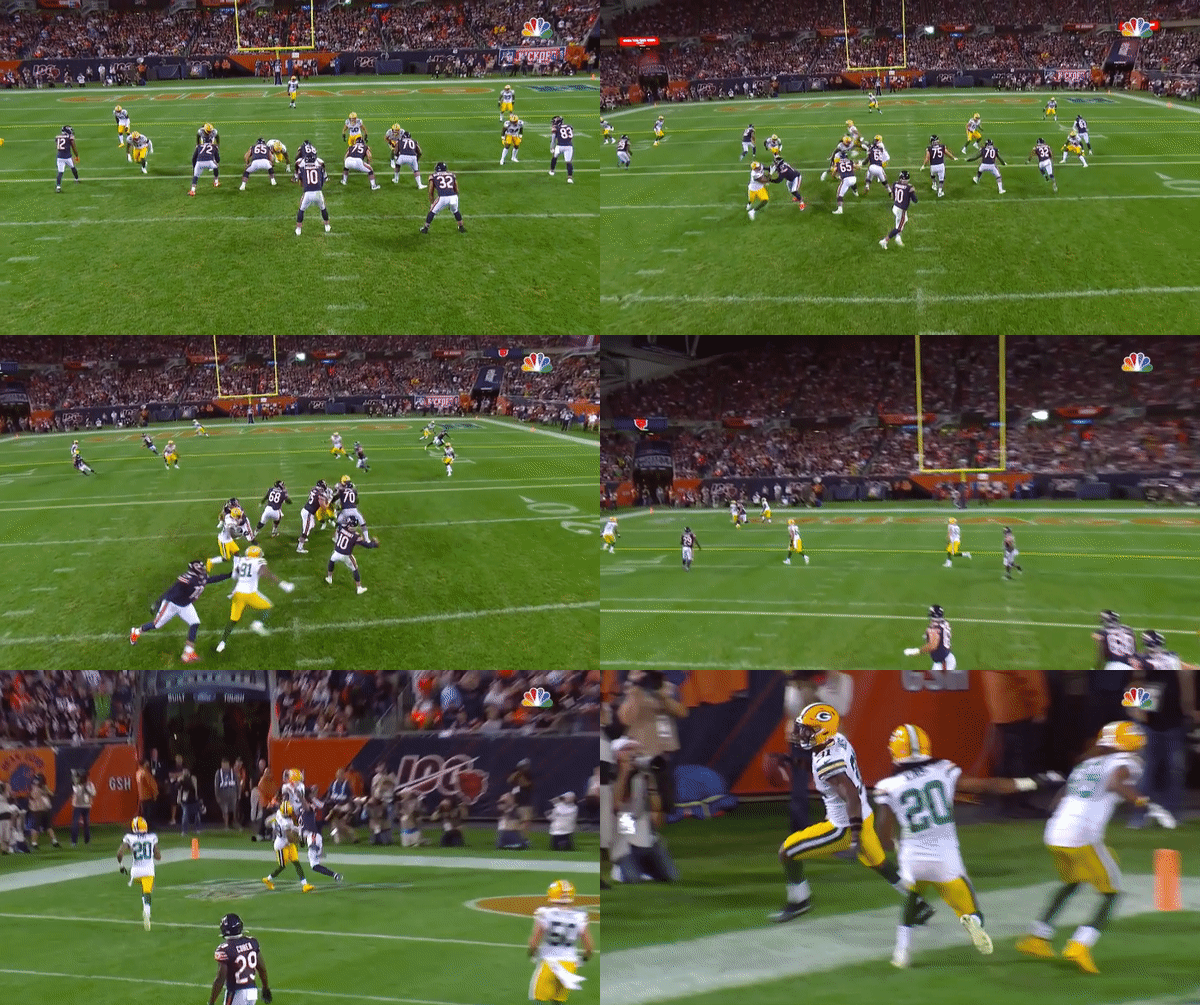
There were missed openings that Trubisky didn’t see — just ask Allen Robinson, who was wide open on more than occasion, but didn’t always get the target his openness demanded. Below, in videos courtesy of NFL Game Pass (start your free trial today to rewatch Thursday’s game), Trubisky missed an uncovered Robinson and instead fired a late pass into traffic that very easily could’ve been picked.
There were wildly thrown passes sailing over the heads of his receivers — just like the missed passes that sailed over the heads of his receivers last year.
There were carelessly thrown passes that should’ve been intercepted. He was fortunate to finish with only one interception instead of three or four.
And there was a game-losing interception on a pass that never should’ve been thrown — into double coverage.
NFL Game Pass
The angle from behind the play is particularly damning. You can see Trubisky lock in on his target, which allowed former Bears and current Packers safety Adrian Amos to follow his eyes, which created the double coverage. And you can see exactly how Trubisky struggles against the blitz, lofting up a softball without stepping into the throw. It was a lazy pass that deservedly resulted in an interception.
NFL Game Pass
In fairness to Trubisky, he made a couple nice throws — mainly to Robinson, who was the lone bright spot on offense with seven catches for 102 yards. But it’s those moments of brilliance that make his inconsistencies that much more frustrating.
It felt a lot like last year, when Trubisky posted decent enough numbers, but lacked consistency on a play-to-play, game-to-game basis. Over the course of a 14-game regular season, Trubisky completed 66.6 percent of his passes, averaged 7.4 yards per attempt, threw 24 touchdowns and 12 interceptions and generated a 95.4 passer rating. Those numbers are fine — good even for a second-year quarterback in a brand new system. It’s how he posted those numbers that was concerning. In six starts, he posted a passer rating below 80.0. In six starts, he posted a passer rating above 100. Consistency was lacking.
The problems that plagued him a year ago were the exact same problems that plagued him Thursday night. Missing open targets with both his eyes and arm. Forcing passes into interceptable coverages. Not handling pressure with poise and composure. Making unforced errors.
Last year’s Bears managed to capture the NFC North crown with a 12-win season and would’ve been onto the divisional round of the playoffs if not for Cody Parkey‘s double-doink, which is why the Bears (and all of us) spent the offseason obsessing over their problem at kicker. But the Bears’ problem at kicker feels rather trivial after witnessing their problem at quarterback.
The problem is, if the Bears are going to take the next step, they’re going to need Trubisky to take the next step in his development and emerge as a consistently good quarterback, and based on what we saw Thursday night, Trubisky isn’t at that point — at least not yet.
Whatever growth the Chicago Bears expected from quarterback Mitchell Trubisky in Year 2 under coach Matt Nagy never materialized in Thursday night’s season opener against the Green Bay Packers.
Chicago’s offense, captained by Trubisky, ruined a stellar effort by the defense, losing 10-3 to Green Bay in front of a capacity Soldier Field crowd that just before kickoff believed the home team had legitimate Super Bowl aspirations. Now, not so much. It’s early, but the offense — lowlighted by Trubisky — looked worse than last year when Nagy first took over. It’s not a good sign, either, that, according to ESPN Stats & Information research, no team has reached the Super Bowl after failing to score a touchdown in its season opener.
QB breakdown: Bad, bad, bad, bad. Outside of a couple of nice throws to Allen Robinson, Trubisky looked out of sync the entire game. A third-year quarterback can’t let the offense be called for two delay of game penalties on the same drive, as Trubisky allowed in the third quarter when Chicago appeared on the verge of scoring. The Bears praised Trubisky’s during preseason at every turn, but all the 25-year-old quarterback did in Week 1 was provide fodder to those who criticized the Bears’ refusal to play starters in preseason games and brought up familiar criticisms about Trubisky’s viability as a franchise quarterback. Trubisky capped off the evening by throwing an interception in the end zone into double coverage. It was a fitting end to such a lackluster game by Chicago’s starting quarterback.
Readers of this blog are familiar with Keith Olbermann (formerly of more media outlets than you can list) and his identification of “one of the NFL’s great unrecognized traditions” back in 2008 when Da Bears were about to change quarterbacks … again. “With brief interruptions of stability from the likes of Jim McMahon and Billy Wade, this job has been unsettled since Sid Luckman retired. There has always been a Rex Grossman, he has always underperformed, and they have always been about to replace him.”
I last quoted Olbermann when Trubisky was a rookie and about to replace Mike Glennon, for whom Da Bears ridiculously overpaid. Sure enough, out went Glennon and in came Trubisky. Two years later, there is not an apparent heir apparent, but when your home crowd boos you, that’s not a good harbinger of things to come.
Meanwhile, the Packers haven’t played defense like that since the 2010 season. That may be irrational exuberance, but starting 1–0 is better than starting 0–1 regardless of what kind of game it was. Offensive slow starts under new coaching staffs are not uncommon. (Recall that Mike Holmgren, Mike Sherman and Mike McCarthy lost their first two games each, and McCarthy got shut out in his first game by Da Bears.)


 Steve Prestegard.com: The Presteblog