Those who are not fans of country music stereotype by creating lyrics like:
My girl left me
My dog died
My truck blew up
Mama’s goin’ back to prison
So let’s all get drunk!
Those who are not fans of today’s country music take the tack with which Peter Lewis begins:
If you know any fans of classic country music, you know how much we like to complain about today’s country scene and how it’s all gone wrong. What used to be a genre full of wry, bittersweet songs about bad luck and heartbreak, has become an endless series of interchangeable party anthems and syrupy love songs. (You could tell a similar story about R&B, but one problem at a time.)
Of course, in today’s world, no one believes anything without an infographic. And after years of waiting for Nate Silver to take an interest, I realized it was up to me to make one.
My initial plan was to take the annual Billboard country #1 hits for the last 50 years, tag every song according to its lyrical content, and then chart the trends over time. I quickly realized that would be way too much work, so I decided to use every tenth year as a sample: 2015, 2005, 1995, and so on. I made up abbreviated tags to summarize each type of song as I was going through the lists, like WCYBT (why can’t you be true) or CGOY (can’t get over you), and then tried to hammer them into a few larger categories.
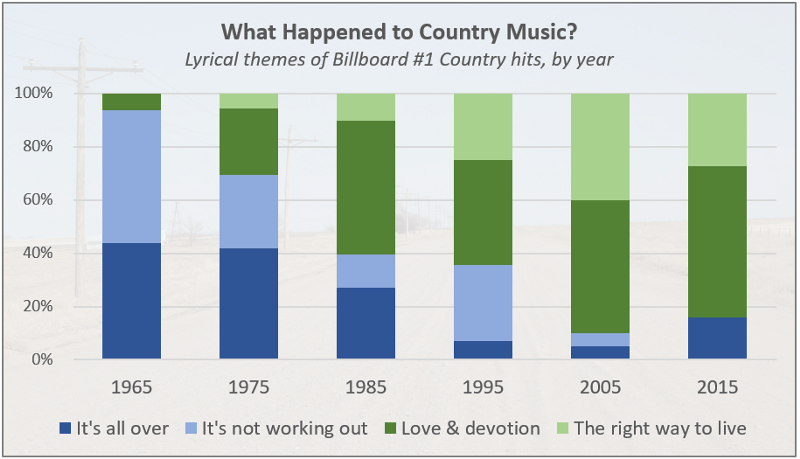
What I learned is that there are four main types of country song, two sad types and two happy ones. After removing one instrumental track and a few novelty songs (mostly about truck drivers), the rest of the list fell into one of these four buckets:
1. It’s all over
What unites these songs is a core theme of regret or loss. Usually what’s over is a romantic relationship, but it could be about anything else good that the singer has lost, often by actively screwing it up. I JustCan’t GetOver You and You’ll Get Yours are among the subtypes; common elements include drinking, cheating, bad luck and bad decisions. In some ways this was once the quintessential country song, the one that spawned jokes like “What do you get when you play a country song backwards? You get your girl back, your job back, your dog, your truck, your house…”
2. It’s not working out
Again it’s usually about a relationship, but a little earlier in the timeline — and the main theme here is frustration. Subtypes include You Don’t Love Me Anymore, Why Can’t You Be True, Don’t Leave Me, and Why I’m Leaving You.
3. Love and devotion
I actually tagged most of these as SLS, for “sappy love song,” but decided to go with a more neutral label. It’s not so different from the same category of pop song, although some variations are particularly popular with country singers, including They Said We’d Never Make It (who did?), Back Together, and assurances of fidelity (maybe because so many country songs in the first two categories are about cheating).
4. The right way to live
The other type of upbeat country song, which turns out to be a key part of this story, has a dominant theme of pride and homespun wisdom. Other than the generic party anthem mentioned above, variants include Things Were Better Back Then, Me and My Rowdy Friends, and Let’s Get Back to Basics.
Diagnosis
There are still some common threads in the genre; one thing I noticed in going through the newer songs is how the old lyrical templates from the first two categories have been updated to be more positive. For example, “I’m over you (but clearly I’m not),” as practiced by George Jones, Connie Smith, Tammy Wynette and many others, has had the subtext stripped away in this song by Cole Swindell to become “I’m really over you, time to party” — which completely misses the central joke of the premise (why would you be singing about someone if you’re really over them?) and just comes off as mean-spirited. Or the classic “don’t screw up your life like I did,” often delivered by an old man in a bar (here are two examples from Vern Gosdin and Robbie Fulks), which has been inverted in this song by Lee Brice to make the old man a positive role model and source of trite life advice.
In any case, that chart pretty much speaks for itself: modern country fans are more interested in healthy relationships, motivational speeches and having a good time than sadness and misery. And on a certain level, who can blame them? But that tiny uptick in sad songs last year offers a ray of hope for those of us who still like a few tears in our beer now and then.
This also got picked up by MetaFilter, which included this comment …
A guy I know who works in Nashville pointed out to me that all the producers who were doing hair metal in the ’80s ended up doing country in Nashville in the 2000s. That probably explains something, but I’m not sure what. Maybe nothing? Hard to tell, without doing the same analysis for rock and pop that he’s done with country. I’d be interested in that analysis. Is it just country fans who are getting more into “healthy relationships, motivational speeches and having a good time”, or is it everybody?
… answered by Lewis:
Don’t know, but I’ve seen a few studies suggesting that pop songs are actually getting more sad over time, both in terms of more minor-key songs and more downbeat lyrics — here’s a recent podcast that discusses some of the lyrics research — so that could suggest that country music is even more of an outlier. I do feel subjectively though that country’s not the only genre that’s gotten happier, I mention R&B in the post as another potential example..
Someone else asked about the “damned drinking songs.”
I spent most of January working with someone who listened to country music all day–specifically, to a station that played the same twenty songs, over and over again, all day every day. It was my first major exposure to modern country music. One of the things that struck me (aside from how abjectly terrible and derivative the songs were), was that roughly half of them included some reference to drinking. Sometimes just a line about getting a beer with the boys, but drinking to forget also seemed to be a reoccurring theme.
Unrelatedly, there’s an actual song called She Thinks My Tractor’s Sexy and I honestly cannot tell if it’s supposed to be an ironic send-up of country music themes or like a proud embrace of stereotypes or what. I’m guessing proud embrace, but it kinda breaks my irony meter.
Someone else found the need to inject politics:
I wonder whether this could be connected to the polarisation in American politics/culture/society between the blue-state/coastal/secular/liberal folks and the red-state/conservative/religious folks, with each consuming their own media and regarding the other as an alien enemy. As such, if country-listening folks are a fortified camp at war against the other side, country music (the musical genre that defines them) could be pressed into service to rally the troops and reinforce shared values that differentiate Us from Them; something that songs about The Right Way To Live are much more suited for than melancholy ballads about having lost everything.
This is probably a minority opinion today, but current country music is, to me, much better to listen to than steel guitars, fiddles and twangy singing of the heartbreaks and sucky life of the songwriter. (I am also, as you know, one of those cretins who doesn’t generally listen to the words of songs, which is how I am able to listen to music that doesn’t correspond to my worldview but sounds good to me.) Life is hard enough without being reminded of it on every song on the radio or your favorite MP3 playback device. I prefer to listen to music that doesn’t make me want to drive into a bridge support at 100 mph.
It’s not as if rock or pop are suffused with originality either. At least half, and probably more than half, of rock and pop songs since the beginning of the rock era in the 1950s have to do with love and/or sex, including lack thereof or end thereof. The other half is comprised of partying, cars (’60s), protest (late ’60s and early ’70s), shaking your booty (’70s), angst (particularly ’80s and ’90s) and weird stuff (“MacArthur Park, “Mexican Radio,” etc.).
There may be a legitimate observation about how country songs sound alike …
… but country is far from the only offender in that regard:
It may also be true that country singers are more likely to get airplay if they look like, say, Carrie Underwood or Miranda Lambert instead of Betty Friedan or Hillary Clinton. This is not a new thing. For that matter, none of the male country singers of today look like Willie Nelson or Mick Jagger.
 Steve Prestegard.com: The Presteblog
Leave a comment