Because apparently what most people consider to be the Confederate flag …

… now drives people to murderous acts, the shooting in the Charleston, S.C., church has prompted calls to ban the Confederate flag. (Or, one assumes, flags.)
I wouldn’t fly any of the Confederate flags myself, since none of my ancestors (as far as I know) came from the South (if so, you’d think they would have returned South after one winter up here), though I feel no white guilt for slavery since none of my ancestors owned slaves. (My ancestors were relatively recent arrivals to the U.S.) The Confederate flag also represents, it should be pointed out, the losing side in the Civil War, similar to the Nazi swastika representing the loser in World War II.
Regardless of my feelings about the Confederate flag, whether the flag should fly or not is up for South Carolina to decide, not anyone else. The Confederate flag (found in the flags of seven Southern states) is the creation of Democrats, as was the Ku Klux Klan and Jim Crow laws, of course.
It is interesting that the Confederate flag comes up now given the number of prominent Southerners …


… who didn’t have a problem with this flag before now.
It’s also hypocritical for liberals to support getting rid of the Confederate flag when liberals are apparently perfectly fine with an immensely divisive organization, identified by Victor Davis Hanson:
There are plenty of other overt racialist symbols that separate Americans. One is the prominent use of La Raza, “The Race” — seen most prominently in the National Council of La Raza, an ethnic lobbying organization that has been and is currently a recipient of federal funds. The National Council of La Raza should be free to use any title it wishes, but it should not expect the federal government to subsidize its separatist nomenclature. The pedigree of the term La Raza is just as incendiary as that of the Confederate battle flag. The Spanish noun
The pedigree of the term La Raza is just as incendiary as that of the Confederate battle flag. The Spanish noun raza (cf. Latin radix: “root” or “race”) is akin to the now-discarded German use of Volk, which in the early 20th century came to denote a common German racial identity that transcended linguistic and cultural affinities: To be a real member of the Volk one had to “appear” German, in addition to speaking German and possessing German citizenship. La Raza is just such a racialist term. It goes beyond a common language and country of origin, and thus transcends the more neutral
La Raza is just such a racialist term. It goes beyond a common language and country of origin, and thus transcends the more neutral puebla (“people”: Latin populus) or gente (“people”: Latin gens). Raza was deliberately reintroduced in the 1960s to promote a racially superior identity of indigenous peoples and mestizos born in the Spanish-speaking countries of the New World. That is why the National Council of La Raza once had a close affinity with MEChA (Movimiento Estudiantil Chicano de Aztlán), the infamous racialist U.S. student group (its ironic motto is “Unity creates strength”), some of whose various past slogans (cf. the Castroite derivative “Por La Raza todo, Fuera de La Raza nada”) finally became sources of national embarrassment. The use of the phrase La Raza reflects its illiberal modern origins. It came into popular currency during the 1930s in Spain, when the Fascist dictatorship of Francisco Franco wished to promote a new Iberian identity that went well beyond the commonality of Spanish citizenship and fluency in the Spanish language. Franco expropriated La Raza to promote the racist idea that the Spanish
The use of the phrase La Raza reflects its illiberal modern origins. It came into popular currency during the 1930s in Spain, when the Fascist dictatorship of Francisco Franco wished to promote a new Iberian identity that went well beyond the commonality of Spanish citizenship and fluency in the Spanish language. Franco expropriated La Raza to promote the racist idea that the Spanish were a superior people by birth. He penned a crackpot novel, Raza, embodying Fascist and racist themes of Spanish genetic and cultural superiority. La Raza appeared on the big screen in the form of a hokey 1942 Spanish-language movie, full of racist themes, anti-Americanism, and fashionable Fascist politics. But Franco was only channeling another, more famous contemporary Fascist, Benito Mussolini, who had his own Italian version of the term, la
But Franco was only channeling another, more famous contemporary Fascist, Benito Mussolini, who had his own Italian version of the term, la Razza. In 1938 Mussolini published his Manifesto della Razza (“The Racial Manifesto”), which defined Italians as a superior Aryan race and excluded Italian Jews, Africans, and other supposedly less pure groups from various positions in the Italian government. In sum, the word “Raza” has a disturbing recent history, and that is why Spaniards and Italians today have dropped its common usage. Yet that well-known association with racial chauvinism was precisely why the founders of the National Council of La Raza, by their own admission, reawakened the word in the 1960s to focus on what they saw as a particular racial category of Spanish speakers. But La Raza is now a calcified separatist slogan, one full of implications that are unworthy of taxpayer support.
One wonders why in 2015 there is still nomenclature such as “the Congressional Black Caucus,” over half a century after the civil-rights movement sought to promote integration and the idea that Americans should be judged by the content of their character, not the color of their skin.. The Caucus ostensibly seeks to ensure the end of exclusion by race from full participation in American society by creating a lobbying group focused entirely on one particular race. The postmodern rationale is either that groups that have suffered past disfranchisement and discrimination should not be subject to current anti-discriminatory protocols, or that they should at least enjoy a compensatory period of exclusion from color-blind values to offset centuries of oppression.
Thus the group’s membership is entirely race-based. The Caucus is not open to those members of the House of Representatives who are not African-American, but who might share the Caucus’s racial or political agenda — as the Jewish-American Representative Steven Cohen learned when he was elected to Congress in 2006. The Lebanese-American Ralph Nader was once attacked at a Caucus meeting in clearly racial terms on the understanding that the group was exempt from charges of racism. How far is the racial concept transferable — “the Asian Caucus”? “the Latino Caucus?” “the White Caucus?” “the European-American Caucus”? The premise seems to be that African-American House members seek to promote a common “black” agenda that transcends their local, county, or state interests. If an Asian, white, or Latino voter’s congressional representative is a member of the “Black Caucus,” does that mean that the voter will receive less attention than a black voter — as de facto white caucuses in the Old South most certainly did ignore the interests of their non-white constituents? Is that why conservative African-American legislators who see all their constituents in terms that transcend race tend to avoid joining the Caucus? Could not the “Black Caucus” rebrand itself as the “Civil Rights Caucus” or the “Progressive Caucus”? …
We should pause to appreciate that the American democratic experiment in ethnic and racial diversity is nearly unique. Indeed, the very idea of racial diversity and nationhood does not have much of a record of success in history. Few countries have been able to transcend their ethnic origins and sustain a racially pluralistic society. Rome was an exception and pulled it off for nearly 500 years, as the Roman Empire grew to encompass non-Italian peoples from the Euphrates to Scotland before unwinding into tribal chaos. The Ottoman and Austro-Hungarian Empires worked for long periods, though they relied on the use of autocratic force and imperial coercion to suppress minorities, in ways antithetical to modern notions of governance. In more recent times, religious and racial diversity — in Rwanda, the former Yugoslavia, Iraq, or contemporary Nigeria — has resulted in chaos and, occasionally, genocide. True, some nations have been able to incorporate different tribes, as in the United Kingdom’s unification of the various peoples of the British Isles, but usually after hundreds of years of fighting and only when there were underlying racial and cultural affinities that could trump tribal differences. In other words, the United States is history’s exception, not its rule. America is a great, evolving experiment of a constitutional republic in which peoples of all different races, religions, and ethnic backgrounds are equal under the law and see themselves as Americans first and members of tribes second — appearance and religion being incidental rather than essential to the American body politic. In an America that was originally founded by mostly Northern European immigrants, a Juan Lopez from Oaxaca is freely accepted as a U.S. citizen in a way that a white Bob Jones would never fully be embraced as a citizen of Mexico, a country whose constitution still expressly sets out racially chauvinistic guidelines that govern immigration law. Someone who appears African or European would have a hard time fully integrating as a citizen in Chinese, Korean, or Japanese society, in a way not true of Chinese, Koreans, and Japanese in America. The world assumes that in America a president, attorney general, secretary of state, or Supreme Court justice can be black; but it would be as surprised to find whites as high public officials in Zimbabwe as to find a black as prime minister or foreign minister in Sweden or Germany.
In the last half-century, Americans have increasingly tended to emphasize race and tribe in promoting “diversity,” rather than seeking to strengthen the more tenuous notion of unity with their fellow citizens. We have forgotten that human nature is fond of division and must work at setting aside superficial tribal affinities to unite on the basis of core values and ideas.
Grandpa John, meanwhile, thinks we should be offended with our own _____ist state flag:
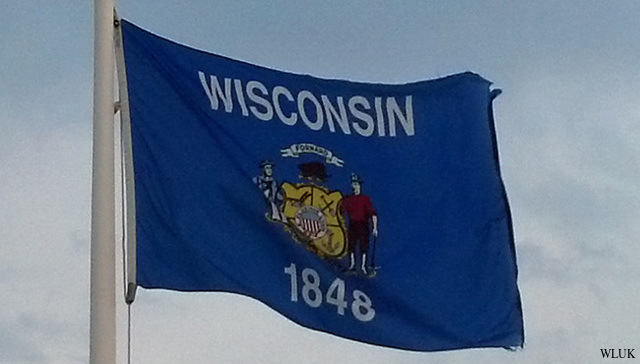
Now that we have thoroughly humiliated South Carolina for daring to display a historical flag because of the evil actions of one man, we can move on to begin the guilt-tripping of the next target. We are a liberal, enlightened society and our deep psychological, politically correct insights into the souls of men must progress.
The next evil windmill against which we joust is the state seal on the flag of Wisconsin. At first look you see two men, a sailor and a miner, bookending a plow, pick and shovel, arm and hammer, and an anchor. Just below lies a cornucopia and stack of lead bars above 13 stars. Above is a badger and the motto, Forward.
Harmless historical symbols, right? WRONG!!
Here’s what a deeper examination yields:
– The two persons pictured are both Straight, White, Christian MEN. One depicts a miner, rapist of Mother Earth. The other is a sailor holding a rope… and you minorities know what that means. These actually symbolize White privilege and rape culture.
– The plow and hammer/shovel also symbolize the willful destruction of the planet. The lead bars prove that Wisconsin wants to kill children, women, and minorities with lead based paint and leaded gasoline.
– The arm and hammer symbolize corporate greed and heavy-handed abuse of workers.
– The cornucopia, horn of plenty, doubles up on the corporate greed theme as well as honoring the rich that earn their wealth by robbing the poor.
– The motto of Forward coupled with the U.S. coat of arms in the center shows that Wisconsin approves of American imperialism.
This has been only a quick perusal of what the symbols mean. Further examination will surely yield much, much more.
It is a well known fact that these symbols inspired the actions of the infamous Ed Gein and Jeffrey Dahmer.
 Steve Prestegard.com: The Presteblog
Leave a comment