I’m still not sure how the Packers managed to beat Dallas 26–21 in their NFC Divisional playoff game Sunday.
I guess the Packers won because, despite the Cowboys’ seeming dominance of the game, the Packers were opportunistic. A missed field goal led to a Packers field goal to cut the halftime deficit to 14–10. A fumble by running back DeMarco Murray led to another field goal to cut the lead to 21–16. The Packers got the game-winning score late in the fourth quarter when they unveiled their no-running-back offense and drove 80 yards through the previously stiff Cowboys defense.
After that, well …


https://vine.co/v/ODZIgmhUxr1/embed/simple
https://vine.co/v/ODZTV7z2UZ2/embed/simple
… here’s the Dallas Morning News’ Tim Cowlishaw:
It looked like a catch. That was true for innocent bystanders and neutral observers and it was painfully true for Dallas fans.
But the Cowboys are the team without a leg to stand on when it comes to sympathy for overturned officials’ calls. And yet it appeared Dez Bryant had gotten one, two, maybe three legs down to put Dallas in position to knock off the Packers right here in Lambeau Field, the site of the Cowboys’ most painful playoff defeat.
Then it was ripped away and, before you knew it, Green Bay was celebrating a 26-21 victory and a date with Seattle.
“I did think it was a catch,” Head Coach Jason Garrett said. “He had three feet down and made a move common to the game. But let me make it really clear. This game wasn’t about officiating. We had 60 minutes…and we didn’t do the things necessary to win the game.”
A week ago Lions fans and Cowboys haters couldn’t believe their eyes and ears when a pass interference flag was picked up, helping to fuel Dallas’ 24-20 rally past Detroit.
This time it was a catch Bryant made inside the one-yard line, a deep throw on fourth-and-two from the Green Bay 32, another roll of the dice from the Cowboys’ ramblin’ gamblin’ head coach. Less than five minutes to play, Packers leading 26-21, it looked like the Cowboys’ playmaking receiver had put Dallas in position to regain the lead it held for most of a cold but windless afternoon here.
In fact, Cowboys owner Jerry Jones said he was unaware the Packers had even challenged the call.
“I thought they were trying to decide where to mark the ball,” Jones said. “It hadn’t even occurred to me we wouldn’t have possession within a yard of the goal line.”
But, like Garrett, he stopped far short of blaming officials for the end of the Cowboys’ best season in five years.
“We’ve all agreed to go with the judgment of the officials in this league,” he said. “I don’t mean to be cavalier about it, but this isn’t a catch in the annals of NFL history. Just like it would have been a catch had it not been overturned, just like it wasn’t interference on 59 (Anthony Hitchens) last week, just like (Ndamukong) Suh played and wasn’t suspended.
“That’s real, and we’ve all said we would live with it.”
The rule might seem contradictory to other rules (the ground cannot cause a fumble, but the ground can cause an incomplete pass?), but that is the rule until the NFL changes the rule. As the previously best known victim of this rule, Lions wide receiver Calvin Johnson, can attest:
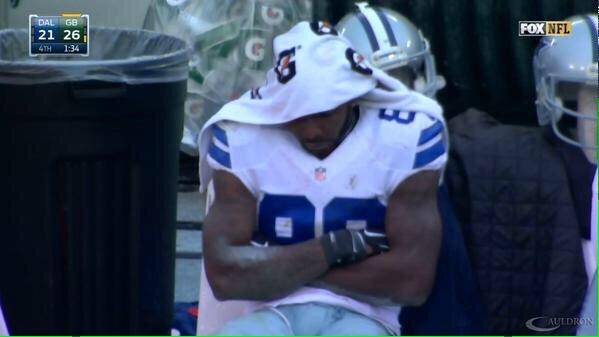
Difference between me and Dez? You’d never see me pout like a little baby
Packers 26, Cowboys 21: “A bad rule, ruled correctly.”
That’s how one longtime NFL operative referred to the call that changed the course of the season for Green Bay and Dallas at Lambeau Field. And when the play was adjudicated by referee Gene Steratore under the hood in Green Bay, connected to NFL vice president for officiating Dean Blandino in the officiating command center in New York, they made the call by the exact interpretation of the rule book. With just over four minutes left and Dallas trailing by five, the Cowboys made a strange call on fourth-and-two with the game on the line: a deep ball down the left sideline. Dez Bryant made a leaping catch over Packers cornerback Sam Shields. But as Bryant landed, the ball became momentarily dislodged. The initial ruling was a completed catch, gain of 31, ball down at the Packer one. Green Bay coach Mike McCarthy challenged the ruling on the field. After a long review, Steratore emerged from the hood and said the call was reversed; Bryant hadn’t completed the act of the catch. Bryant put his hands to his head and, wide-eyed, looked to be saying, “WHAT?! WHAT!”America said the same thing. It looked like a catch. By my Twitter feed, a good 80 percent of the fans who opined considered it a catch.
For Steratore, this had to be an agonizing case of déjà vu. He’s the referee who ruled on a similar replay in 2010, overturning a potential winning touchdown catch by Calvin Johnson in Chicago. On that play, Johnson rolled over in the end zone, using the ball to try to spring up, and the ball skittered away. Steratore ruled that Johnson didn’t complete the process of the catch, and the league backed him on it.
The vital and controversial part of this rule is that as a player falls to the ground in the continuation of the act of trying to make a catch, he has to maintain control of the ball when he hits the ground.
Here, Bryant leaped high in the air, had the ball in his control, took a couple quick steps and fell to the ground. Bryant said later he was attempting to stretch the ball across the goal line as he fell. That is a questionable claim. I’ve looked at the replay from different angles at least 25 times, and there’s no clear evidence Bryant was trying to reach across the goal line.
Bryant failed to maintain possession of the ball when he hit the ground. The ball popped from his grasp when his body hit the turf, and it momentarily left his grip. He caught it while on the ground without the ball hitting the ground. But by rule, that’s not important. Bryant would have had to possess the ball without it leaving his grasp when he hit the ground.
Crucial point two: If Steratore and Blandino had ruled that Bryant fumbled the ball while making a football act “common to the game,” they could have ruled the catch good and the ball down at the one. For instance, if they ruled that he caught the ball and then extended both arms “while making a football act common to the game”—that is, while trying to extend the ball across the goal line, and with the ball never being lost from his grasp—it would have been a catch. By a very close interpretation, Steratore and Blandino ruled that Bryant lost control, and not while making a football act common to the game.
Talking to a pool reporter after the game, Steratore said: “Although the receiver is possessing the football, he must maintain possession of that football throughout the entire process of the catch. In our judgment, he maintained possession but continued to fall and never had another act common to the game. We deemed that by our judgment to be the full process of the catch, and at the time he lands and the ball hits the ground, it comes loose as it hits the ground, which would make that incomplete; although he re-possesses it, it does contact the ground when he reaches, so the repossession is irrelevant because it was ruled an incomplete pass when we had the ball hit the ground.”
To me, this is a classic case of: Hate the rule, don’t hate the ref. I agree that it looked like a catch, but by rule, it wasn’t. “That’s an incomplete pass by rule,” said FOX rules analyst Mike Pereira, who used to have Blandino’s job. “The rule is very specific. In the process of going to the ground, you must maintain possession. That’s what happened here. The ball hit the ground and popped out immediately.” Two other former officials—Mike Carey on CBS and Jim Daopolous on ESPN—were similarly decisive.
“I want to know why it wasn’t a catch,” Bryant asked one wave of reporters. And then another: “Why? Explain why that wasn’t a catch.”
I just did, but Bryant may get some satisfaction this offseason because the rule is going to be debated. Again. For years, I’ve gone to league meetings and listened to debates about the rule. (Actually, the debates are fierce in the 24 or 48 hours after egregious plays; by the time the March meetings roll around, there are often long discussions but little passion about it. That could change this year, with the intensity of interest around this call.) One league source told me Sunday night that the Competition Committee will certainly look at the rule this offseason, beginning (likely) at the group‘s first meeting in February.
Maybe there will be enough momentum for a revolutionary change—for a catch to be catch as soon as a receiver gets two feet down and possesses the ball clearly. The problem with that in the past, as another source said Sunday, is “the cheap fumble.” Think of what happens when a pass, a catch by a receiver, a thudding hit by a defender and a fumble all occur at lightning speed. Did the receiver actually have possession before getting whacked and losing control of the ball? I can recall Jeff Fisher and Rich McKay, the Competition Committee co-chairs, explaining the debate over the rule at one recent meeting and saying, basically, We all agree we don’t love this current rule. We just don’t have a better one. It’s not an easy problem to solve.
With the anger over this call, expect debate to center on either two feet down and possession constituting a catch (with the requisite likely rise in the “cheap fumble”), or a proposal that a receiver doesn’t have to maintain control when going to the ground after taking two steps.
This being a schadenfreude column, we must include memes:


Not only is it ironic that the Cowboys benefited from an official’s call one week and then didn’t the next, the Packers are now going to Seattle, home of the infamous Interceptouchdown.

 Steve Prestegard.com: The Presteblog
Leave a comment