You know that yesterday was the 30th anniversary of the Barneveld tornado.
Yesterday was the 40th anniversary of an event central to online meteorologist Mike Smith‘s career and life:
… at this time 40 years ago, I was gobbling down a quick lunch while I got ready to go back to work at WKY TV and Radio. I had been called in about 3am to cover severe thunderstorms and we were in between storms. I knew the afternoon and evening storms were going to be much worse.
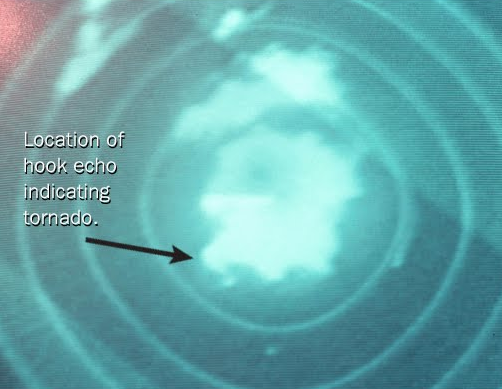
In those days, we had black and white radar. The photo below shows a “hook” echo moving into Oklahoma City, with the tornado about to strike Will Rogers World Airport.
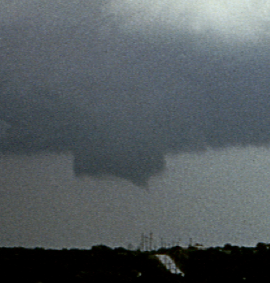
As a result of starting to chase storms two years prior, I knew the storm would pass southeast of the TV station and we had a chance to get a picture of the tornado. Amazingly, we did. Fellow chaser Steve Tegtmeier got this photo of the tornado before it touched down. It was only the second time (the first was KAUZ TV in Wichita Falls in 1959) a tornado had been broadcast live.
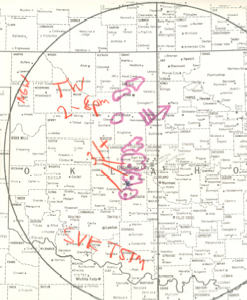
To keep track of each of the storms and so I could remember everything that I needed to tell our viewers, we did radar tracings like the one below. I would hold it in my left hand while gesturing to the map with my right. TW = tornado watch from 2 until 8pm and SVR TSTM = severe thunderstorm warnings in effect for several counties.
As you can imagine, the systems we were using were primitive compared to today’s. Yet, somehow, we were able to get tornado warnings out for every one of the central Oklahoma tornadoes in our viewing area and there were no fatalities.
In northeast Oklahoma, none of the TV stations had radar or meteorologists (but they did have a popular puppet doing weather!) and there were 16 fatalities.
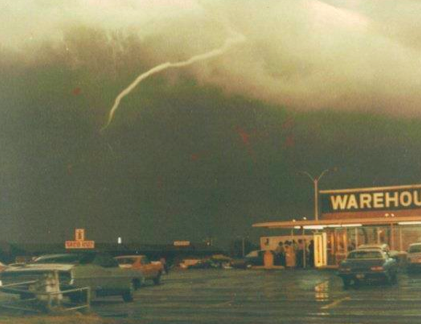
Tulsa tornado, June 8, 1974, NOAA Because of the tornadoes and flash floods in the Tulsa area, all of the television stations were knocked off the air. The WKY weather department got a call from the cable company serving Tulsa informing us of their stations’ situation and wanted to know if we would cover Tulsa until their stations were back on the air. If so, he would put our signal on their cable. We did. The contrast between our approach and what the Tulsa stations were able to do was striking.
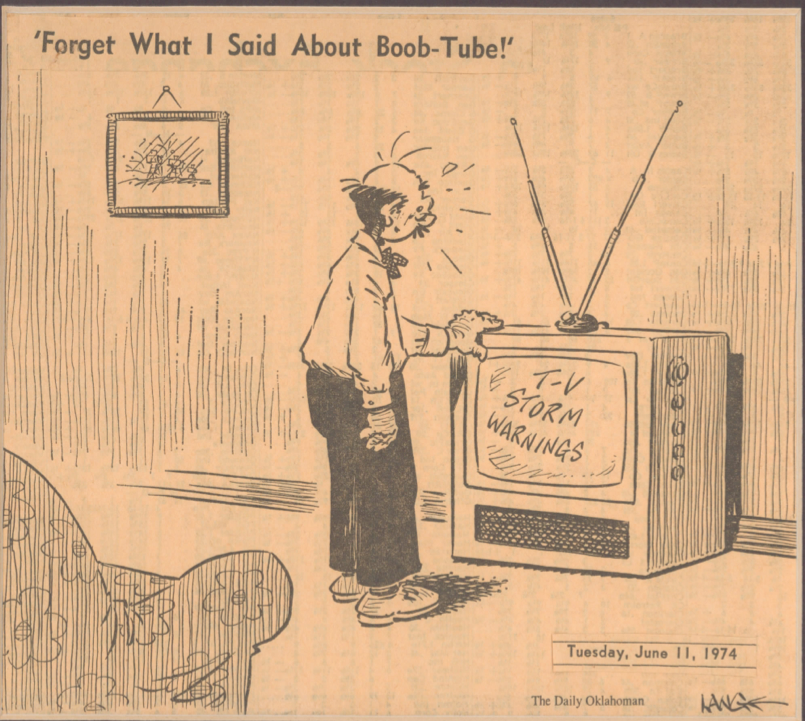
Back in Oklahoma City, the outpouring of appreciation was simply overwhelming. More than seventy letters, an editorial cartoon and countless phone calls from people thanking us for saving their lives.
 Steve Prestegard.com: The Presteblog
Leave a comment