First: Is the federal government really shut down?
Not according to Reason:
They call it a “government shutdown.” But of about 4.1 million people who work for the federal government, about 80% will still be expected to show up for work.
We still don’t have an exact number of federal employees who won’t be working in a shutdown, but most press reports have been pegging the number around 800,000, the number who stayed home the last time the government shut down in 1996.
This is certainly predictable:
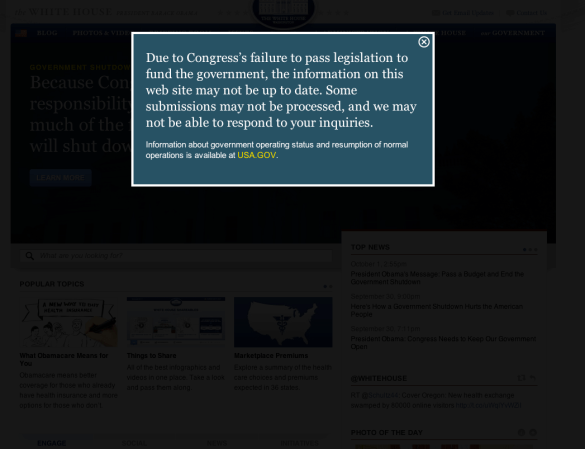
Proof positive that government is too large comes in this graphic:

“FLOTUS” is short for “First Lady of the United States.” That would be Michelle Obama, who apparently is far too busy to Tweet herself. (As a Facebook post put it, Michelle’s Tweeter was furloughed.)
Meanwhile, David McElroy reports that because the shutdown shut down national parks, forest, recreational areas and so on (of which Wisconsin has very few controlled by the feds), Gettysburg National Military Park is closed Saturday, thus forcing the Ku Klux Klan to hold their rally elsewhere.
The government shutdown got, well, invaded, reports CNN:
Busloads of World War II veterans, many in wheelchairs, broke past a barricade Tuesday morning to cross into the World War II Memorial, as onlookers applauded and a man playing the bagpipes led the way.
Moments earlier, a few Republican members of Congress had removed a section of the black gates that surrounded the site, allowing a line of veterans to roll past security officers, who willingly stood aside. …
The National Park Service closed all of its parks, including national memorials, as a result of the federal government shutdown that went into effect at 12:01 a.m ET.
But a spokeswoman from the National Mall and Parks Service said efforts were no longer being made to hold anyone back.
“These are important visitors,” she told reporters, adding that they’re seeking guidance from the director’s office on “where we go next.”
“Obviously we did not want to do anything to mar the trip of these people,” she said, saying the visitors came from Mississippi and Iowa. “They’ve come here specifically to see the memorial that was built for them.”
Some Republican members of Congress and a Democratic senator were on site, blasting the federal government for fencing off the memorial. Outraged and baffled, Sen. Tom Harkin, D-Iowa, crossed through an opening in the railing earlier in the morning–before the breach–and got on the phone to try and reach the secretary of the Department of Interior.
“I don’t get it. I’m furious. I’m trying to get a hold of people,” he said, standing on the other side of the barricade and looking around for help. “But I can’t seem to get a hold of anybody.” …
A few House Republicans were also at the memorial to disparage the government for closing off the landmark on a day that veterans were set to arrive.
“We’ve got park service employees out here,” said Rep. Louie Gohmert of Texas, before the gates were opened. “Why wouldn’t you have them here to allow the veterans in, instead of stand and keep them from coming in?”
Rep. Michele Bachmann of Minnesota, wearing casual clothes, said she was out walking when she heard about the pile-up outside the memorial and decided to hustle over to the site.
“The last thing we should see in America is a barricade for World War II veterans to be prevented from coming to their memorial,” Bachmann said.
She vowed she and colleagues will be there “today, tomorrow, the next day, however long it takes” to keep the memorial open.
“America is not shutting down,” she said. “If we have anything to say about it, we’re going to keep this open.”
That’s funny. This, from Mike Flynn, is not:
The House first tried to defund ObamaCare. Then, it tried to delay the whole law and then just the individual mandate. In the final hours before the midnight deadline, the House ended with a simple proposal. It would agree to fund the government, if the Senate agreed to scrap the special subsidies lawmakers and staff receive to purchase health insurance. The final House proposal only effected people on Capitol Hill. Harry Reid said, effectively, we’ll shut down the government to keep our subsidies.
When ObamaCare was passed in 2010, an amendment was added by Sen. Chuck Grassley requiring members of Congress and their staffs to enroll in the ObamaCare exchanges. The federal government currently covers over 70% of health insurance premiums for Hill staff, but would no longer be able to do so through the exchanges. The end result is that members and staff would have to pick up the costs of their insurance premiums themselves.
The Obama Administration issued a rule earlier this year that effectively waived this. The federal government could still pick up 70% of the premium costs for members and their staffs. It is this special exemption that LA Sen. David Vitter has focused on repealing.
The final proposal on keeping the government open from the House removed this special Congressional exemption. Members and staff would no longer receive special subsidies from the federal government to purchase health insurance. The proposal would have also suspended, for one year, penalties levied on individuals who don’t have health insurance. This is similar to the waiver granted by the Obama Administration to employers earlier this year.
The Senate, however, rejected both provisions. Had it opted to eliminate its own special subsidies, the government would be open today. Preserving its own platinum health insurance coverage drove the Senate to close the government.
I mentioned earlier this week that state finances are superior because if the budget cycle ends without a new budget, appropriations continue under the previous budget until the new budget becomes law. This used to be the case at the federal level, too, until 1980, as National Public Radio reports …
“In the ’60s and ’70s down until 1980, it was not taken that seriously at all,” says Charles Tiefer, a former legal adviser to the House of Representatives, who now teaches at the University of Baltimore Law School. In the old days, he says, when lawmakers reached a budget stalemate, the federal workforce just went about its business.
“It was thought that Congress would soon get around to passing the spending bill and there was no point in raising a ruckus while waiting,” he says.
That easygoing attitude changed during the last year of President Jimmy Carter’s administration. That’s when Attorney General Benjamin Civiletti issued a legal opinion saying government work cannot go on until Congress agrees to pay for it.
“They used an obscure statute to say that if any work continued in an agency where there wasn’t money, the employees were behaving like illegal volunteers,” says Tiefer. “So they not only could shut off the lights and leave, they were obliged to shut off the lights and leave.”
Civiletti later issued a second opinion with a less strict interpretation — allowing essential government services to continue in the absence of a spending bill. But even with that exception, the stakes of a legislative standoff had been raised — which could be why lawmakers suddenly got serious about making deals.
So the political artifice you’re watching is all Civiletti’s fault. And every attorney general since Civiletti, who simply could have issued the legal opinion that Civiletti’s legal opinion is incorrect. Of course, every Congress since 1980 could have passed a law to negate Civiletti’s opinion and require funding under the previous appropriation, too.
You have read opinions that the shutdown is a disaster for Congressional Republicans. Their proof is in polls conducted more than a year before the 2014 Congressional elections, and the supposed bad things that happened to Republicans from the 1995–96 shutdown. And what bad things were those? Republicans controlled both houses of Congress through the remainder of Bill Clinton’s presidency, despite Bill Clinton’s reelection in 1996.
If the Libertarian Party is correct, House Republicans should refuse to sign off on any deal regardless of what it contains:
There is no impending government shutdown — only a government slowdown. The threat of a “shutdown” is designed to scare voters while avoiding scrutiny of reckless government overspending.
If federal lawmakers do not pass a budget or a “continuing resolution” (CR) by Oct. 1, a government spending slowdown will take effect. This could halt almost $1 trillion in annualized spending that the CR would authorize, which is the size of the current federal deficit. If made permanent, this would cut annual federal spending by approximately 27 percent to $2.7 trillion — the current level of revenues coming in.
In other words, a federal slowdown — if allowed to take full effect — would balance the federal budget. This would greatly benefit the U.S. economy.
“Elected Republicans in the House can stimulate the productive private sector by slowing down Big Government,” said Geoffrey J. Neale, chair of the Libertarian National Committee.
“Why?” Neale asked. “Because a government-sector slowdown equals a private-sector growth speedup of small businesses and jobs. Americans should welcome a government slowdown — and fear the opposite: allowing politicians to continue irresponsible, reckless government overspending.”
Do politicians properly prioritize spending cuts when a slowdown takes effect? Yes and no. Functions that affect life or property generally remain funded, but many needed cuts — such as lucrative government perks, Obamacare, and large volumes of waste marbled throughout government spending — remain intact.
Furthermore, lawmakers have made numerous exceptions to the slowdown. Only a portion of the $1 trillion that would be authorized by a CR will be blocked if a slowdown takes effect.
While the particulars of the impending slowdown are far from perfect, any serious spending cuts are a welcome change from wildly irresponsible government overspending and growing government debt.
Every American should ask himself one question: Is my family better off with a government slowdown that cuts federal spending by 27 percent? Or is my family better off with another trillion dollars in federal government debt?
Transferring wealth out of the government sector and into the private sector creates jobs. Every government-funded job loss is matched by roughly two private sector job gains — a panacea for jobseekers. …
At any time, the Republican-controlled House can do the right thing: Both fully defund Obamacare and refuse to pass a continuing resolution. They control the federal purse strings.
All that House Republicans need to do is debunk phony “shutdown” talk and pass a new bill.
“Lawmakers do not need to concede to either overspending or Obamacare,” said Neale. “Instead, we must move in the opposite direction: dramatically cut government spending and remove existing health care mandates, taxes, and regulations that stifle human progress.”

 Steve Prestegard.com: The Presteblog
Leave a comment