I posted last week about global climate change and the silliness of trying to predict same, since the meteorologists cannot get even forecasts five days in advance correct.
Mike Smith, a meteorologist, found something interesting:
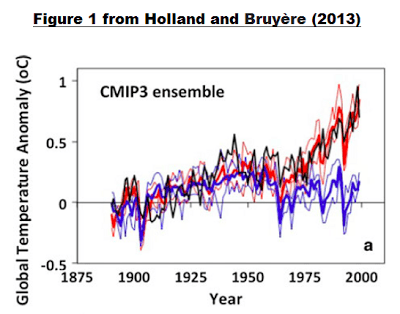
Anthony Watts has an article about a recent paper that purports to tie computer model simulations (what else?) to changes in hurricane intensity. While that is a topic of interest, what struck me was this graph showing actual temperatures (red) for the last 50 years and, in blue, what the climate models hindcast the temperatures to have been if humans had not been adding CO2 to the atmosphere. For the sake of this discussion, let’s assume they are correct.
In the original paper, authors Holland and Bruyere explain their finding that the bulk of human-caused global warming occurred “in the past four decades.” If you view the above graph (the red lines) you see temperatures rise rapidly from about 1970 to 2000 (of course, temperatures have flattened since). According to the authors, had humans not injected so much carbon dioxide into the atmosphere (blue lines), temperatures would have been stable or have fallen slightly.
So, what was the world like in the late 1960’s and 70’s?
Does the word “famine” mean anything to you?
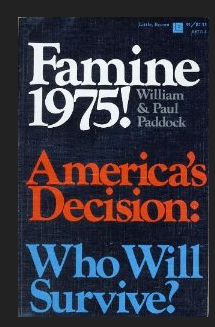
Take a look at two of the best-sellers of that era:
Published in 1967, the authors argued …
They suggest a system of triage in which the United States must “divide the underdeveloped nations into three categories: 1) Those so hopelessly headed for or in the grip of famine (whether because of overpopulation, agricultural insufficiency, or political ineptness) that our aid will be a waste; these “can’t-be-saved nations” will be ignored and left to their fate; 2) Those who are suffering but who will stagger through without our aid, “the walking wounded”; and 3) Those who can be saved by our help.”The Paddocks were aware that their policy of abandoning food aid to the “hopeless countries” for example India and Egypt, would lead to an immediate worsening of the situation there, but they wrote “to send food is to throw sand in the ocean.” Using the triage system they hoped to avoid a broader catastrophe and stabilize the global population.Then, there was the best-selling The Population Bomb:
Early editions of The Population Bomb began with the statement:The battle to feed all of humanity is over. In the 1970s hundreds of millions of people will starve to death in spite of any crash programs embarked upon now. At this late date nothing can prevent a substantial increase in the world death rate…Much of the book is spent describing the state of the environment and the food security situation, which is described as increasingly dire. Ehrlich argues that as the existing population was not being fed adequately, and as it was growing rapidly it was unreasonable to expect sufficient improvements in food production to feed everyone. He further argued that the growing population placed escalating strains on all aspects of the natural world.Why were so many starving? Why were the forecasts for more starvation becoming more dire by the year? Because world temperatures had been falling since about 1944 (see graph above). The growing season had shortened to the point that world agriculture could not support the world’s population which, in 1970, was 3.7 billion.
The population of the world today is just over 7 billion. But, “famine” is rarely in the news*. Why? Two reasons: The Green Revolution and the fact that temperatures warmed. The growing season has lengthened to where we can feed the world.
Had temperatures continued to fall, causing the growing seasons to continue to shorten, there would have been starvation on a scale unprecedented in world history. Let that sink in for a moment. Hundreds of millions more people in grinding poverty going to bed hungry every night.
I constantly ask climate scientists, including in articles on this blog,”What is the ideal temperature for humanity?” I never get an answer. One would think this temperature would have been determined, or at least estimated, decades ago. Yet, the “consensus” is we are currently too warm.
What’s that? You say the world still has starving people in it? Smith has an answer:
Of course, there are hungry people in the world but it is not due to a shortage of food. Per capita food production (measured in calories) is more than adequate to feed the world’s population especially if we stop using food grains (corn, for example) for fuel.
Or if countries replace their bad governments with better governments. (Pick your favorite Eastern European country under the late Warsaw Pact.)
Is climate change occurring? Obviously, because climate change has occurred as long as anyone can count. Are human activities contributing to climate change? Human activities change the environment, and that’s pretty necessary for human survival, unless you don’t care about eating. Neither of those statements requires you to be an acolyte of Al Gore or Thomas Friedman, who hypocritically pontificate about the need to starve and bankrupt people to prevent global climate change from the comfort of their five-digit-square-foot houses.
People forget or ignore history. The Industrial Revolution pumped who knows how many tons of unfiltered pollutants into the sky. Earth survived that. Watch any TV show based in Los Angeles in the 1960s or 1970s and you’ll see something less than a clear sky. The American sky is clearer, and American water is cleaner, than other industrialized countries’ air and water. (See: China.) You know what affects the climate the most on Earth? The sun. Read a few of these links for evidence.
The idea that mankind — too many people, people using fossil fuels, and/or people engaged in too much economic activity — is destroying Earth is not only not backed up by evidence, but impugns the credibility of those who make those claims. They’re in it for the power to control others’ lives to fit their own misbegotten ideas of the proper way to live.
 Steve Prestegard.com: The Presteblog
Leave a comment