First, a math story problem:
Person A makes $25,000 per year from his job. Person B has $250,000 in investments.
Person A receives a 5-percent raise. Person B’s stocks increase 10 percent in value. At the end of the year, A is now making $26,250 per year, and B’s investments have increased in value to $275,000.
Question: Who is better off?
Answer: It depends whom you ask. A has less disposable income than B, but now has more than he had a year ago. B’s investment increase means the companies in which B owns stock had a sufficiently successful year for its stock to increase in price.
That story problem describes reality in a free enterprise society — rich people make more money because, well, they’re rich, and they have more ways to improve their financial fortunes.
Even if you reduce B’s gain to 5 percent, the gap still increases. Whereas B is worth $225,000 more than A at the beginning, B is worth $236,250 more than A a year later. In other words, simple math says that the gap between the “rich” and the “poor” will almost always increase. The only way to reduce the gap is to restrict B’s gain so that A’s income increases more than B’s does.
Question: Do we really want to do that? Consider who the “rich” are, according to Fool Me Never:
Let’s personalize this. My parents would fall into the “rich” category. My dad went to college, got good grades, got a job and climbed the corporate ladder, basically from the bottom. He was able to make enough to support my mom and me, pay off the house and cars, all while saving for retirement and a vacation here and there. He was able to do this while keeping a comfortable lifestyle, but truth be damned if you’ll see my mother carrying a purse costing more than 20 bucks, or my dad trading in his 10-year-old vehicle. Like I said, they live comfortably, but hardly the glitz and glamor, little dog-carrying and cognac-sipping extravagance that Obama would like you to believe. Also, like most families, mine has also taken a hit by the economy, forcing them to cut back on labor and completely pull out of the market. This is a very common reality among upper-middle class Americans. They spent and saved their money wisely like any NORMAL, RESPONSIBLE PEOPLE. But under Obama, they have gone from being considered the upper-middle class, to the “evil rich,” ruling class… the Bourgeoisie. …
According to the IRS, tax filers with $200,000 or more in Adjusted Gross Income, the “rich” in America made up about three percent of all tax filers in 2008. They earned 30 percent of all income and paid 52 percent of all income taxes, paying an average tax bill of $123,264. The average income tax bill for the handful of Americans who earned more than one million per year was a whopping $780,039.
On the other hand, individuals making less than $200,000 paid an average of $5,734 (2.8% or less) while those making less than $50,000 paid an average of $1,796 (3.5% or less).
A large percentage of the “rich” in America are also small business owners. According the Heritage Foundation, 65 percent of all married couples with incomes above $250,000 and 50 percent of all individuals with incomes above $200,000 report business income. In Obama’s words, these “small businesses are the heart of the American economy. They’re responsible for half of all private sector jobs—and they created roughly 70 percent of all new jobs in the past decade. So small businesses are not only job generators, they’re also at the heart of the American Dream.”
However, they’re the targets of Obama’s new taxes. Estimates from the Tax Foundation show that nearly 40 percent of the estimated tax revenue generated by raising the top two marginal tax rates will come from small business income.
We know that Occupy Wall Street and its socialist sister protests are opposed to 0.1 percent of U.S. companies, whose stock, by the way, are owned by half of U.S. households. (If Forbes.com’s Bruce Upbin‘s list of 147 Companies That Control Everything is accurate, then some enterprising financial advisor should put together a mutual fund of those 147 companies.) Try to punish those 0.1 percent for their success, and you are guaranteed to punish millions — literally millions — of more companies.
Or perhaps you won’t punish them at all. Consider this graphic:
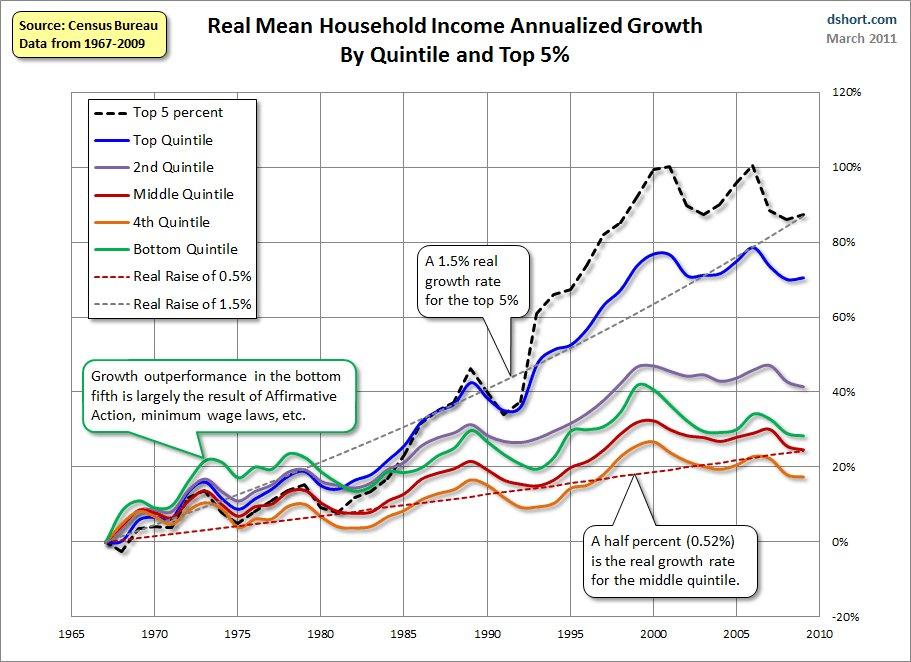 The most noticeable growth in the gap comes between the early 1990s and 2000. In 1993, remember, Congress increased taxes on the “rich” to 39.6 percent and also increased gas taxes. Since 2000, over the decade the gap remained reasonably flat.
Then look at the beginning of the graphic. Growth in the gap between 1967 and 1980 was not as much as growth in the gap between 1980 and the late 1980s. But ask yourself this question: In which period were we better off? During the 1970s, when we had inflation followed by hyperinflation and high unemployment? (Remember the term “misery index”?) Or in the 1980s, when money tightened and we had two rounds of tax cuts?
Jim Pethokoukis asks a few inconvenient questions about the gap:
Just think for a second: If inequality had really exploded during the past 30 to 40 years, why did American politics simultaneously move rightward toward a greater embrace of free-market capitalism? Shouldn’t just the opposite have happened as beleaguered workers united and demanded a vastly expanded social safety net and sharply higher taxes on the rich? What happened to presidents Mondale, Dukakis, Gore, and Kerry? Even Barack Obama ran for president as a market friendly, third-way technocrat.
Nope, the story doesn’t hold together because the financial facts don’t support it. …
In a 2009 paper, Northwestern University economist Robert Gordon found the supposed sharp rise in American inequality to be “exaggerated both in magnitude and timing.” Here is the conundrum: Family income is supposed to rise right along with productivity. But median real household income—as reported by the Census Bureau—grew just 0.49 percent per year between 1979 and 2007 even as worker productivity grew four times faster at 1.95 percent per year. The wide gap between the two measures, if accurate, would suggest wealthy households rather than middle-class families grabbed most of the income gains from faster productivity.
But Gordon explained that this “compares apples with oranges, and then oranges with bananas.” When various statistical quirks are harmonized between the two economic measures, Gordon found middle-class income growth to be much faster and the “conceptually consistent gap between income and productivity growth is only 0.16 percent per year.” That’s barely one‐tenth of the original gap of 1.46 percent. In other words, income gains were shared fairly equally. …
A pair of studies from 2007 and 2008 conducted by the Federal Reserve Bank of Minneapolis supports Gordon. Researchers examined why the Census Bureau reported median household income stagnated from 1976 to 2006, growing by only 18 percent. In contrast, data from the Bureau of Economic Analysis showed income per person was up 80 percent. Like Gordon, they found apples-to-oranges issues such as different ways of measuring prices and household size. But in the end, they concluded that “after adjusting the Census data for these three issues, inflation-adjusted median household income for most household types is seen to have increased by 44 percent to 62 percent from 1976 to 2006.” In addition, research shows that median hourly wages (including fringe benefits) rose by 28 percent from 1975 to 2005.
Set all the numbers aside for a moment. If you’ve lived through the past four decades, does it really seem like America is no better off today? It doesn’t to Jason Furman, the deputy director of Obama’s National Economic Council. Here is Furman back in 2006: “Remember when even upper-middle class families worried about staying on a long distance call for too long? When flying was an expensive luxury? When only a minority of the population had central air conditioning, dishwashers, and color televisions? When no one had DVD players, iPods, or digital cameras? And when most Americans owned a car that broke down frequently, guzzled fuel, spewed foul smelling pollution, and didn’t have any of the now virtually standard items like air conditioning or tape/CD players?”
No doubt the past few years have been terrible. But the past few decades have been pretty good—for everybody.
James Wigderson channels his inner Santayana:
So many in the Madison protests and the Occupy Wall Street movement (with its local components) like to indulge in the fantasy that there is some great conspiracy at work to keep them economically oppressed. It’s as if they really believe that somewhere the Koch brothers, the American Legislative Exchange Council, or even some “neoconservative” cabal are meeting right now to figure out how to make gender studies majors take out more student loans.
Some of the protesters have even rediscovered anti-Semitism, a sign that they may be running out of scapegoats so they’re resorting to the worst forms of the mob mentality.
It would probably never occur to them that control of their existence is largely in their hands. If it did, the thought of taking personal responsibility has obviously caused them to lose their senses.
A common theme is that the protesters are against “capitalism,” as if there is some alternative. They might as well be opposed to gravity. We see how well that works for the coyote as he chases the road runner.
Unfortunately for the Occupy movement, so much of this has all been heard before. Where it was actually put into practice, there was nothing but misery, economic collapse, political oppression, and in some cases mass murder. We have the whole of human history to draw upon as lessons but somehow these children believe that they can force a different outcome. …
This really is not surprising when you consider how much of the current protest movement is built upon nostalgia for the 1960s. They forget that Woodstock was a drug-filled sanitary nightmare that almost was a human disaster if it wasn’t for the assistance of the very “system” they were supposedly against.
The Occupy _____ types like to blame banks. Banks, remember, were the biggest donors to the Barack Obama presidential campaign, and donated more to Democrats than Republicans. Democrats’ being on the side of the Occupy ____ types proves that politicians have no shame.

Here’s a really inconvenient question: What is going to change after Occupy _____? (Particularly given the aforementioned Obama donations.) Is punishing (as in increasing the taxes of) the wealthy going to make things better for the non-wealthy? Or is more government revenue going into the same rathole into which goes the trillions of our tax dollars now? As Pethokoukis says, “America needs an informed debate on how the American middle class can prosper in the future the way it has in the past—even if it is ideologically inconvenient for … liberals.”
 Steve Prestegard.com: The Presteblog
Leave a comment