The $60,000 (MSRP) Corvette

Earlier this week an email arrived announcing a raffle for America’s Sports Car, the Corvette, at a Catholic school in Effingham, Ill.

The grand prize is a new Corvette coupe with a pricetag of up to $60,000 Manufacturer’s Suggested Retail Price, or $55,000 cash. Tickets are $100 each, with 1,500 tickets to be sold.

The grand prize (for which the winner need not be present) will be presented at Mid-America Motorworks in Effingham, one of the nation’s biggest Corvette accessories sellers and the creator of National Drive Your Corvette to Work Day, which is today. (It’s the last Friday in June because the first Corvette went on sale June 30, 1953.) I drove past Effingham, Ill., coming back from a wedding in 2011. I still kick myself that I didn’t stop at Mid-America Motorworks; no one else in the van wanted to stop after a night in a hotel that featured a fire alarm at 1:30 a.m.

The pricetag of the ticket means I’m probably not going to enter. Remember, I work in journalism. (The St. Anna Fire Department Corvette raffle, which the fire department’s website doesn’t mention yet, is much more affordable.)

It did make me wonder, on National Drive Your Corvette to Work Day, how much Corvette I can get for $60,000 MSRP. Nearly every new car sells for less than sticker price, but the raffle website does say $60,000 MSRP. The website specifies a coupe and not a convertible, and the $60,000 limit eliminates the ZO6 ($75,600) and the ZR1 ($111,600).

That leaves either the base model, at $49,600, or the Grand Sport coupe, at $56,000. Both have a 43o-horsepower V-8 that can propel my Corvette from 0 to 60 mph in less than four seconds and to a top speed of 190 mph, while getting 26 highway mpg. (Your mileage may vary if you keep stomping the loud pedal.)

I’m OK with the coupe over the convertible. The convertible theoretically has unlimited headroom, which is good for the tall driver, but taking off the roof panel accomplishes that too. The hatchback adds a handy amount of storage space that the convertible does not have.

The choice between the base model and the  Grand Sport depends on what you get for that extra $6,400. Most of the difference appears to be in the Grand Sport’s Z52 Performance Package, which includes a dry-sump oil cooler and “differential color” for those who select the correct transmission, the six-speed manual The Grand Sport has aluminum wheels instead of chrome, Goodyear F1 Eagle supercar tires, upgraded brakes, and front-fender paint stripes.

Chevrolet adds another level of complexity with three option packages to add on. Package LT2 adds Bluetooth, a Bose audio system and navigation system, Heads Up Display so you can see in your windshield how fast you’re going (in case you can’t figure that out from how fast the terrain is going by), and a luggage shade and cargo net. (With 0–60 under four seconds, you can rearrange what’s in back pretty fast.) Package LT3 adds a Memory Package, heated sport seats with perforated leather surfaces, and power telescoping steering wheel. Package LT4 adds a Custom Leather Wrapped Interior Package, microfiber suede seat inserts, and a Carbon Gunmetal console trim plate.

Unfortunately, the last two packages take the Grand Sport’s MSRP over our $60,000 limit. Nothing in LT4 is particularly necessary, but LT3 would be useful. That limits our choice to the base coupe with the LT3 package, much as I’d like the upgraded brakes.

There’s little option wiggle room since we’re already at $56,570. We will not waste $1,250 by ordering the paddle-shift (damnable automatic) transmission. One important option to select is Corvette Museum Delivery, where you can pick up your Vette at the National Corvette Museum in Bowling Green, Ky., where your Corvette is built, for $450. I also want the transparent roof panel ($750), because I like the sun coming in regardless of whether the top’s 0n or not.

That leaves enough money for one, but not both, of two high-cost options. I chose the The Magnetic Selective Ride Control (little magnets, believe it or not, in the shock absorbers improve handling and ride) for $1,995, instead of the dual-mode performance exhaust (six more horsepower, four more lb-ft of torque, and “a more aggressive exhaust sound”) for $1,195.

That takes us to $59,805. That also influences the color choice in taking out four alternatives, Crystal Red Tintcoat and Velocity Yellow Tintcoat ($850), and Inferno Orange Metallic and Supersonic Blue Metallic ($300). If this were a perfect world, the Donnybrooke Green of the first Corvette I remember seeing, a 1970 coupe down the street, would be available, but it isn’t. If I had more than $60,000 to spend, I’d pick Crystal Red, but for purposes of this I don’t.

A book about the creation of the C5 Corvette was called All Corvettes Are Red. They’re not all red, but even though I prefer the extra-cost red, we’ll go with the standard red, with a red interior too. And the result is …

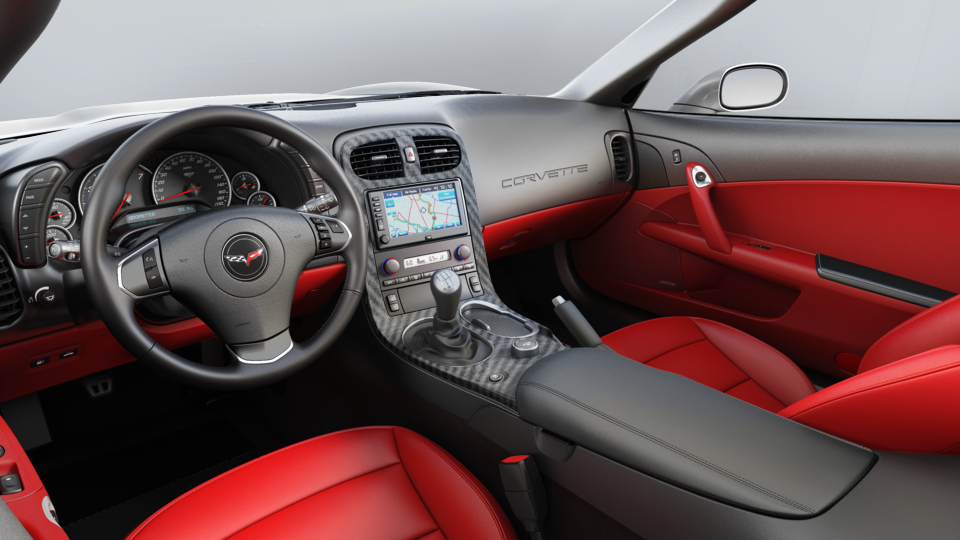
… a car that would get me to stories and other appointments really, really quickly, you must admit.

The right Mike

Since on a 90-plus-degree day every Wisconsinite thinks about the Packers, you cannot help but be impressed with this Milwaukee Journal Sentinel interview with Packers coach Mike McCarthy:

Q. Having won a Super Bowl, though, and going 15-1 last year, where do you set the bar?

A. I think I said it the first day I was here. It’s always about winning the world championship in Green Bay. I don’t think you ever settle for less than that. Just take a look at last year, 15-1 doesn’t cut it.

Q. So to you, 15-2 last year doesn’t cut it?

A. That’s not what I’m looking for, and it’s not what our players want and that’s really all that matters. If we can stay focused on what the group’s trying to accomplish and continue to do the things that are necessary. We have a blueprint of success for the way we train, but it’s a challenge every year. The team takes on a new face every year. There’s a path out there for us to get to New Orleans and win the championship. It’s our responsibility, and with a little touch of grace from the good Lord, we’ll be able to stay on that path. …

Q. At the 2011 NFL combine, you said one of your goals was to become the No. 1 offense in the NFL and then you went and scored 560 points, the second most in NFL history. What’s your level of pride in achieving that, and can this offense get better?

A. We felt we clearly left a lot of offense on the table (in 2010). There was actually a lot of offense we didn’t even use because of the injuries. That year was clearly the highest of all the years here where things we did in training camp we never even used during the season. So with that being said, I was very confident and I thought the offense was ready for Aaron (Rodgers). Aaron’s been ready for more responsibility, but it’s more is everybody else around him ready, too? And we felt Aaron was ready for more responsibility at the line, and I think it’s been very beneficial to our team. To me, last year was the standard. We set the standard on offense, and that’s what we’d like to hold ourselves to.

Q. So 35 points per game is now the standard?

A. Yep. I like that. …

Q. [Aaron] Rodgers is at almost the identical point in his career as Brett Favre was when you were his position coach here in 1999. Can you compare how it is to coach the two at this particular juncture of their careers?

A. I’m in a different job today, and frankly, I miss coaching quarterbacks. I just have too many responsibilities. The most important thing that I’ve done as far as the quarterback room is make sure the structure and the emphasis was put into place, and I did that my first year here. Tom (Clements) did a fantastic job of carrying that through and now he’s doing that with (new quarterbacks coach) Ben (McAdoo). The only thing is when I look at the quarterback room, I just want to walk over and be sure it’s continuing to be done the right way, because everybody has a certain way they’d like to see a quarterback trained. As far as coaching Brett, he was a lot more accomplished in the offense, so it was a transition. I’d say it’s a lot different. I look at Ben walking in the room now. Ben’s been here. Aaron knew Ben. I was the new guy coming in. I didn’t coach Brett until the first minicamp. To me, it’s a whole different off-season layout. Brett was a great player. He went through a bunch of injuries that year and did a remarkable job playing all 16 games that year.

Q. Have you ever had anybody quite like Jermichael Finley – on and off the field?

A. Oh yeah. He’s not that hard. I’ve had a lot more challenging situations. I think with Jermichael, people are on Jermichael a little bit too hard because he’s the only one that carries himself that way. The guy has a big heart and he means well. He’s extremely competitive and very talented. Everybody expresses themselves differently and obviously his style is very resourceful to the media, and that kind of takes on a different life. But I like him. I enjoy working with Jermichael. And if people didn’t enjoy working with Jermichael Finley, then he wouldn’t be here, and that’s not the case. We think he’s a young man that still has so much in front of him. The only thing I concern myself with Jermichael is I just want to see him stay healthy. But I’ve been around a lot more challenging people than Jermichael. …

Q. Do you ever want [Ted Thompson's] job, here or somewhere else?

A. No. If I did that job I wouldn’t coach. I don’t think you can do two. I think it’s too much. I think you’d be robbing Peter to pay Paul. You can’t be in two places at one time. I’m a football coach, and I don’t see anything in the near future that’s going to change that. But I’ll also say this: I feel like I have something bigger in my life than being the head coach of the Green Bay Packers. I think there’s something out there for me to do after my time is up. I hope it’s not up for a long time because I enjoy it. But those questions are always answered by someone a lot bigger than you and I. But when that time comes, I do feel like there’s one more big challenge out there for myself professionally.

Q. Most people in this state don’t think there’s very much that’s bigger than where you’re sitting.

A. Well, it’s the best job I’ll ever have. I’ll never have a better one.

Q. You hint about that next challenge. Any idea what that is?

A. No I don’t. I’ll let the good Lord tell me what that is. …

Q. Once July 26 arrives, will you have any type of home / work balance over the ensuing seven or eight months?

A. How do you define balance?

Q. Let’s say seeing your family an hour, maybe two a day.

A. I like to think we have balance here as far as the coaching profession goes. We’re not going to have coaches sleeping here in the office. I can promise you that. I won’t allow that. I’ve done that. I know why it’s happened, but I’m very conscientious of the time management of our staff. I’ve done the sleep in the office thing, or two or three hours of sleep, but you’re not the same guy on the field. The thing I’ve noticed from the old way and the way we do it is I want the coaches fresh. I want them getting home, getting a good night sleep. The most important time you spend is with your players, in your meeting room, on the field and you need proper sleep to get that done. …

Q. You obviously learned something from the loss in 2007. What did you learn from last year’s loss?

A. Really, it takes you right back to the emphasis of the fundamentals. That’s something I feel we do every day, but maybe we had to take a look. Maybe I wasn’t doing it enough. We adjusted some practice things because of it.

Q. That was also one of the most unique weeks leading up to a football game that I’m sure you ever had [with the death of the son of Packers offensive coordinator Joe Philbin]. In retrospect, how much did that hurt you?

A. Unique is a kind word. I don’t know how you explain that week. It was like getting run over by a truck. That’s a better description. …

Q. What do you want your legacy to be here?

A. That he was a better person than a coach.

Q. In 2010, you went with the ‘Super Bowl or Bust’ theme. Will you do that again?

A. I just don’t believe in the crash and burn theory. I believe in winning and learning. I don’t believe in that other word. I don’t even like to say it. I believe you keep building and keep working at it, keep winning. And as long as they keep giving you opportunities, make the best of it. I’m not satisfied with coming close. I’m going to do everything I can to win the championship and that will never change. And when that does change, I probably need to step out and let someone else take a swing at it.

Wouldn’t you want to play for a coach like that?

Presty the DJ for June 29

Proving that there is no accounting for taste, here is the number 17 song today in 1968:

Today in 1971, Mick Jagger and Keith Richards were sentenced on drug charges. And, of course, you could replace “1971″ with any year and Jagger’ and Richards’ names with practically any rock musician’s name of those days.

Or other people: Today in 2000, Eminem’s mother sued her son for defamation from the line “My mother smokes more dope than I do” from his “My Name Is.”

Birthdays start with LeRoy Anderson, whose first work was the theme music for many afternoon movies, but who is best known for his second work (with which I point out that Christmas is less than six months away, today’s searing heat notwithstanding):

Continue reading