A day at the auto show

As I warned last week, I spent Saturday at the Greater Milwaukee Auto Show.

Which has nothing to do with possibly the craziest thing I’ve ever seen in sports two days later, except that it too involved four-wheeled vehicles:

Well, there was a NASCAR-like race car at the car show, and Edgerton’s own Matt Kenseth won the race.

The first thing I noticed about this year’s show was the continuing encroachment of less-than-new vehicles — or, as the show literature put it, the “Manufacturer-Certified Pre-Owned Showcase.” Some of this is understandable simply because Lamborghini isn’t in the habit of sending its cars across the planet to car shows:

This is the 6.2-liter V-12 from a 2005 Lamborghini Murcielago, for which Harry Kaufmann Motorcars is asking $149,998. That presumably includes the mileage premium, since it has just 12,971 miles. Happily, it has a six-speed manual transmission and all-wheel drive, just the thing for later today’s apocalyptic forecast.

Harry was also showing off a 1988 Bentley Brooklands, a 2006 Lotus Elise, a 2008 Maserati Quattroporte, and two Corvettes.

The opposite of the Lamborghini, I suppose, is this Fiat 500, Fiat’s answer to the Mini Cooper, my daughter’s favorite car. The common thing of the Mini and the 500 beyond their diminutive size is their surprising room for the driver. On the other hand, I’m pretty sure I wouldn’t want to be a passenger in either.

(The Mini irony is that the Mini display was across from the Freightliner Sprinter, a van so large that it appeared able to swallow the Mini whole.)

Porsche had a new car display. But every Porsche was locked. However, the second floor had a section of lightly used cars, including this 2009 Porsche Carrera S. You can barely see from the photo that this silver Porsche had a butterscotch-colored interior. At least I fit in the car, which my German side approves of. But this Porsche had an automatic, which rather ruins the experience, particularly, I imagine, of the squirrelly handling of a rear-engine rear-drive car.

One reason for the appeal of less-than-new cars beyond their more reasonable prices (in exchange for the uncertain previous owner experience) is that manufacturer improvements are not necessarily improvements in the eye of the consumer. I own a 2005 Subaru Outback, a definite improvement from its previous iteration. (Before the 2005 Outback I owned a 1998 Outback, so I skipped iterations.) The current Outback doesn’t look to me like an improvement from what I own, in that it looks more like an SUV and less like a station wagon. (The Legacy line, from whence came the Outback, doesn’t offer a station wagon anymore.) The Outback no longer offers a turbocharged four-cylinder, and someone buying an Outback probably thinks the Impreza and Forester (which do offer turbo fours) are too small. (In case you haven’t noticed by now, the official positions of this blog are that (1) there is no such thing as too much horsepower and (2) automatic transmissions are necessary evils at best.)

The other thing about older cars is that they’re more likely to have manually adjustable seats instead of power seats. Both our cars have power seats, so I don’t object to owning them. But most power-seat-equipped cars in a car show don’t have their batteries connected, so the seat will be wherever it’s left, so you don’t get a good idea of whether the car would fit you or not. And when you’re 6-foot-4, that is not an insignificant issue.

Car shows are great for displaying manufacturers’ answers in search of questions. Want an SUV and a convertible, but can’t afford one of each? Buy a Nissan Murano, and you can have both in one vehicle, if you’re OK with, from what I read, poor acceleration and handling. (On the other hand, since Land Rover is reportedly introducing a convertible, perhaps there is a market for SUV convertibles after all.)
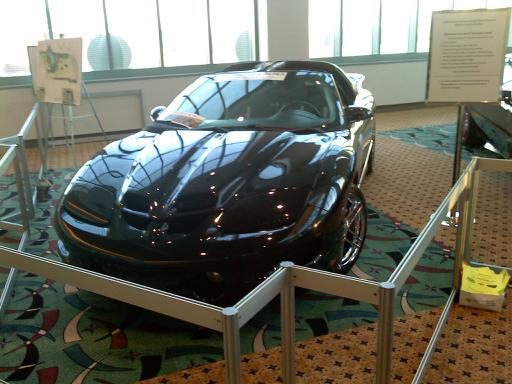
One of the displays was of an old-car trend I like — “restomods,” old cars with more modern engines and suspensions. The styling of yesterday’s cars is mostly superior, but their performance and accouterments (for instance, air conditioning) are not. Schwartz Performance of Woodstock, Ill., was there with a modern chassis and several cars, including this Pontiac Trans Am with, if I recall correctly, about 600 horsepower under the hood. To its right was a 1970s Trans Am with, according to the sign, a 1,200-horsepower V-8 under the hood. In front of it was a 1967 Chevy Nova with a 675-horsepower V-8.

The car Schwartz didn’t bring was a 1982 Cadillac Fleetwood Brougham that the owner had taken to Road America, after installing a heavily modified 500-cubic-inch V-8 and a suspension from his fabricated parts. Since early ’80s Caddys met no one’s definition of race car, one can imagine the surprise of those he passed on the track.

As an owner of a Subaru Outback, I of course checked out the Subaru display. This is the upcoming Subaru BRZ, a sports car developed with Toyota (20-percent owner of Subaru) without Subaru’s usual all-wheel-drive. It’s certainly cool looking, and it has Subaru’s boxer engine, but it’ll be interesting to see how potential owners react to the lack of all-wheel-drive. (Of course, if you want all-wheel-drive, you can get an Impreza WRX STI, with a 305-horsepower flat four.)

The ponycar wars of the ’60s continue with the Chevy Camaro …
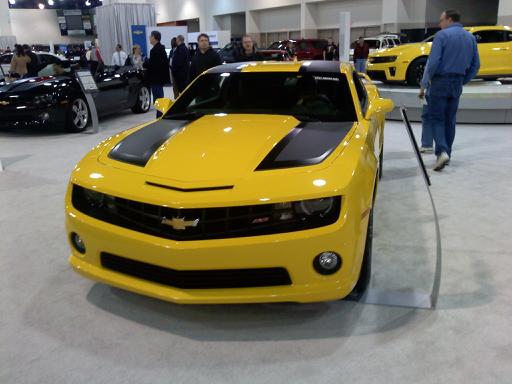
… and the Ford Mustang:

The new competition in this category is, of all things, a Hyundai — the Genesis coupe, available with either a 210-horsepower turbocharged four or a 306-horsepower V-6.
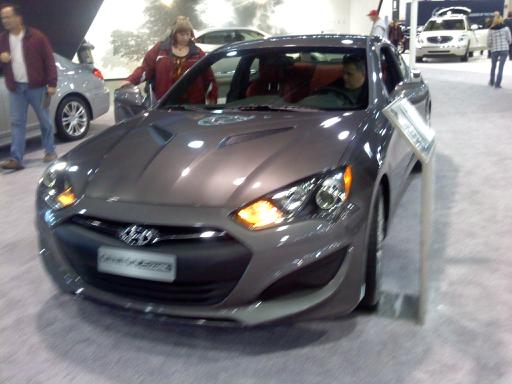
I drove one of these at a Bergstrom Susan G. Komen Driver for the Cure event two years ago. I believe I wrote it was more fun than a box of puppies that  had just been fed. Other than my usual issue of my height vs. the car’s (lack of) height, it would be a fun ownership experience.

I drove the sedan version, which has a V-8 like the Detroit big cars of old (and unlike the Detroit big cars of today save the Cadillac CTS-V, Dodge Charger and Chrysler 300), at last year’s Drive for the Cure. I was impressed by its turbine-like power, its heated and cooled seats, and its 528-watt sound system, more power than some radio stations put out.
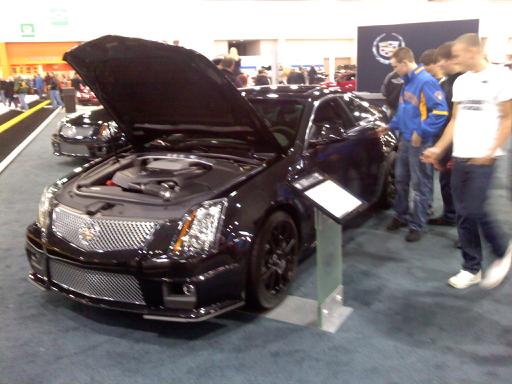
For those who like their V-8s from domestic manufacturers, you can choose the Cadillac CTS-V sedan, coupe (above) …

… and station wagon. I’m not sure how usable the wagon’s storage space is, but getting the kids to their current sports team would be a stylish, yet fast, trip. (We’d have to get the wagon because the coupe has one fewer seat than we need.)

What? You ask if something’s missing?
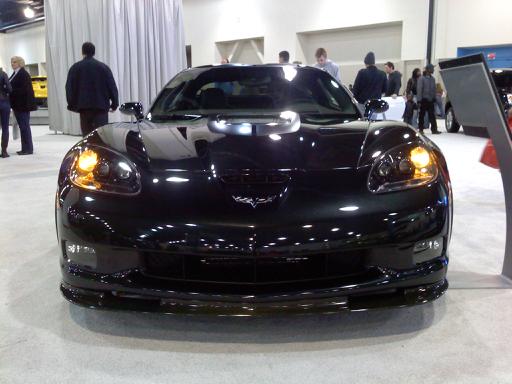
You didn’t think I’d forget a Corvette, did you? (The ZR1 was locked, but the convertible wasn’t. I still fit.)

A hairy subject to debate

Anyone who has seen my face on this blog or elsewhere knows that my face is partially covered by facial hair. (Since the winter of 1992–93, for those who didn’t know.)

Seeking to improve its public profile, the American Mustache Institute introduced a proposal it called the Stimulus To Allow Critical Hair Expenses — yes, STACHE — Act, a tax deduction of up to $250 for, yes, facial hair expenses:

The STACHE Act is based on the celebrated white paper “Mustached Americans And The Triple Bottom Line.”  … Written by noted tax policy professor Dr.John Yeutter, Ph.D., CFP, Associate Professor of Accounting and Tax Policy at Northeastern State University, it argues that the social and environmental benefits to mustache growth and maintenance provide a service to the U.S. economy.

“Given the clear link between the growing and maintenance of mustaches and incremental income … mustache maintenance costs qualify for and should be considered as a deductible expense …,” Dr. Yeutter wrote.

Said $250 tax deduction would cover such expenses as:

  • Mustache and beard trimming instruments;
  • Mustache wax and weightless conditioning agents;
  • Facial hair coloring products (for men and women over 43 years of age);
  • Bacon;
  • Mustache combs and mirrors;
  • DVD collections of “Magnum P.I.” and “Smokey and the Bandit”;
  • Mustache insurance (now required by state law in Alabama, Oregon, Maine, New Mexico, and Puerto Rico);
  • Billy clubs or bodyguards to keep women away as a mustache increases good looks by an estimated 38 percent;
  • Little black books and jumbo packages of kielbasa sausage;
  • Burt Reynolds wallet-sized photos.

I don’t know how many people AMI expected to read Yeutter’s white paper. I did. The Environmental Impact part claims:

Mustache grooming aids are largely natural and environmentally friendly, and do not contribute to either ozone depletion or global warming as is the case with other hair care products.

In addition, the cookie duster can act as a natural warming device, allowing the Mustached American to reduce dependencies on artificial heating devices and save vast quantities of energy during cooler months. Further, proper mustache maintenance reduces solid waste, as not only are the vibrissae themselves not deposited into landfills, but also a significant amount of disposable razors are saved from dangerous misuse.

Other environmental benefits of the appropriate growth and grooming of mustaches include inarguable proof that owning and operating a proper mustache reduces shaving, thus reducing the use of water, shaving cream, and environmentally harmful chemicals found in after-shave lotions and tonics. Additionally, reduced nasal drainage caused by breathing harmful pathogens are effectively filtered through mustache fur, thus limiting the amount of dangerous carbon dioxide reaching the ozone layer.

If you’re not convinced by now of the seriousness of AMI’s proposal, consider that AMI further proposed to publicize the STACHE Act by holding a Million Mustache March on Washington on April 1.

The STACHE Act is of little use to me, since I use neither mustache wax nor “weightless conditioning agents” nor “facial hair coloring products,” and I’m really not interested in the DVDs or the Burt Reynolds photos. (However, I would take the bacon and kielbasa deductions.)

But to demonstrate that truth is stranger than fiction:

After barnstorming the Nation’s Capitol in support of the proposed Stache Act (details and white paper here), the office of of [sic] Maryland 6th district U.S. Rep. Roscoe Bartlett informed the American Mustache Institute that the congressman has begun the process of ensuring the ‘Stache Act becomes law by passing the proposal to the House Ways and Means Committee for study — an essential first step for tax legislation.

The Weekly Standard adds:

The surprising thing is not that a congressman—Rep. Bartlett, a Republican—would support the creation of another tax loophole. …

Instead, it was odd that Bartlett would even participate in what clearly seems to be an elaborate parody of Washington, D.C., think tanks and advocacy groups—and Congress. (The group is, after all, holding a rally on Capitol Hill on April 1.)

So I called Bartlett’s office to see if something so silly could possibly be real. Sure enough, it is—but there’s a wrinkle: Congressman Bartlett was never aware that the bill had been referred to the committee in his name. …

“Congressman Bartlett has referred their proposal to the Ways and Means Committee, without commenting on the merit of the bill,” Lisa Wright, Bartlett’s press secretary, told me. The House Ways and Means Committee, Wright explained, has jurisdiction since the Stache Act is a tax bill.

Wright was then asked that since Bartlett referred the bill with comment, would she be able to comment on her boss’s opinion of the proposed legislation. “Congressman Bartlett merely referred it without recommendation,” Wright told me after a big pause.

Indeed, Wright conceded, when asked whether it’s a waste of the congressman’s time to be toying with legislative stunts like this one, that Bartlett actually knew nothing about the bill he supposedly had referred to the House Ways and Means Committee.

“I did not raise it with him,” Wright admitted. “Actually it’s a staff referral . . . I did it, I referred it.” When asked whether Congressman Bartlett knew about the referral, Wright sheepishly said, “I don’t think I told him yet.”

That was posted Tuesday. One day later:

UPDATE: Lisa Wright called Wednesday morning to clarify that she only referred the mustache proposal to the Ways and Means Committee, and did not actually send a bill to the committee. In a follow-up message left on my voicemail, Wright says, “Please check Thomas to look for the Stache Act. You will not find it. It does not exist. There is no bill. There is no legislation. And an advocacy group that characterizes it as legislation—and you used that term with me—does not make it legislation.”

I think Wright’s next job evaluation with Bartlett might not go so well.

Presty the DJ for March 2

The number one British single today in 1961:

The number one single today in 1963:

Today in 1964, the Beatles began filming “A Hard Day’s Night,” and George Harrison met Patti Boyd, who became Harrison’s wife.

Boyd later would become the subject of an Eric Clapton song (in fast and slow versions), and then Clapton’s wife, and then Clapton’s ex-wife.

Stevie Wonder won R&B song of the year for “Superstition,” and album of the year for “Innervisions” in today’s 1974 Grammy Awards:

The number one album today in 1985 was the first album of Wham!, which wanted to “Make It Big”:

The number one British album today in 1985 was Phil Collins’ “No Jacket Required”:

The number two British single today in 1991 was recorded 21 years earlier but became popular because of its use in a Wrigley’s Gum ad:

Birthdays begin with Lawrence Payton of the Four Tops:

Lou Reed:

Former New York police officer Eddie Mahoney, better known as Eddie Money:

Karen Carpenter:

John Cowsill:

John Francis Bongiovi Jr., better known as Jon Bon Jovi:

Chris Martin of Coldplay:

Four deaths of note today: Serge Gainsbourg, who recorded a highly suggestive song, in 1991 …

… Dusty Springfield in 1999 …

… songwriter Hank Ballard in 2003 …

… and Jeff Healey in 2008: