The number one song today in 1957:
Today in 1967, bowing down to popular music, the BBC began its Radio 1:
No comments on Presty the DJ for Sept. 30
The number one song today in 1957:
Today in 1967, bowing down to popular music, the BBC began its Radio 1:
The number eight song today in 1958:
Today in 1967, the Beatles mixed “I Am the Walrus,” which combined three songs John Lennon had been writing. The song includes the sounds of a radio going up and down the dial, ending at a BBC presentation of William Shakespeare’s “King Lear.” Lennon had read that a teacher at his primary school was having his students analyze Beatles lyrics, Lennon reportedly added one nonsensical verse, although arguably none of the verses make much sense:
The number 33 single today in 1973 …
… 32 slots behind number one:
For those with nothing better to do tonight, I will be announcing the Platteville–River Valley football game around 7 p.m. You can listen at wglr.com.
The timing is coincidental, but the Wall Street Journal decided that one of the burning questions of today is … how biased home-team baseball TV announcers are:
The conventional wisdom in sports is that TV announcers should strive to call the game straight down the middle. It’s a philosophy that’s been embraced over the years by most of the famous baseball voices.
The first problem is: Where, other than the networks and national sports channels (that is, ESPN), is that the conventional wisdom? If you’re watching baseball on Fox or ESPN, you expect an unbiased broadcast. If you’re watching on Fox Sports or whoever carries the team in its market, you expect them to favor the team they’re covering, though not egregiously.
What’s my definition of “egregiously”?
If you’re wondering what’s going on in the American League Central pennant race over the next week, all you need to do is tune into a Chicago White Sox telecast and listen for the voice of the team’s play-by-play man, Ken “Hawk” Harrelson.
Harrelson is, to put it diplomatically, a bit of a “homer.” In other words, he’s unapologetic about his devotion to the White Sox, the team he routinely calls “the good guys.” According to one measure, Harrelson and his booth partner, Steve Stone, make more nakedly biased statements during a single game than every other TV broadcast team in the American League combined.“Let’s just say that if we’re losing, you’re going to know it,” Harrelson said in a recent interview. “I won’t sound happy.” …
Harrelson has taken a decidedly different approach. He considers himself the biggest White Sox fan on the planet. It just so happens that he’s paid to talk about them. He’s known for begging long fly balls (Stretch! Stretch!) to soar over the fence and imploring the players for key hits. He even criticizes calls that don’t go Chicago’s way. In May, he went on a rant against umpire Mark Wegner, saying that he “knows nothing about the game of baseball.” After that outburst went viral, he met with Commissioner Bud Selig and ultimately apologized.
Harrelson should apologize to anyone watching White Sox games for not only his blatant homerism — which one would expect to some extent for watching a WGN-TV White Sox game — but his unprofessionalism in announcing. Several years ago I watched the White Sox blow a ninth-inning lead and lose to California … I mean Anaheim … I mean the Los Angeles Angels. I don’t think Harrelson said 10 words as the White Sox proceeded to lose their lead and the ballgame.
(Harrelson should also apologize to Stone for ruining Stone’s reputation as a really good analyst, which he was with the Cubs’ Harry Caray before the Cubs stupidly decided they didn’t need him around anymore because he was — horrors! — too hard on the Cubs.)
Regardless of who employs them — the team or their broadcast outlet — an announcer should be expected at least to tell listeners or viewers what’s going on, not sit there in a snit because he doesn’t like what’s happening. (I once announced a season of a football team in which the team lost every game. I didn’t like that, but I didn’t take entire drives off because I didn’t like how they were playing. At a minimum, that’s unfair to the listeners and viewers. At the high school level, it’s also unfair to the players, who certainly do not intend to lose.)
Some comments claim Harrelson recognizes good performances by the “bad guys.” (Yes, that’s what he calls Sox opponents.) I have yet to hear this, but we’ll assume they’re right. The point, however, is that WGN is carried across the world via satellite, which means that not only White Sox fans, but fans of their opponents watch, and because of their superstation status, probably in greater proportions than other teams’ cable outlets.
Based on one game — yes, one game — the Journal proceeded to rate all 32 baseball team TV announcers for bias, or lack thereof:
 Some of what the writer sees as bias doesn’t strike me as bias, or at least objectionable bias. The Pirates’ “E-I-E-you’re-out!” comment might be funny … once. “Casilla’s window-shopping!” is a more contemporary version of longtime Tigers’ announcer Ernie Harwell’s comment on an opponent’s called-strikeout that “He stood there like a house by the side of the road and watched it go by.” (If I ever got a chance to do baseball, I’ve thought of announcing a called strikeout as “SIT … dowwwwwwwwn.”)
As a viewer, I would be annoyed by “Can I get a big WOOOO!” or “Paul GOOOOOOOOLDSCHMIDT!” As an announcer, I am not saying anything close to that. I’m not sure who’s to blame for this, but announcers, even at the major-league level, seem increasingly eager to shriek like baboons at big moments. Some announcers sometimes seem to spend more time practicing their catch-phrases than, say, doing game prep. (I have exactly two catch-phrases: “Bullseye!” for a three-point basket, and “To the end zone!” to announce the end of a long touchdown run. The former replaced “Bango!”, a reference to former Bucks announcer Eddie Doucette that no one remembers; the latter was my attempt to say something other than “touchdown” for a football team that averaged 46 points a game.)
I do not refer to the team I’m announcing as “we,” because I’m not a member of the team. (Believe me, no team wants me on their team. And yes, that rule includes when I’m watching the Packers, Badgers or Brewers; I’m not on their teams either.) I don’t refer to players by their nicknames. The story does point out that former players who become analysts, which could include the Brewers’ Bill Schroeder, are probably more comfortable saying “we” or “us” because they were on the team. And if I say “we go to the fourth quarter,” that means the listeners or viewers along with us announcers.
But if I’m announcing one specific team, I would be an idiot if I didn’t want that team to win. For one thing, the listeners want that team to win. (Which means the sponsors too.) Beyond that, if I’m covering a team in the postseason, it’s in my own best interest as an announcer for that team to win. The more the team wins, the farther it goes in the postseason. Teams that win titles tend to help their announcers’ careers, as Wayne Larrivee, who called the Bears’ Super Bowl XX win, can probably attest.
I used to announce Ripon College football and basketball games for Ripon’s cable TV channel. The last few years, those games were broadcast live on the Internet as a conference package, with each home team originating the webcast. Our games had the same announcers broadcasting for three different audiences — each teams’ fans live, and the Ripon viewers (including the players) the next day. If I got any complaints about bias, I never heard them. (In fact, one of the nicest announcing compliments I’ve ever gotten came from a follower of one of Ripon’s opponents.)
There is a difference between an announcer who wants his team to win, and an announcer who wants his team to win so badly that he refuses to acknowledge reality — that maybe his team is not as good as its opponent, or that an official’s call justifiably went the other way. One reason Harry Caray was tolerable to watch if you weren’t a Cubs fan is that Caray would turn on the Cubs when they did poorly. (Caray’s call of a Henry Aaron home run in a Braves–Cardinals game: “Here’s the pitch … oh my god … it’s over the roof.”) That also applied to his son, Skip, who was legendary for wittily skewering the team that was paying his salary. (He was fond of announcing “partial sellouts” at Atlanta–Fulton County Stadium, where fans dressed as empty seats got in free, and opened one game with “And like lambs to the slaughter, the Braves take the field.”)
The first, most important thing a sports announcer must do is call the game. It amazes me how often the little things like, say, score and time don’t get mentioned. (Having written that, I must admit that one issue for me in converting from tape-delay TV to live radio is calling the score and time enough.) Beyond that, an announcer has to know his audience. Fans forgave Packer and Badger announcer Jim Irwin, and forgive Brewers announcer Bob Uecker, for their announcer lapses because their careers demonstrated that they wanted the teams they were announcing to win. That seems to be priority number one among Wisconsin sports listeners. They even forgave Larrivee for having been the Bears’ announcer before he got to the correct side of the Bears–Packers rivalry.
The National Weather Service Climate Prediction Center has good news:
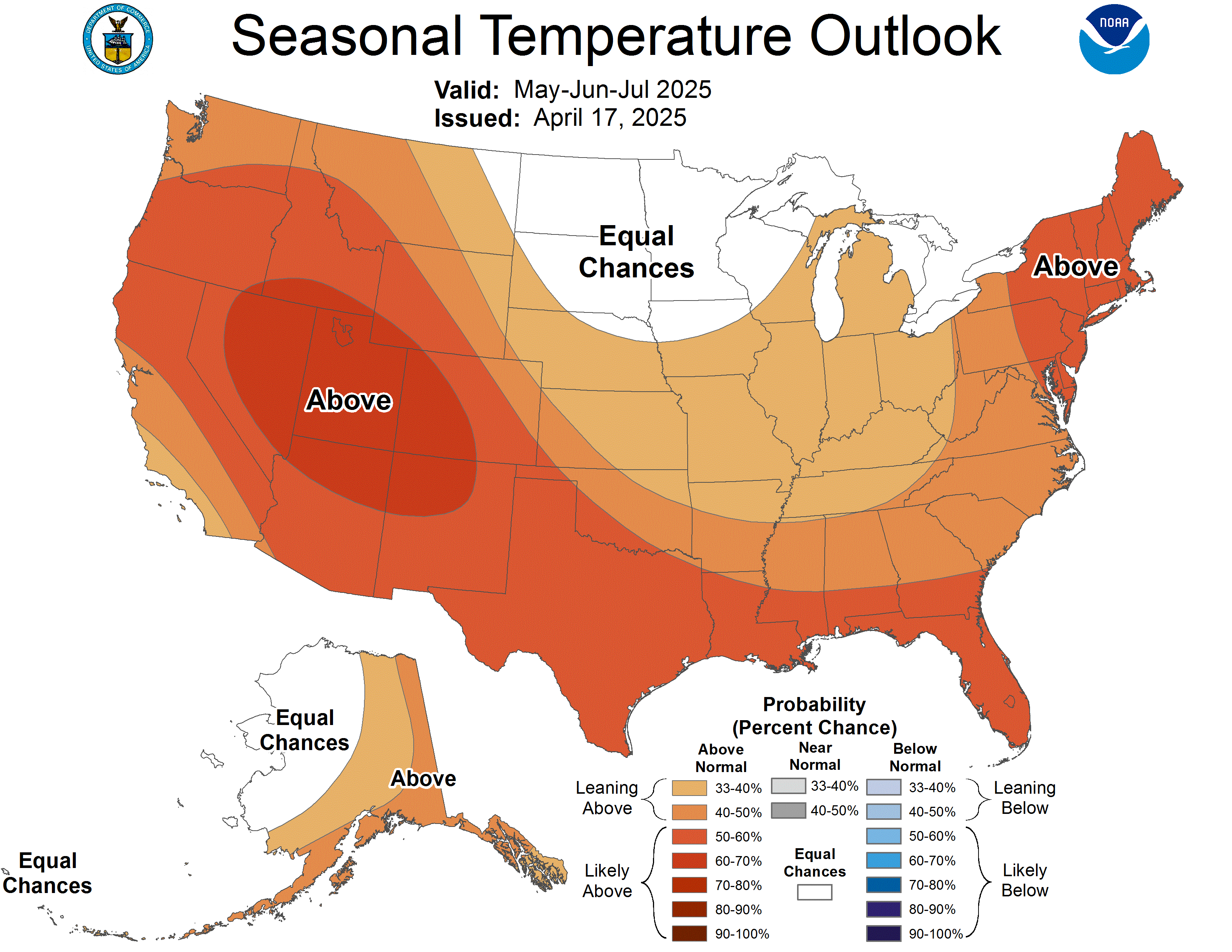
 For those who do not speak meteorology: The orange areas indicate above-normal temperatures. The blue areas would indicate below-normal temperatures if there were any. Green indicates above-normal rainfall and brown indicates below-normal rainfall.
We could use more precipitation. But above-normal temperatures mean less need to heat, and less need for gas for snowblowers, among other benefits of warm winters. Of course, given last year’s wildly wrong prediction of winter (blamed on El Niño), and the less-than-accurate forecast (AccuWeather was half-right; the Climate Prediction Center was completely wrong) for this past summer, feel free to take this with a grain of salt.
Proving that there is no accounting for taste, here is Britain’s number one single today in 1963:
Five years later, record buyers made a much better choice:
The number one U.S. album on the same day was “Time Peace: The Rascals Greatest Hits”:
I need name neither title nor artist of the number one album today in 1974:
The number four single today in 1985:
The number one album that day was Kate Bush’s “Hounds of Love”:
The number one single today in 1991:
Birthdays begin with Ben E. King, one of the numerous lead singers of the Drifters before his solo career:
Nick St. Nicholas played bass for Steppenwolf:
Paul Burgess played drums for 10cc:
Med Lucart of Wall of Voodoo:
Moon Unit Zappa, fer sure fer sure:
One death of vote today in 1968: Dewey Phillips. Who? The first DJ to play the first record of Elvis Presley, on WHBQ in Memphis:
Former Government Motors chairman Ed Whitacre opined earlier this month:
The Treasury Department should sell every last share that it owns of General Motors—as quickly as possible.
I don’t say that critically, but the government has been an active participant in GM’s management for more than three years, and that’s long enough. It’s time for Treasury to step out of the way so that GM can fully focus on what it does best: designing, building and selling the world’s best vehicles.
I got that far and had to stop reading. Read the rest, and you’ll find ludicrous claims about post-bailout GM, which were rightly slammed in the comments section.
Before the bailout, though, to say that GM designed, built and sold “the world’s best vehicles” is at least as ludicrous. Limiting this list to my own lifetime, I can without too much difficulty note GM examples that are closer to “worst” than “best” on the vehicle design spectrum:
The Chevrolet Corvair wasn’t a bad car for the day, but, as Dan Neil wrote:
While rear-engine packaging offers enormous advantages, putting the vehicle’s heaviest component behind the rear axle gives cars a distinct tendency to spin out, sort of like an arrow weighted at the end. During World War II, Nazi officers in occupied Czechoslovakia were banned from driving the speedy rear-engined Tatras because so many had been killed behind the wheel. Chevrolet execs knew the Corvair — a lithe and lovely car with an air-cooled, flat-six in the back, a la the VW Beetle — was a handful, but they declined to spend the few dollars per car to make the swing-axle rear suspension more manageable.
Nor did GM apparently market the Corvair very well. (You’ll note that rear engines haven’t hurt Porsche at all.)
From the Corvair, GM unveiled the Chevy Vega, of which Car & Driver writes:
It was so unreliable that it seemed the only time anyone saw a Vega on the road not puking out oily smoke was when it was being towed.
That’s not to say the choice of the Vega as 1971 [Motor Trend magazine] Car of the Year didn’t make sense in context. This was the year Ford and Chevy introduced new small cars, and compared with Ford’s Pinto, the Vega at leastseemed better. The Vega handled more precisely, was available in more body styles, and with styling cribbed straight off the Camaro, looked more attractive. The Vega’s aluminum engine block even seemed like a technological leap forward.
However, the aluminum block’s unlined cylinder bores scored easily, and the (usually misaligned) iron cylinder head let oil pour into them. Every element of the Vega’s chassis was built about as flimsily as possible, and the unibody structure’s metal was usually attacked by rust mere moments after being exposed to, well, air.
Another writer claimed that Vegas were made of compressed rust. The same could probably be said of Vega spinoffs, the Chevy Monza (basically a better-looking Vega) and Pontiac Astre (Pontiac’s Vega) and Sunbird (Pontiac’s Monza).
About the Vega’s 140-cubic-inch four-cylinder, Popular Hot Rodding adds:
At the time, John Delorean was on Chevy’s executive team, and had reportedly commented that the design of this engine resembled a pre-war tractor motor. Though some are not aware, this little “four-lunger” featured silicone-impregnated aluminum cylinders — not cast-iron sleeves, like most aluminum blocks. Early in production, Chevy re-called some 132,000 vehicles to correct the possibility of a carburetor fire. Other design characteristics were displayed as the blocks were subject to distortion, due to overheating, and the cylinders were prone to wear, causing an unusually high oil consumption.
The ’70s were really bad for GM. About the time the Vega/Astre/Monza were heading toward their demise, someone took a look at the diesel engines being sold by Mercedes–Benz and Volkswagen and decided GM needed to get into that trend. It is apparently not correct that GM took a gas 350 V-8 and made it into a diesel. Nevertheless, GM’s work left a lot to be desired, as Popular Hot Rodding notes:
Contrary to popular belief, the engine was completely different than its gasoline brethren, but it did look the same since it needed to go down the same assembly line and fit into vehicles that could be either gas or compression-ignition powered. The block was much sturdier and the crankshaft mains and crankpins were 0.500-inch bigger, measuring 3.00 inches instead of 2.5 inches. The crankcase was heavier and the pistons were fitted with full-floating pins. The block was so good that during that era many drag racers used it to make big power and it was known to stay together.
Then what happened to the Olds Diesel to give it such a poor reputation and the impetus for a class-action law suit? The engine suffered from poor familiarity by the consumer and Olds service personnel along with the lack of a water/fuel seperator and drain in the fuel system. This was compounded by a flood of very poor-quality diesel fuel into the market place shortly after the engine’s introduction. Any moisture or dirt that would get into the high-pressure Roosa Master injection pump would cause some of the parts to hang up. This could have occurred for only a second, but that was enough time of an incorrect fuel inject cycle that would allow cylinder pressure to peak and overcome head bolt tension or break down the head gasket. The driver may have only sensed a slight shudder but the damage was already done. The injured head gasket would then let coolant seep into the cylinder and since there is little quench volume in a diesel, the uncompressability of a liquid was a theory very quickly reinforced. Something had to give and it often was a piston, connecting rod or crankshaft but it spelled disaster either way. In addition, both the dealer body and the consumer often used the incorrect oil for the engine, creating further service issues.
The Olds Diesel, when cared for properly, ran for hundreds of thousands of miles, but only in the hands of an experienced diesel operator. Other than that, it makes a great gasoline race engine block.
It’s interesting that the disaster diesel is blamed largely on failure to separate water and diesel, since it’s widely believed that this diesel has soured American car-buyers on diesels for more than three decades. The Olds diesel also was slow, and GM compounded that problem by creating a diesel V-6 from the diesel V-8. (The diesel engines you find in cars and pickups today are turbocharged, which gives them decent horsepower and pull-your-house-off-its-foundation levels of torque), unless they’re in an Isuzu-powered GMC C-7500 rented by Budget Car Rental. But I digress.)
Those diesels ended up in GM’s B-body and A-body cars of the late 1970s. GM’s downsizing began with the 1977 B-bodies, and that well-designed car lasted until 1996. The next round, the Chevy Malibu/Pontiac LeMans/Olds Cutlass/Buick Century was not designed nearly as well. For one thing, the rear windows didn’t roll down — not an issue with two-doors, but an issue with sedans and wagons. GM’s lame explanation was that not having roll-down windows increased rear-seat elbow room. (Not in any useful fashion, I can attest.)
At least the Malibu and LeMans looked normal. I wonder who at Olds and Buick signed off on the fastback sedan look:

I had a chance to drive two — my grandmother’s 1980 Malibu, a car in which it was impossible to exceed speed limits, and our 1981, about which I have written before. (To call the latter a piece of manure is to insult manure.) The weak V-6 engines (despite having started to sell them in 1957, GM was late to figure out that balancing power, fuel economy and emissions required adopting fuel injection), hampered by their crude computer controls, were further handicapped by a downsized automatic transmission with a converter clutch (instead of overdrive gear(s)) that made the driver think someone had hit his car.
As bad as the A-bodies were, what followed the next year was even worse: The X-body Chevy Citation/Pontiac Phoenix/Olds Omega/Buick Skylark. The Truth About Cars tells the sad story:
GM was betting its future here, and we all know how it turned out: the eighties were GM’s worst decade ever in terms of market share loss, and the Citation not only kicked it off, it also set the template for almost all of its sins from then on.
GM’s biggest act of hubris was in even thinking it could execute such an undertaking, given its history. And clearly, the results got worse with each act. The fact that the Citation would be GM’s first ever-front wheel drive mass-market car didn’t help. As well as GM’s perpetual obsession with the next quarter’s profit. The mega-billions GM committed to its downsizing was taking its toll on the bottom line, and the Citation was behind schedule. Switching production facilities and suppliers over to a completely new generation of cars was taking its toll. …
Unfortunately, GM’s greatest industrial re-investment didn’t include a new four cylinder engine. The noisy, crude and rude “Iron Duke” 2.5 L OHV four was adapted for its new east-west orientation, and shook 90 hp from its crankshaft.
But GM was a bit more ambitious with the optional engine: the immortal 60-degree V6, still being built in China, and only just recently departed from the US GM line-up. In its first incarnation here, it had 2.8 L and 115 hp (110 beginning in 1981). And in 1981, the sporty X-11 Citation was graced with a bumped-up HO version, which churned out 135 hp. Just the ticket to fully display the Citation’s truly prodigious torque steer and other entertaining characteristics, some of them quite genuine, especially in later model years. …
It felt as if your favorite H-mobile was composed of two separate components (which it sort of was), or to take the analogy further, it felt like the body was a semi-trailer hooked to the back of a semi-truck. Floor it, and the truck started heading one direction (left, if I remember correctly) while the trailer both followed as well as tried to keep the truck from running off the roadway. Amusing, sort of. …
One might eventually get used to that, and if you had a good running V6, these cars could feel pretty lively given their light weight. But what goes fast must slow down, eventually, especially in LA traffic. And that’s where the fun disappeared, in a cloud of burning rubber. GM made almost the same penny-ante mistake with Citation as with the Corvair. Then, they left off a $14 camber-compensating spring. Now it was a $14 (?) rear brake proportioning valve. Drivers complained, NHTSA sued GM, which GM ended up winning in 1987, way too late: the perception/sales battle was then long lost. …
That was just for starters (and stoppers). In between, a seemingly endless rash of maladies made these cars recall kings and queens. Transmission hoses that leaked and cause fires. Various driveability issues: fuel injection was deemed too expensive; meanwhile the two-barrel carb on the V6 was the most complicated and expensive fuel mixing device Rube Goldberg was ever commissioned to design. (A replacement cost over $1000 in today’s money, as I well know). Shifting the manual transmission was like sending messages to a distant cohort in secret code via carrier pigeon.
The Citation interiors were hard and cheap. Sundry pieces of trim were prone to suddenly disassociating themselves from the rest of the car, in shame perhaps. Starting on day one. General build quality varied greatly, somewhere between miserable and mediocre. Cost cutting resulted in skin cutting from rough edges. Within one model year, the word was out and the jig was up: the Citation was a lemon.
Chevrolet sold 811,000 Citations its first model year, 1980. Chevy did not match that sales number in the next five years combined.
Having failed to combine power and better fuel economy through the diesel, GM came up with another answer: The V-8–6–4, about which Neil wrote:
When the engine is running at light loads, it’s logical to shut down unneeded cylinders to save fuel, like turning off lights in unused rooms. But in 1981, when semiconductors and on-board computers were still in their infancy, variable displacement was a huge technical challenge. GM deserves credit for trying, but the V-8-6-4 was the Titanic of engine programs. The cars jerked, bucked, stalled, made rude noises and generally misbehaved until wild-eyed owners took the cars to have the system disconnected. For some it was the last time they ever saw the inside of a Cadillac dealership.
Around that time came the second iteration of the Cadillac Seville, first introduced in 1976 to fight Mercedes. The first edition, despite coming from a mid-’70s Chevy Nova, did well in the marketplace. Edition number two looked weird …

… while saddling the owner with the diesel or the V-8–6–4 engine choice.
Next on the list is an example of GM’s laziness, and arguably a foreshadowing of Pontiac’s fate. Pontiac’s version of the B-b0dy was the Catalina and Bonneville. For some reason, GM switched the Bonneville nameplate to the aforementioned A-body in 1982, only to decide to bring back the big Pontiac a year later. In Canada, the Catalina was called the Laurentian and the Bonneville was called the Parisienne. The 1984 Parisienne was indistinguishable from a Caprice because it used Caprice sheetmetal. The Parisienne didn’t sell either, so GM reverted to the full-size Bonneville’s sheetmetal (including the big Bonneville’s fender skirts) for its last two years. (And to think GM paid people to make decisions like these.)
Speaking of lazy, or perhaps cynical, there is the Cadillac Cimarron, which made Neil channel his inner Francis Ford Coppola:
The horror. The horror. Everything that was wrong, venal, lazy and mendacious about GM in the 1980s was crystallized in this flagrant insult to the good name and fine customers of Cadillac. Spooked by the success of premium small cars from Mercedes-Benz, GM elected to rebadge its awful mass-market J-platform sedans, load them up with chintzy fabrics and accessories and call them “Cimarron, by Cadillac.” Wha…? Who? Seeking an even hotter circle of hell, GM priced these pseudo-caddies (with four-speed manual transmissions, no less) thousands more than their Chevy Cavalier siblings. This bit of temporizing nearly killed Cadillac and remains its biggest shame.
GM’s biggest shame might be what it failed to do with Saturn, branded as “a different kind of company, a different kind of car.” The latter certainly was not the case; in comparison to the cars it was built to compete against, the SL sedan, SW wagon and SC coupe couldn’t cut it. (On the other hand, 41 percent of Saturn sales were to owners of GM cars, so other GM brands couldn’t cut it against Saturn.) In the former case, despite supposedly doing things differently from other GM brands, including having a separate dealer network from other GM brands, the only thing that stuck about Saturn was its no-haggle pricing. The last nine years of Saturn were mainly American versions of GM’s European-brand cars, which might have worked as a strategy from the beginning, but that wasn’t the strategy from the beginning.
Finally, there is the Pontiac Aztek, which is apparently seared in Neil‘s mind:
I was in the audience at the Detroit auto show the day GM unveiled the Pontiac Aztek and I will never forget the gasp that audience made. Holy hell! This car could not have been more instantly hated if it had a Swastika tattoo on its forehead. In later interviews with GM designers — who, for decency’s sake, will remain unnamed — it emerged that the Aztek design had been fiddled with, fussed over, cost-shaved and otherwise compromised until the tough, cool-looking concept had been reduced to a bulky, plastic-clad mess. A classic case of losing the plot. The Aztek violates one of the principal rules of car design: We like cars that look like us.
The Washington Post explained what happened:
In the mid-1990s, then-General Motors Corp. Chairman John G. Smale decided to bring the world’s biggest automaker a dose of the give-the-people-what-they-want ethic that had animated Smale’s old company, Procter & Gamble Co. And what the people wanted was sexy, edgy and a bit off-key; in short, a head-turner. General Motors’ culture took over from there. Design would be by committee, the focus groups extensive. And production would have to stick to a tight budget, with all that sex appeal packed onto an existing minivan platform. The result rolled off the assembly line in 2000: the Pontiac Aztek, considered by many to be one of the ugliest cars produced in decades and a flop from Day One. …
The penny-pinchers demanded that costs be kept low by putting the concept car on an existing minivan platform. That destroyed the original proportions and produced the vehicle’s bizarre, pushed-up back end. But the designers kept telling themselves it was good enough. “By the time it was done, it came out as this horrible, least-common-denominator vehicle where everyone said, ‘How could you put that on the road?’” the official said.
Sales never reached the 30,000 level needed to make money on the Aztek, so it abruptly went out of production last year. The tongue-in-cheek hosts of National Public Radio’s “Car Talk” named it the ugliest car of 2005. “It looks the way Montezuma’s revenge feels,” one listener quipped.
I’ll let readers decide which looks better — the concept …

… or the actual product:

The Police had a request today in 1980:
That same day, David Bowie’s “Scary Monsters (and Super Creeps)” was Britain’s number one album:
Birthdays start with Randy Bachman of the Guess Who and Bachman–Turner Overdrive:
Who is Marvin Aday? Meat Loaf, or Mr. Loaf to you:
Greg Ham played, yes, flute for Men at Work:
Mark Calderon of Color Me Badd:
Avril Lavigne, the youngest female singer to reach number one:
Two deaths of note today: Jimmy McCullough, formerly of Paul McCartney and Wings, in 1979 …
… and Cliff Burton of Metallica, who died in a bus crash today in 1986:
It’s one thing to complain, correctly, about the traveshamockery that are the NFL’s replacement officials generally and the botch job they did in the Packers–Seahawks game specifically.
If I were in NFL management, I’d be more concerned about reactions like this, from Automotive News’ Larry P. Vellequette:
For three weeks, automakers have spent millions of dollars advertising their products during games whose outcomes have been decided by wrong-headed calls made by folks who have no NFL experience — and no business being — on the field.
Look, blown calls are not new to professional football. But there was always an assurance that certain staple calls (spotting the ball, interpreting the rules accurately, etc.) would be handled correctly.
In short, muffed calls were the noticeable exception, not the rule for each and every game. Officials on the field kept control of the games, and disrespecting an official was verboten.
Now, what was a steady drip of blown officiating calls has turned first into a trickle, and then a stream of muffed decisions, infuriating fans on both sides of each of the league’s games.
Then on Monday night, during what used to be the NFL’s spotlight contest, the Green Bay Packers were robbed of a victory by what could most generously be called “amateur” officiating.
I’m no fan of the Packers, but I am a fan of fairness and professionalism — and Green Bay and its fans received neither.
So what does this have to do with the auto industry? Quite a bit, actually, because it’s the auto industry that is largely subsidizing this ongoing dispute through its continued advertising.
Meanwhile two of the NFL’s 30 teams — Detroit and Jacksonville — are owned by people who have made their money making cars and trucks. …
And, after seeing General Motors pour serious marketing money on European soccer this year, the NFL ought to realize it’s not the only game in town for sports advertising.
If I were a marketing chief for any automaker — with the possible exception of Ford Motor Co., whose family association with the Detroit Lions might put them in a special category — I don’t know that I’d want to showcase my vehicle in a venue that’s beginning to generate so much contempt and hatred.
Or, to put it in automotive terms, allow me to congratulate the NFL for transforming itself from the marketing equivalent of a Porsche 911 into a Pontiac Aztek.
The NFL’s 1987 strike, during which three games per team were played by replacement players, is remembered sort of fondly, but because of neither the quality of play nor fan support at the time. (The Packers’ last home non-sellout was during the 1987 strike.) The lockout so far demonstrates that, yes, the regular officials are considerably better than their replacements, particularly in, as Monday night’s last play demonstrated, knowledge of the rules. The NFL may not care about fans’ reaction, but the NFL had better care about what its sponsors think.
It’s analogous to a college football coach who wins less often than fans think he should. (See Bielema, Bret.) As long as his team fills the stands, administration is not likely to make a coaching change, regardless of Fire ______ movements. As soon as revenues drop as a result of fewer fans showing up (particularly in this era where stadiums generate revenues for their teams), management starts getting itchy. And if the NFL’s sponsors think they’re paying too much to support the product on the field (of which the opinion of officiating, more than actual officiating is a part), that should cause commissioner Roger Goodell sleepless nights.
The number one song today in 1960:
The number one song today in 1964:
Today in 1965, Roger Daltrey was fired from The Who after he punched out drummer Keith Moon. Fortunately for Daltrey and the Who, he was unfired the next day. (Daltrey and Pete Townshend reportedly have had more fistfights than Muhammad Ali and Joe Frazier.)
The number one album today in 1980 was the Go-Gos’ “Beauty and the Beat,” in which they reminded us …
The number one album today in 1981:
The number one album today in 1987:
Birthdays start with singer and NASCAR racer Marty Robbins:
Before Julie London was Nurse Dixie McCall on “Emergency!”, she was a singer:
George, one of the Chambers Brothers:
Joe Bauer, drummer for the Youngbloods:
Bryan Ferry of Roxy Music:
Olivia Newton-John:
Craig Chaquico of Jefferson Starship …
… was born the same day as Cesar Rosas of Los Lobos:
Tracey Thorn of Everything but the Girl:
Cindy Herron of En Vogue:
One death of note today: Robert Palmer in 2003:
A friend (and Facebook Friend) predicted that “Civilization set a new record for most f bombs in one night.”
This is why (watch until the NFL pulls this off YouTube):
Or listen to the incredulous Packer announcers (while they’re still on YouTube).
Facebook showed off various people’s quick graphics skills:


To say that the (replacement) officials FUBARed the call and the replay is to engage in gross understatement. The NFL rules state:
Item 5: Simultaneous Catch. If a pass is caught simultaneously by two eligible opponents, and both players retain it, the ball belongs to the passers.
It is not a simultaneous catch if a player gains control first and an opponent subsequently gains joint control. If the ball is muffed after simultaneous touching by two such players, all the players of the passing team become eligible to catch the loose ball.
The Green Bay Press–Gazette also reported the officials, if that’s what you want to call them, forced Packer quarterback Aaron Rodgers to use a kicking ball instead of a regular football for the two-point conversion attempt that, had it succeeded, would have made the finish different.
Sports Illustrated’s Peter King tweeted that it was “One of the great disgraces in NFL history.” I’m sure he’ll have more on this later today.
 Steve Prestegard.com: The Presteblog